Plan paint for a room measured in feet when the coating is sold in litre containers. The estimator calculates wall and ceiling area, subtracts doors and windows, applies the number of coats, coverage rate and extra allowance, and recommends a low-waste combination of available containers. It also reports the requirement in US gallons, making imported paint easier to compare with familiar American packaging. The 20-litre fuel-can story later on explains why identifying the gallon system still matters whenever litres and gallons appear together.
Explore other capacities through our volume converters, or use the US gallons to litres converter when the original measurement is in gallons.
Why a 20 L Fuel Can Is Not Exactly Five Gallons
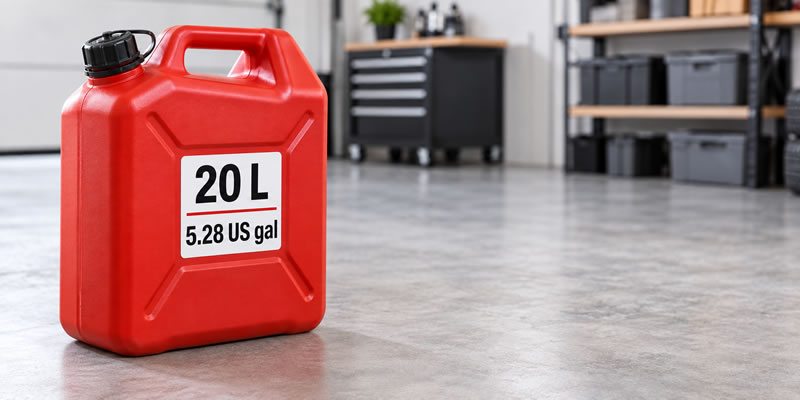
A portable fuel can may be made in one measurement system and used with equipment described in another. A can might be marked 20 L while a vehicle manual, generator specification or fuel-pump display refers to US gallons. A 20-litre container holds approximately 5.28 US gallons; both values describe the same internal capacity.
A Museum Label That Rounds
The Australian War Memorial holds an Australian Army petrol can made in Australia by Rheem in 1957. Its record describes a pressed, welded steel can with a single central carry handle and a clip-lock spout, and gives its capacity as "20 litre (5 gallon)". The pairing is a round label, not a measurement, and the table shows why:
| Gallon | Five of them in litres | 20 litres in that gallon |
|---|---|---|
| US liquid gallon | 18.93 L | 5.28 US gal |
| Imperial gallon | 22.73 L | 4.40 imperial gal |
A 20-litre can sits between the two: about 6% more than five US gallons and about 12% less than five imperial gallons. When a can, label or catalogue says "5 gallon", check the marked litre figure and the manufacturer's instructions before relying on it. Fill only to the marked fill line, use a container designed for fuel and follow local rules for storing it.
How to Convert Litres to US Gallons
One US liquid gallon is exactly 3.785411784 litres, which NIST also defines as 231 cubic inches. Divide litres by this number:
US gallons = litres ÷ 3.785411784
The equivalent multiplication formula is:
US gallons = litres × 0.2641720524
For a 20-litre fuel can:
20 ÷ 3.785411784 ≈ 5.28344 US gal
Rounded to two decimal places, the can holds 5.28 US gallons. The exact US value comes from the tables in NIST Handbook 133, Appendix E.
US Gallons and Imperial Gallons Are Different
- 1 US liquid gallon = 3.785411784 litres
- 1 imperial gallon = 4.54609 litres
NIST describes the imperial gallon as about 20% larger than the US gallon, equal to 1.201 US gallons. The same 20-litre container holds approximately 5.28 US gallons but only 4.40 imperial gallons. If a label shows only "gal", check its intended market or documentation before using the figure.
Common Capacities in Litres and US Gallons
| Litres (L) | US gallons (US gal) | Possible use |
|---|---|---|
| 0.5 L | 0.132 US gal | Small paint container |
| 1 L | 0.264 US gal | Paint or drinks bottle |
| 2.5 L | 0.660 US gal | Imported paint container |
| 5 L | 1.321 US gal | Paint or emergency fuel |
| 10 L | 2.642 US gal | Portable equipment fuel |
| 15 L | 3.963 US gal | Vehicle or machinery reserve |
| 18.927 L | 5.000 US gal | Five US gallons exactly |
| 20 L | 5.283 US gal | Full-size jerry-can capacity |
| 22.73 L | 6.005 US gal | Five imperial gallons |
| 25 L | 6.604 US gal | Large portable container |
| 50 L | 13.209 US gal | Passenger-vehicle fuel tank |
| 100 L | 26.417 US gal | Aquarium or storage container |
| 200 L | 52.834 US gal | Water barrel or storage tank |
| 500 L | 132.086 US gal | Domestic storage tank |
| 1,000 L | 264.172 US gal | Industrial or rainwater tank |
These are mathematical conversions. A container's usable capacity may be lower because of its shape, fittings, fill line or required empty space.
When an American Room Is Measured in Feet but Its Paint Is Sold in Litres
Most household paint in the United States is described in gallons and quarts. Imported coatings can create a different purchasing problem. Fine Paints of Europe, for example, sells coatings imported from Holland through independent US retailers and by direct shipping to US addresses. Its 2.5-litre size is called a Eurogallon, but 2.5 litres is only about 0.66 US gallons by volume.
The company's customer-service page explains why the name is not a volume claim. It says the intense pigmentation of its finishes gives substantially greater coverage than conventional paint, and that as a rule a 2.5-litre container covers the same area as a domestic gallon of similar gloss, while a 1-litre container gives about 30% more coverage than a US quart. Those are coverage rules of thumb, not statements that 2.5 litres and one US gallon are the same volume.
The comparison below turns those rules into coverage per litre. Paint retailers commonly quote 350 to 400 ft² per US gallon for a single coat, which is about 92 to 106 ft² per litre.
| Container | Volume in US gallons | Rule of thumb | Implied coverage per litre |
|---|---|---|---|
| Conventional paint | 1 US gal (3.785 L) | 350 to 400 ft² per gallon | about 92 to 106 ft²/L |
| 2.5 L Eurogallon | 0.660 US gal | Same area as a US gallon | about 140 to 160 ft²/L |
| 1 L container | 0.264 US gal | About 30% more than a US quart | about 114 to 130 ft²/L |
The last two rows are UnitConversionPlus's own arithmetic from the manufacturer's rules and the retailer range, not published product figures, and they do not agree with each other, which is a reason to use the coverage on the technical sheet for the exact product. Paint formulation, surface porosity, application method, colour change and film thickness all affect real coverage.
The estimator below keeps the ideas separate. It calculates surface area first, applies the coverage rate you enter, adds the selected allowance and recommends a combination of metric containers. It also converts the paint required into US gallons for comparison with familiar American packaging.
Plan Paint Coverage, Litres and Container Quantities
Add every room in the project. Doors and windows are deducted automatically from wall area, while ceilings retain their full floor-plan area. Wall and ceiling paint have independent coat counts, coverage rates, container sizes and prices. Results update immediately and compare the least-waste purchase with the lowest-cost one.
Your Whole-Project Paint Plan
Wall-Paint Purchase Options
Ceiling-Paint Purchase Options
This is a planning estimate, not a product guarantee. Coverage may fall when a surface is porous, textured, repaired or changing from a very dark colour to a light one. Confirm the coverage, preparation, primer, coat and container information supplied by the paint manufacturer.
Litres to US Gallons for Tanks, Pools, Brewing and Aquariums
The conversion is also useful when a container and its instructions use different measurement systems. Tank buyers can compare supplier specifications, pool and aquarium owners may meet treatment directions written for US gallons when the capacity is known in litres, and brewers can compare recipe quantities and fermenter sizes. Follow product instructions in their stated units. Choosing the imperial gallon instead of the US gallon makes a difference of about 20%, which grows with volume: 500 litres is 132.1 US gallons but 110.0 imperial gallons.
Sources and Calculation Notes
- NIST Handbook 133 (2026), Appendix E: the exact US gallon, its 231 cubic inches, and the imperial gallon's size relative to it.
- Australian War Memorial: 20 Litre Petrol Jerry Can: the 1957 can and its "20 litre (5 gallon)" description.
- Fine Paints of Europe: Customer Service: the Eurogallon, container sizes, US-only shipping and the coverage rules of thumb.
- Boyd's Decor: how much paint will I need: a retailer's typical coverage of 350 to 400 ft² per gallon per coat.
The conversion table, the coverage comparison and the estimator are UnitConversionPlus's own calculations. Coverage figures are rules of thumb and the product label controls. Figures on this page are checked against the sources listed. Spotted an error? Contact us.