Convert a labelled container from US gallons or fluid ounces into litres, then work out how much supply you have and how many containers a planned period requires. The planner supports water deliveries, cleaning products, liquid storage and other situations where package size, quantity and daily use matter more than one isolated conversion. The product story below also explains why a large jug is not necessarily a full gallon and why five-gallon water bottles are commonly marked 18.9 litres.
Explore additional units through our volume converters, or use the litres to US gallons converter when the original measurement is in litres.
Container Volume and Supply Planner
Start with the size printed on one container. Enter how many containers you already have, the period you want to cover and your expected daily use. The planner converts the package into litres, estimates how long the available supply will last and calculates a purchase quantity with an optional reserve.
Planning result
This is a volume and quantity estimate. Do not use it to determine safe fuel fill levels, chemical compatibility, drinking-water requirements or aquarium treatment doses without following the relevant product and safety guidance.
Why Is a Big Jug Not Always a Gallon?
A US gallon is exactly 128 US fluid ounces. Many large household containers hold close to that without matching it, and a jug's shape or place on the shelf does not tell you which kind you are holding. The fluid-ounce figure on the label does.
The sizes below come from retailer listings checked on 12 October 2026. They show how far common "big bottle" sizes sit from a true gallon:
| Labelled volume | US gallons | Litres | Difference from one gallon | Example from retailer listings |
|---|---|---|---|---|
| 117 US fl oz | 0.914 US gal | 3.460 L | 11 fl oz less | Clorox Splash-Less bleach |
| 121 US fl oz | 0.945 US gal | 3.578 L | 7 fl oz less | Clorox and store-brand bleach |
| 128 US fl oz | 1.000 US gal | 3.785 L | Exactly one US gallon | A bleach bottle listed as 1 gallon |
| 150 US fl oz | 1.172 US gal | 4.436 L | 22 fl oz more | Tide liquid detergent |
| 170 US fl oz | 1.328 US gal | 5.028 L | 42 fl oz more | Tide liquid detergent |
The conversion is the same for every row: one US fluid ounce is 29.5735 millilitres, or 0.0295735 litres. Retail listings change, so read the figure on the package you are buying. When you compare prices, divide by the fluid ounces or litres on the label rather than by the number of jugs, because two bottles that look alike on a shelf can differ by several fluid ounces.
How Labels Pair Gallons with Litres
In the United States the pairing is often a legal requirement. NIST says labels on packages covered by the Fair Packaging and Labeling Act, which includes most foods and many household products, must show both metric and US customary units. NIST's labelling guide shows "2 Gallons (7.57 L)" as an acceptable declaration, which shortens 7.5708 litres to three digits, and says metric figures use two or three digits. Applying the same rule gives 3.78 litres for one gallon and 18.9 litres for five. The printed litre figure is therefore a rounded version of the exact one.
How to Convert US Gallons to Litres
One US liquid gallon is exactly 3.785411784 litres, or 231 cubic inches. Multiply the gallon value by this factor:
Litres = US gallons × 3.785411784
For a five-US-gallon water bottle:
5 × 3.785411784 = 18.92705892 L
A manufacturer does not normally print every decimal place, and rounding to one decimal place gives 18.9 L. To start from fluid ounces instead, multiply by 0.0295735295625 litres per US fluid ounce:
121 fl oz × 0.0295735295625 ≈ 3.578 L
The exact factors come from NIST Handbook 133, Appendix E.
Check Which Gallon the Label Uses
One imperial gallon is 4.54609 litres, about 20% larger than the US gallon, so five imperial gallons would be 22.73 litres. A bottle marked 5 gal / 18.9 L is using US gallons. The litres to gallons page works through the difference in detail with a 20-litre fuel can.
Why Are Water-Cooler Bottles Labelled in Gallons and Litres?
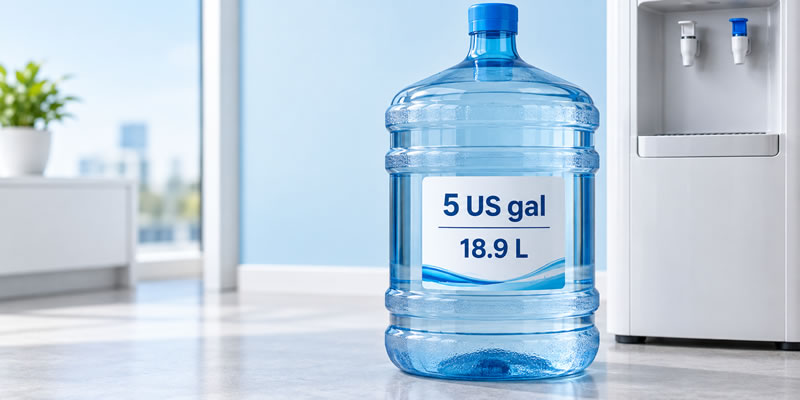
A refillable water-cooler bottle is the clearest everyday example of a true gallon figure. Bottles, dispensers and delivery equipment are made in one country and used in another, so a bottle may carry 5 US gal and 18.9 L to describe the same capacity.
Supplier specifications show the units appearing together. Water-bottling equipment supplier Steelhead lists its 3-gallon polycarbonate bottle as 11.4 litres and its 5-gallon bottles as 18.9 litres. Brio Water Technology lists a reusable bottle as 18.9 L / 640 fl oz / 5 gal, which puts litres, fluid ounces and gallons on one line. The exact markings on a particular bottle can vary by maker and market.
| US gallons | US fluid ounces | Litres (exact) | Litres (as listed) |
|---|---|---|---|
| 3 US gal | 384 US fl oz | 11.356 L | 11.4 L |
| 5 US gal | 640 US fl oz | 18.927 L | 18.9 L |
A dispenser advertised for 18.9-litre bottles and replacement bottles listed as five US gallons therefore describe approximately the same container.
Common US Gallon Capacities in Litres
This quick reference covers fractional sizes, household containers and larger tanks, with the fluid-ounce figure beside each.
| US gallons (US gal) | US fluid ounces | Litres (L) |
|---|---|---|
| 0.25 US gal | 32 US fl oz | 0.946 L |
| 0.5 US gal | 64 US fl oz | 1.893 L |
| 1 US gal | 128 US fl oz | 3.785 L |
| 2 US gal | 256 US fl oz | 7.571 L |
| 2.5 US gal | 320 US fl oz | 9.464 L |
| 3 US gal | 384 US fl oz | 11.356 L |
| 4 US gal | 512 US fl oz | 15.142 L |
| 5 US gal | 640 US fl oz | 18.927 L |
| 10 US gal | 1,280 US fl oz | 37.854 L |
| 20 US gal | 2,560 US fl oz | 75.708 L |
| 50 US gal | 6,400 US fl oz | 189.271 L |
| 100 US gal | 12,800 US fl oz | 378.541 L |
| 250 US gal | 32,000 US fl oz | 946.353 L |
| 500 US gal | 64,000 US fl oz | 1,892.706 L |
| 1,000 US gal | 128,000 US fl oz | 3,785.412 L |
Everyday Gallon-Based Containers in Litres
Gallon capacities are used for jugs, buckets, fuel cans, coolers, aquariums and rain barrels. The sizes below are nominal examples rather than a promise that every brand or retailer stocks them, and a container's usable capacity can be lower than its nominal one.
| Container | US gallons | Litres | Note |
|---|---|---|---|
| Milk or drinking-water jug | 1 US gal | 3.785 L | Household container |
| Large paint can | 1 US gal | 3.785 L | Interior or exterior paint |
| Small fuel can | 1 US gal | 3.785 L | Portable fuel |
| Medium fuel can | 2 US gal | 7.571 L | Portable fuel |
| Water-cooler bottle (3 gal) | 3 US gal | 11.356 L | Compact refillable bottle |
| Water-cooler bottle (5 gal) | 5 US gal | 18.927 L | Standard refillable bottle |
| Utility bucket or large fuel can | 5 US gal | 18.927 L | Nominal size |
| Beverage cooler | 10 US gal | 37.854 L | Event or team cooler |
| Small aquarium | 20 US gal | 75.708 L | Before gravel and decoration |
| Rain barrel | 50 US gal | 189.271 L | Nominal capacity |
An aquarium holds less water once gravel, decoration and equipment are added, and a fuel container needs empty space for safe handling and for the liquid to expand. For paint, volume alone does not tell you coverage: the paint estimator on the litres to gallons page turns room size and coverage into litres and US gallons.
US Gallons to Litres for Fuel, Aquariums and Storage
Drivers may compare a vehicle's gallon-based fuel-tank capacity with fuel sold by the litre, households can use the conversion when choosing rainwater tanks or emergency water containers, and aquarium owners may need it when filters, pumps or treatments are labelled in litres. For every application, identify the gallon definition before calculating, because the gap between a US and an imperial gallon grows with the size of the tank.
Estimating Workplace Water Use
If employees use four five-US-gallon bottles each week, the nominal weekly volume is:
4 × 5 × 3.785411784 ≈ 75.7 L per week
That figure can support delivery and storage planning. Actual consumption may differ, and partly used bottles should be counted separately.
Sources
- NIST Handbook 133 (2026), Appendix E: the exact US gallon, its 231 cubic inches, and the imperial gallon relationship.
- NIST Special Publication 1020: Guide for Labeling Consumer Packages: the "2 Gallons (7.57 L)" example and the two-or-three-digit rule for metric figures.
- NIST: Packaging and Labeling Requirements FAQs: which labels must show metric and US customary units.
- Steelhead: polycarbonate water cooler bottles and Brio Water Technology: 5-gallon bottle: the 11.4 L, 18.9 L and 640 fl oz figures.
- Retailer listings checked on 12 October 2026 for the large-bottle sizes: Clorox bleach at Walmart (117 and 121 fl oz), commercial bleach at Walmart (a 1-gallon bottle), Tide at Costco, 150 fl oz and Tide at Costco, 170 fl oz. Retail listings change.
The conversion tables are UnitConversionPlus's own calculations from the exact factors. Figures on this page are checked against the sources listed. Spotted an error? Contact us.