Enter a suitcase weight in kilograms and compare it with the exact limit printed on your booking in kilograms or pounds. The checker converts the bag into decimal pounds and pounds with ounces, allows for possible differences between scales and forecasts the effect of purchases added before the return flight. This matters because 23 kg equals about 50.71 lb: it meets a 23 kg allowance but can exceed a limit stated as exactly 50 lb.
Browse all weight converters or use the pounds to kilograms converter when the original measurement is in pounds.
Why 23 kg Is Not Exactly 50 lb
IATA's passenger baggage guidance gives its figures in both units. It says international occupational-health guidance advises keeping an individual checked bag to 23 kg (50 lb) or less, that many regions, including the EU and the United States, permit up to 32 kg (70 lb) for a single checked bag, and that carry-on weight limits typically start at 5 kg (11 lb). It also says allowances and conditions of carriage remain airline specific.
Each pair is a convenient rounding, not an exact conversion. Calculating them exactly shows which way the rounding falls:
| Kilogram figure | Exact pounds | Paired pounds figure | Paired figure in kilograms | Gap |
|---|---|---|---|---|
| 5 kg | 11.02 lb | 11 lb | 4.99 kg | 0.01 kg (0.02 lb) |
| 23 kg | 50.71 lb | 50 lb | 22.68 kg | 0.32 kg (0.71 lb) |
| 32 kg | 70.55 lb | 70 lb | 31.75 kg | 0.25 kg (0.55 lb) |
In all three pairs the pounds figure is slightly smaller than the exact equivalent of the kilogram figure. A bag weighed to the kilogram limit can therefore sit a little over the pound figure, and a bag packed to the pound figure has a little room to spare against the kilogram one.
- 23 kg ≈ 50.71 lb
- 50 lb ≈ 22.68 kg
The difference at the main checked-bag figure is about 0.32 kg, or 0.71 lb. If a booking states a limit of 50 lb, a suitcase weighing exactly 23 kg can exceed it. Use the unit and figure printed on your booking rather than treating the rounded pair as interchangeable.
Why Do Luggage Scales Display Kilograms and Pounds?
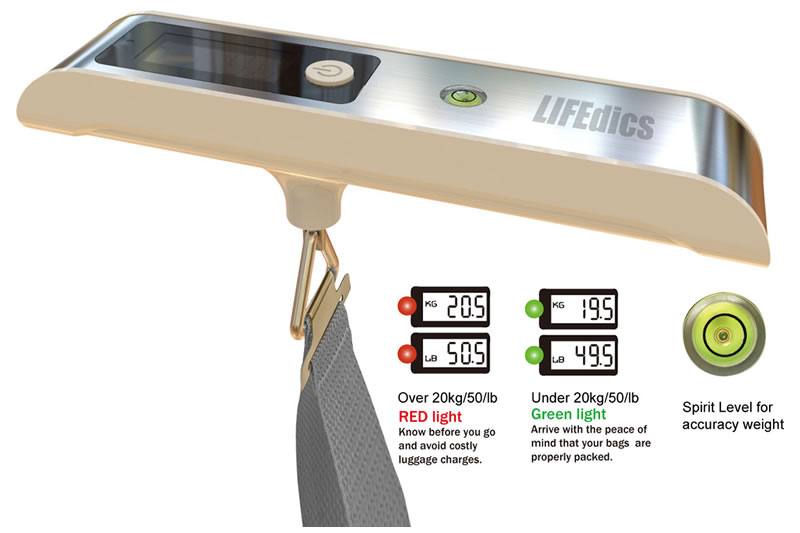
International travel brings two measurement systems into the same airport. An airline may state its baggage allowance in kilograms while a passenger is accustomed to pounds. A dual-unit luggage scale solves this by showing the bag's mass in either kg or lb.
An analogue scale may print both sets of numbers around one dial, and digital models normally have a button that changes the displayed unit. Switching the unit does not change the suitcase or its mass; it only changes the number shown on the screen. That is why a scale set to pounds can read a number that looks safe against a 50 lb figure while the same bag sits at or over 23 kg.
Why Baggage Allowances Use Different Units
Kilograms are common in baggage policies outside the United States, while pounds remain familiar to many American travellers. Airlines serving international routes may show both, but the allowance and conditions attached to the traveller's own booking take priority over any general reference.
Check Your Bag Against the Airline Allowance
Enter the weight shown by your luggage scale, then copy the allowance and unit from the booking. Add a scale margin if you want protection against a slightly higher airport reading, and include any shopping or equipment expected on the return journey. The result updates instantly.
Luggage Check
| Bag | Current weight | Projected return | Allowance remaining | Status |
|---|
Airline policies vary by route, fare, cabin and traveller. The booking and the airline's check-in scale control the real allowance. This planner does not estimate baggage fees or guarantee acceptance.
Common Luggage Weights in Kilograms, Pounds and Ounces
These examples place familiar kilogram values beside decimal pounds and pounds with remaining ounces. The contexts are illustrations, not guaranteed airline allowances.
| Kilograms | Decimal pounds | Pounds and ounces | Possible example |
|---|---|---|---|
| 0.5 kg | 1.10 lb | 1 lb 1.64 oz | Small personal item |
| 1 kg | 2.20 lb | 2 lb 3.27 oz | Compact travel accessory |
| 2 kg | 4.41 lb | 4 lb 6.55 oz | Small packed item |
| 5 kg | 11.02 lb | 11 lb 0.37 oz | Light cabin bag; IATA's typical carry-on weight figure |
| 7 kg | 15.43 lb | 15 lb 6.92 oz | Light cabin bag |
| 10 kg | 22.05 lb | 22 lb 0.74 oz | Cabin bag or small suitcase |
| 15 kg | 33.07 lb | 33 lb 1.11 oz | Medium suitcase |
| 20 kg | 44.09 lb | 44 lb 1.48 oz | Checked suitcase |
| 23 kg | 50.71 lb | 50 lb 11.30 oz | IATA's checked-bag reference figure |
| 25 kg | 55.12 lb | 55 lb 1.85 oz | Large checked suitcase |
| 32 kg | 70.55 lb | 70 lb 8.77 oz | IATA's maximum for one checked bag in many regions |
| 50 kg | 110.23 lb | 110 lb 3.70 oz | Large parcel or freight item |
Baggage rules can depend on the airline, route, aircraft, cabin, fare, ticket conditions and loyalty status. Always check the current policy associated with the booking.
Checking a Suitcase Before the Flight
The airport check-in scale provides the airline's operational measurement. Discovering an overweight suitcase at the airport can lead to repacking, checking another bag or paying an additional fee. A portable scale lets the traveller check the bag at home and again before the return journey.
Set the personal scale to the unit printed on the reservation. If the allowance is 23 kg, weigh in kilograms. If it is 50 lb, select pounds. Leaving a margin can be sensible because portable and airport scales may display slightly different readings.
A Quick Mental Estimate
Doubling a kilogram value gives a quick pound estimate, but it is a little low. A closer shortcut is to double the kilogram value and add about 10 percent. For a 20 kg suitcase:
20 × 2 = 40; add about 10% ≈ 44 lb
The calculated conversion is approximately 44.09 lb. The shortcut is useful for orientation, while the calculator is better for checking a precise limit.
Kilograms to Pounds and Ounces for Food and Parcels
Kilogram-to-pound conversion is also useful when recipes, food labels, bulk ingredients and packages use an unfamiliar measurement system. A 5 kg bag of flour, for example, weighs approximately 11.02 lb, or 11 lb 0.37 oz.
International deliveries are another common use. A household scale may show kilograms while a US customer, marketplace or shipping document requests pounds and ounces. For shipping, weigh the complete parcel, including the product, box, padding, tape and labels. Carriers may apply their own rounding rules or charge by dimensional weight, so converting physical mass alone may not determine the final price.
Food packaging follows a different convention. A product's net weight normally excludes its packaging, while a parcel's shipping weight generally includes everything transported.
Sources
- NIST Guide to SI, Appendix B: conversion factors: the exact relationship of the pound to the kilogram.
- IATA: Passenger Baggage Rules: the 23 kg (50 lb), 32 kg (70 lb) and 5 kg (11 lb) figures, and the statement that allowances and conditions of carriage are airline specific.
The paired-figures table and the calculator are UnitConversionPlus's own calculations from the exact conversion factor. Airline conditions of carriage and the traveller's ticket remain the controlling sources for an actual journey. Figures on this page are checked against the sources listed. Spotted an error? Contact us.