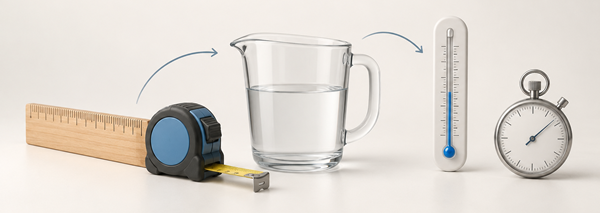
Convert kilograms to grams for recipes, shopping, postage, science, and any situation where a smaller metric unit is easier to use.
1 kg = 1,000 g
How to Convert Kilograms to Grams
The kilogram (kg) is the SI base unit of mass. The prefix kilo represents a factor of 1,000, so every kilogram contains exactly 1,000 grams:
1 kg = 1,000 g
To convert kilograms to grams, multiply the kilogram value by 1,000:
Grams = kilograms × 1,000
You can often perform the conversion by moving the decimal point three places to the right:
- 0.5 kg → 500 g
- 1.25 kg → 1,250 g
- 3 kg → 3,000 g
These relationships follow the International System of Units. The Bureau International des Poids et Mesures SI Brochure identifies the kilogram as the SI base unit of mass and defines kilo as 103, or 1,000.
The National Institute of Standards and Technology guide to SI mass units also confirms that 1 kilogram equals 1,000 grams. Its guidance for writing SI units explains the correct use of the symbols kg and g.
Kilogram to Gram Conversion Table
| Kilograms | Grams |
|---|---|
| 0.001 kg | 1 g |
| 0.01 kg | 10 g |
| 0.05 kg | 50 g |
| 0.1 kg | 100 g |
| 0.25 kg | 250 g |
| 0.5 kg | 500 g |
| 0.75 kg | 750 g |
| 1 kg | 1,000 g |
| 1.5 kg | 1,500 g |
| 2 kg | 2,000 g |
| 2.5 kg | 2,500 g |
| 5 kg | 5,000 g |
| 10 kg | 10,000 g |
| 20 kg | 20,000 g |
| 50 kg | 50,000 g |
| 100 kg | 100,000 g |
Four Weigh‑Ins That Show How the Mobile Phone Lost a Kilogram
Place a modern compact smartphone on one side of a scale and the first handheld cellular prototype on the other. More than ten compact phones would be needed to approach the mass of that early experimental handset.
The difference becomes clearer when both measurements are expressed in grams. Motorola’s 1973 prototype weighed approximately 1.13 kg, or 1,130 g. The compact Unihertz Jelly 2 is listed at 106.5 g.
1.13 kg × 1,000 = 1,130 g
1,130 g ÷ 106.5 g ≈ 10.6
The early prototype was therefore about 10.6 times as heavy. The comparison is not between equivalent products: one was experimental hardware designed to prove portable cellular calling was possible, while the other is a complete Android smartphone. That contrast highlights how much the technology has changed.
Weigh‑In One: 1,130 Grams
On 3 April 1973, Motorola engineer Martin Cooper made a public handheld cellular call on a street in New York. The equipment in his hand weighed about 2.5 lb.
Converted to kilograms:
2.5 lb × 0.45359237 ≈ 1.13 kg
Calling the device “mobile” meant that the telephone was no longer fixed to a building or installed in a vehicle. A person could walk while holding the radio, battery, controls and telephone hardware needed to make a cellular call.
The prototype offered only a short calling period and required a long recharge, but reducing cellular equipment to something one person could lift and operate was a major engineering milestone.
Weigh‑In Two: 794 Grams
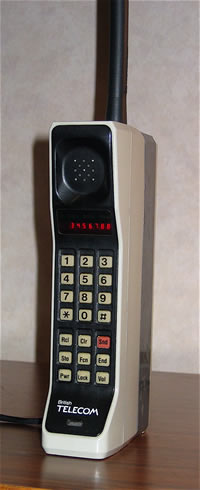
It took roughly another decade to turn the demonstration into a consumer product. The Motorola DynaTAC 8000X retained the upright shape and projecting antenna associated with the “brick phone”, but its mass fell to approximately 28 oz, or 794 g.
The reduction from the prototype was:
1,130 g − 794 g = 336 g
A 336 g reduction was significant, but the DynaTAC remained far heavier than today’s phones. Its price, battery endurance and developing network coverage meant it was not yet an everyday household device.
What Had to Shrink?
There was no single moment when manufacturers removed a kilogram from the mobile phone. Engineers reduced many parts over multiple generations, often while adding new capabilities.
- Separate electronic components were consolidated into more capable integrated circuits.
- Batteries stored more useful energy for a given mass and volume.
- Antennas moved from long external rods to compact internal designs.
- Digital networks used radio spectrum and power more efficiently.
- Circuit boards, microphones, speakers and connectors became smaller.
- Lightweight enclosures replaced some of the bulky structures needed by early experimental equipment.
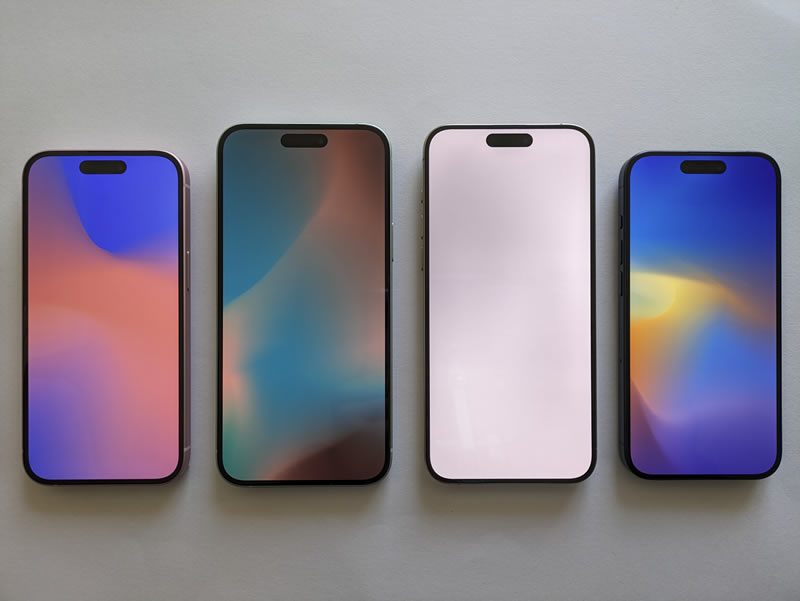
Miniaturisation did more than reduce weight. It created space for displays, cameras, memory, sensors and processors. The telephone gradually became a portable computer without returning to the mass of the original handset.
Weigh‑In Three: 106.5 Grams
The Unihertz Jelly 2 shows how small a functional Android smartphone can be. Its manufacturer lists a mass of 106.5 g with the battery installed.
Despite weighing less than one‑tenth of the 1973 prototype, it includes a touchscreen, cameras, satellite navigation, Wi‑Fi, Bluetooth, mobile data and NFC. Its compact three‑inch display contributes to the low mass but also introduces practical compromises such as smaller text and limited battery capacity.
Converted to kilograms:
106.5 g ÷ 1,000 = 0.1065 kg
Weigh‑In Four: 116 Grams
The later Unihertz Jelly Star weighs 116 g. It is slightly heavier than the Jelly 2 but includes more recent hardware, such as 8 GB of memory, 256 GB of storage and a 48‑megapixel rear camera.
Its mass in kilograms:
116 g ÷ 1,000 = 0.116 kg
These miniature models show that smartphone hardware can operate near the 100 g level. They do not establish 100 g as the typical weight of a present‑day phone.
Why Did Mainstream Phones Stop Getting Lighter?
Once essential electronics occupied less space, manufacturers did not use every improvement to produce a smaller handset. Consumers also wanted larger displays, longer battery life, stronger cases and more capable cameras.
As a result, many current smartphones weigh substantially more than 100 g. Foldable phones and rugged models can be heavier again. This reflects a different use of available weight rather than a reversal of technological progress.
A manufacturer might use a lighter processor and circuit board but add a larger battery, another camera or a reinforced frame. The finished phone can become more capable without becoming lighter.
Comparing Every Phone in One Unit
Historical specifications may use pounds, ounces, kilograms or grams. Converting every value to grams makes the progression easier to compare:
| Device | Year | Grams | Kilograms |
|---|---|---|---|
| Motorola handheld cellular prototype | 1973 | Approximately 1,130 g | Approximately 1.13 kg |
| Motorola DynaTAC 8000X | 1980s | Approximately 794 g | Approximately 0.794 kg |
| Unihertz Jelly 2 | 2020 | 106.5 g | 0.1065 kg |
| Unihertz Jelly Star | 2023 | 116 g | 0.116 kg |
To move between the two metric units:
Grams = kilograms × 1,000
Kilograms = grams ÷ 1,000
In 1973, a handheld telephone weighing more than one kilogram demonstrated that a cellular call could follow the person rather than the vehicle. About half a century later, a smartphone close to 100 g can carry maps, photographs, messages and computing tools as well as voice calls. The missing kilogram tells only part of the story: while the hardware became lighter, the range of tasks it can perform became much greater.