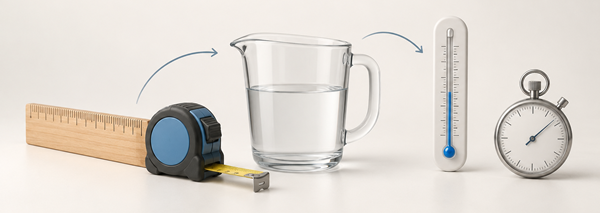
Convert grams to kilograms when a weight becomes easier to read or compare in a larger metric unit.
1,000 g = 1 kg
How to Convert Grams to Kilograms
The kilogram (kg) is the SI base unit of mass. The SI prefix kilo represents a factor of 1,000, so one kilogram contains exactly 1,000 grams:
1 kg = 1,000 g
1 g = 0.001 kg
To convert grams to kilograms, divide the gram value by 1,000:
Kilograms = grams ÷ 1,000
You can also multiply the value by 0.001:
kg = g × 0.001
For a quick manual conversion, move the decimal point three places to the left:
- 250 g → 0.25 kg
- 750 g → 0.75 kg
- 2,500 g → 2.5 kg
These relationships follow the International System of Units. The Bureau International des Poids et Mesures SI Brochure identifies the kilogram as the SI base unit of mass and defines the prefix kilo as 103, or 1,000.
The National Institute of Standards and Technology guide to SI mass units likewise confirms that 1 kilogram equals 1,000 grams. NIST also provides guidance on writing SI units and metric prefixes .
Grams to Kilograms Conversion Table
| Grams | Kilograms |
|---|---|
| 1 g | 0.001 kg |
| 10 g | 0.01 kg |
| 25 g | 0.025 kg |
| 50 g | 0.05 kg |
| 100 g | 0.1 kg |
| 250 g | 0.25 kg |
| 500 g | 0.5 kg |
| 750 g | 0.75 kg |
| 1,000 g | 1 kg |
| 1,250 g | 1.25 kg |
| 1,500 g | 1.5 kg |
| 2,000 g | 2 kg |
| 2,500 g | 2.5 kg |
| 5,000 g | 5 kg |
| 10,000 g | 10 kg |
The 1,000‑Fold Bear: How a Giant Panda Grows from Grams to Kilograms
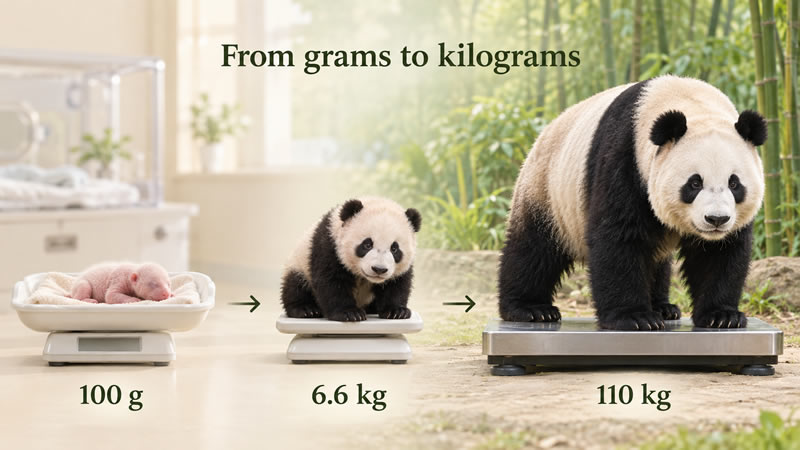
An adult giant panda has the heavy frame, powerful jaws and broad paws expected of a bear. Its life, however, begins at a scale that seems entirely out of proportion to its eventual size. A newborn usually has a mass of only 85 to 142 grams, while a large adult can exceed 100 kilograms.
Consider a cub born at 100 g that later reaches 110 kg. Before comparing the two values, they must be expressed in the same unit:
110 kg × 1,000 = 110,000 g
Dividing the adult mass by the birth mass shows that the animal has become approximately 1,100 times heavier:
110,000 g ÷ 100 g = 1,100
This is not a guaranteed growth rate for every panda. Birth weights and adult sizes vary, but the calculation illustrates one of the most striking changes in scale among placental mammals.
The First Weigh‑In
At birth, a giant panda cub is pink, blind and only lightly covered with hair. Its legs cannot yet support its body, and it depends on its mother for warmth, milk and protection.
The Smithsonian’s National Zoo reports that newborn cubs generally weigh between 3 and 5 ounces, equivalent to approximately 85–142 g. Relative to its mother, a cub may be only about 1/900 of her size.
Most placental mammals are born at a much larger proportion of their mother’s mass. Only the extremely undeveloped newborns of marsupials, including kangaroos and opossums, provide more dramatic proportional examples.
The Month in Which the Unit Changes
A growing panda provides a practical lesson in choosing measurement units. During the first weeks, carers can record the cub’s mass neatly in grams. Once it passes 1,000 g, kilograms make the figures easier to read.
Smithsonian records for the male cub Xiao Qi Ji document this transition:
| Age | Recorded mass | Equivalent value |
|---|---|---|
| Birth | Approximately 85–142 g | 0.085–0.142 kg |
| Three weeks | 634.8 g | 0.6348 kg |
| One month | 952 g | 0.952 kg |
| Two months | 2,950 g | 2.95 kg |
| Three months | 4,720 g | 4.72 kg |
| Four months | 6,600 g | 6.6 kg |
These observations belong to a particular cub and should not be treated as a universal timetable for every panda. Genetics, health, nutrition and individual development can all influence growth.
Growing More Than Body Mass
The rising numbers on the scale accompany major physical changes. The cub’s black markings become visible, its eyes open and its muscles strengthen. It begins crawling and later develops enough coordination to walk, climb and explore its surroundings.
Bamboo eventually becomes its characteristic food, but a young cub remains dependent on milk for many months. Sampling bamboo is not the same as obtaining enough nutrition from it; the digestive transition and separation from the mother happen gradually.
Young pandas commonly remain with their mothers for at least a year and a half. During that period, they develop the strength and behaviour needed for the largely solitary life of an adult.
Crossing the 100‑Kilogram Mark
San Diego Zoo Wildlife Alliance gives an adult mass range of approximately 70–100 kg for females and 86–125 kg for males. These ranges overlap, so sex alone does not determine the exact adult mass.
Smithsonian records also provide real examples of pandas exceeding 100 kg. In March 2022, the adult female Mei Xiang was listed at 112 kg, while the adult male Tian Tian was listed at 123.6 kg.
Converted back to grams, their recorded masses become:
- 112 kg = 112,000 g
- 123.6 kg = 123,600 g
Both forms are mathematically correct, but a six‑digit value in grams is unnecessarily awkward for an adult bear. Kilograms communicate the same mass more clearly.
Why Does the Cub Begin So Small?
Giant pandas, like other bears, experience delayed implantation. After fertilisation, the developing embryo does not immediately attach to the uterine wall, creating considerable variation in the apparent length of pregnancy.
Once implantation occurs, active fetal development occupies a relatively short period. The cub is consequently born at an immature stage, and much of the development seen before birth in other mammals occurs while the panda is being cared for by its mother.
Delayed implantation helps explain the timing, but scientists do not attribute the panda’s extreme mother‑to‑cub size difference to a single cause. Bear reproductive biology and evolutionary history both contribute to the explanation.
One Animal, Two Useful Units
Panda development shows why metric units are selected according to scale. The relationship is exact:
1 kg = 1,000 g
Kilograms = grams ÷ 1,000
Grams = kilograms × 1,000
At birth, 100 g is easier to understand than 0.1 kg. In adulthood, 110 kg is easier to understand than 110,000 g. Changing the unit does not change the panda; it changes only how conveniently its mass is expressed.
Within the life of one animal, the scale moves from a three‑digit number of grams to more than 100 kilograms. That journey turns an ordinary metric conversion into an unusually vivid example of mammalian growth.