Convert microseconds to milliseconds when comparing camera-flash durations, electronic sensors and other high-speed events. This Microseconds to Milliseconds converter divides the microsecond value by 1,000 and presents the result instantly. Explore the formula, common conversion values and the story of how a brief flash can freeze a water-droplet splash in sharp detail.
Microsecond to Millisecond Conversion Formula
The conversion formula is:
1 µs = 0.001 ms
Or simply:
µs × 0.001 = ms
This conversion uses fixed seconds-based factors: 1 µs = 0.000001 s and 1 ms = 0.001 s.
Microsecond to Millisecond Conversion Table
| Microseconds (µs) | Milliseconds (ms) |
|---|---|
| 1 µs | 0.001 ms |
| 5 µs | 0.005 ms |
| 10 µs | 0.01 ms |
| 50 µs | 0.05 ms |
| 100 µs | 0.1 ms |
| 500 µs | 0.5 ms |
| 1,000 µs | 1 ms |
| 5,000 µs | 5 ms |
| 10,000 µs | 10 ms |
To convert microseconds to milliseconds, divide the number of microseconds by 1,000. One millisecond contains exactly 1,000 microseconds.
Harold Edgerton: The Scientist Who Made Time Stand Still
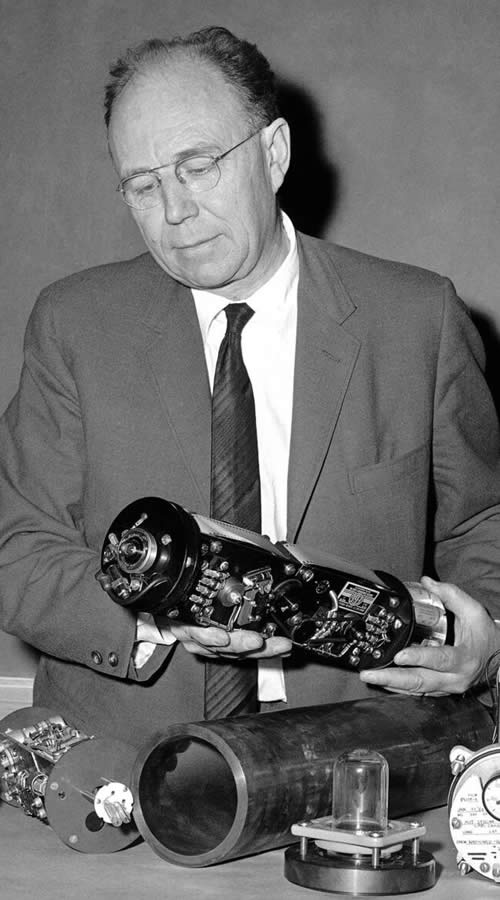
The water-droplet photography described below isn't just a hypothetical example — it's essentially the signature work of one real scientist. Harold "Doc" Edgerton, an electrical engineering professor at MIT from the 1930s until his death in 1990, is widely credited as the father of high-speed flash photography. Starting as a graduate student in the 1920s, he developed xenon flash tubes capable of producing high-intensity bursts of light as short as a single microsecond — technology that remains the basis of still-camera flash to this day.
Edgerton's most famous image, "Milk Drop Coronet" (1957), captured the instant a falling drop of milk struck a surface and threw up a perfectly symmetrical crown of smaller droplets — a shape far too brief for the human eye to perceive on its own. The photograph was later named one of Time magazine's 100 most influential images of all time.
Edgerton pushed the technique even further for fast-moving solid objects. His 1964 photograph of a .30-caliber bullet piercing an apple used a flash lasting approximately one-third of a microsecond — shorter still than the flash needed to freeze a falling drop of liquid, because the bullet itself was moving many times faster than any droplet.
Edgerton worked out of what MIT still calls "Strobe Alley," and the microsecond-scale flash durations he pioneered are the same basic principle behind the water-droplet photography example below — just demonstrated, decades later, with the same underlying physics.
How a Camera Flash Turns Microseconds into Milliseconds
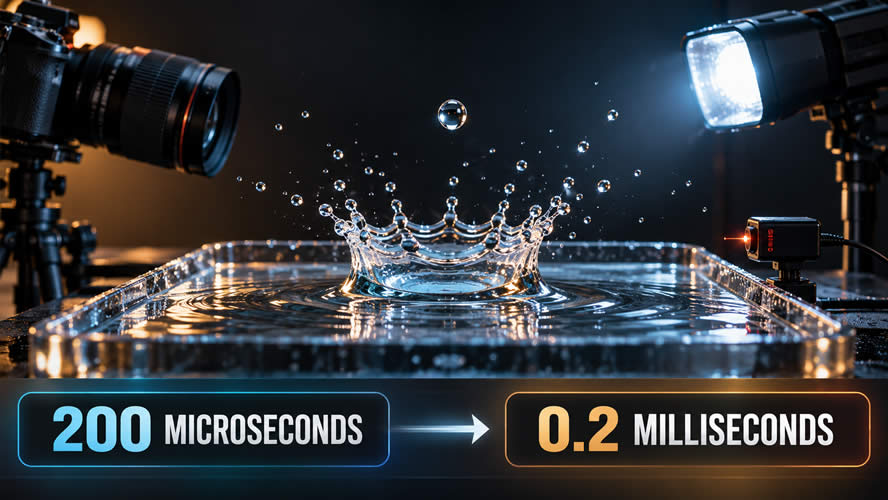
A falling water droplet may look slow to the human eye, but the moment it strikes a surface can pass too quickly for an ordinary photograph to preserve clearly. The droplet changes shape, forms a crown and sends smaller droplets into the air within a tiny fraction of a second. High-speed photographers use carefully timed flashes to capture one instant from that rapid sequence.
The camera shutter is only part of the process. In a darkened studio, the shutter can remain open while the scene receives very little light. A brief flash then illuminates the subject. Because most of the recorded light arrives during that flash, its duration can have a major influence on how sharply the motion is frozen.
Preparing the Water-Drop Photograph
Imagine a photographer placing a tray of coloured water beneath a dropper. A camera is fixed on a tripod and focused on the point where each droplet will land. A small electronic sensor detects the falling drop and, after a programmed delay, triggers the flash.
The photographer begins with a flash duration of 1,000 microseconds. To compare that duration with a camera or controller displaying milliseconds, it is necessary to convert microseconds to milliseconds:
1,000 µs ÷ 1,000 = 1 ms
The resulting photograph captures the splash, but the edges of the fastest droplets show a small amount of motion blur. The photographer reduces the flash duration to 200 microseconds:
200 µs ÷ 1,000 = 0.2 ms
With the shorter burst of light, the subject moves a smaller distance while the image is being exposed. Fine details in the splash may therefore appear sharper, although the shorter flash can also deliver less light and may require changes to the flash power, aperture or sensor sensitivity.
Why the Shutter Can Stay Open Longer
In normal daylight photography, the shutter duration controls how long light reaches the camera sensor. In a dark high-speed setup, however, the photographer may use a shutter time that is much longer than the flash itself. The ambient light is kept low so that it contributes very little to the picture.
For example, the shutter might remain open for 50 milliseconds, while the flash illuminates the droplet for only 200 microseconds, or 0.2 milliseconds. Most of the visible exposure is created during that short burst rather than throughout the entire shutter interval.
This does not mean every flash freezes motion equally well. Flash duration can vary with the equipment, power setting and the way the manufacturer measures the light output. Photographers should consult the specifications for the actual flash rather than relying only on its brightness or power label.
Converting the Timing Values
One millisecond contains exactly 1,000 microseconds. The conversion formula is:
Milliseconds = microseconds ÷ 1,000
A Microseconds to Milliseconds converter is useful when a flash specification uses microseconds but a camera controller, laboratory timer or technical report uses milliseconds. Common examples include:
- 50 µs = 0.05 ms
- 100 µs = 0.1 ms
- 250 µs = 0.25 ms
- 500 µs = 0.5 ms
- 1,000 µs = 1 ms
- 2,500 µs = 2.5 ms
More Than a Unit Conversion
Changing microseconds into milliseconds does not alter the duration of the flash. It simply expresses the same interval using a larger unit. The conversion makes it easier to compare the flash with shutter settings, sensor delays and other parts of the photographic sequence.
The final image still depends on more than one number. Trigger timing, subject speed, focus, ambient light and flash output all matter. The conversion provides a common time scale, while careful experimentation determines which settings successfully capture the intended moment.
In the finished photograph, a delicate splash may appear perfectly still. Behind that image is a precisely coordinated process in which a burst lasting only a few hundred microseconds becomes a fraction of a millisecond—and preserves a moment that the unaided eye could never examine in the same detail.