
A university degree may be advertised as lasting three or four years, but students organise lectures, assignments, examinations and placements one week at a time. Use this years to weeks converter to express a long calendar period in weeks and understand how a multi-year course becomes a practical study schedule. For example, three average years contain approximately 156.54 weeks.
Year to Week Conversion Formula
The conversion formula is:
1 y = 52.1785714285714 Week
Or simply:
y × 52.1785714285714 = Week
This conversion uses fixed seconds-based factors: 1 y = 31,557,600 s and 1 Week = 604,800 s.
Year to Week Conversion Table
| Years | Weeks |
|---|---|
| 1 year | 52.1786 weeks |
| 2 years | 104.3571 weeks |
| 3 years | 156.5357 weeks |
| 5 years | 260.8929 weeks |
| 7 years | 365.25 weeks |
| 10 years | 521.7857 weeks |
| 12 years | 626.1429 weeks |
| 20 years | 1,043.5714 weeks |
| 30 years | 1,565.3571 weeks |
| 40 years | 2,087.1429 weeks |
| 50 years | 2,608.9286 weeks |
| 60 years | 3,130.7143 weeks |
| 70 years | 3,652.5 weeks |
| 80 years | 4,174.2857 weeks |
| 90 years | 4,696.0714 weeks |
| 100 years | 5,217.8571 weeks |
| 1,000 years | 52,178.5714 weeks |
| 10,000 years | 521,785.7143 weeks |
These values use an average year of 365.25 days, divided by seven days per week. Calendar dates should be used when an exact start or end date is required.
From a University Degree in Years to a Teaching Schedule in Weeks
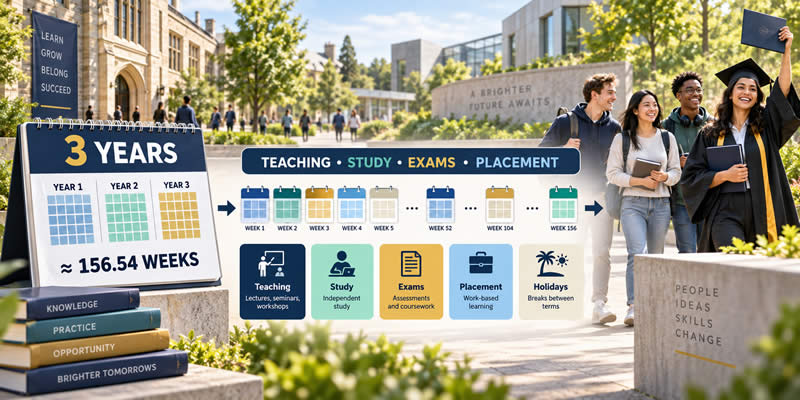
A university prospectus may describe a degree as a three‑year course, but students rarely experience it in three‑year blocks. Their calendars are shaped by induction weeks, teaching periods, assignment deadlines, examinations, placements and holidays. The qualification is measured in years, yet most of the work required to complete it is organised week by week.
How Many Calendar Weeks Are in a Degree?
Using an average year of 365.25 days, one year contains approximately 52.1786 weeks. A three‑year course therefore spans:
3 years × 52.1786 ≈ 156.54 weeks
A years to weeks converter is helpful when students want to compare a degree length with a weekly calendar. This figure represents continuous elapsed time — including weekends, holidays and periods with no scheduled teaching.
The same calculation gives approximately:
- 1 year ≈ 52.18 calendar weeks
- 2 years ≈ 104.36 calendar weeks
- 3 years ≈ 156.54 calendar weeks
- 4 years ≈ 208.71 calendar weeks
Calendar Weeks Are Not the Same as Teaching Weeks
Converting the full duration does not reveal how many weeks contain lectures or seminars. Universities set their own academic calendars, and course structures vary by institution, subject and country.
For example, imagine a course with 24 scheduled teaching weeks per academic year. Across a three‑year degree, that would provide:
24 teaching weeks × 3 years = 72 teaching weeks
The degree still spans roughly 156.54 calendar weeks from start to finish. Only 72 weeks in this example are formal teaching weeks. The remaining weeks may be used for revision, examinations, independent study, placements or university holidays.
Why Weekly Planning Matters to Students
A three‑year target is too broad to guide the work required on an ordinary Monday morning. Weekly planning is more practical because it breaks the qualification into manageable commitments.
For example, a student might organise a 12‑week module like this:
- Weeks 1–3: introductory lectures and background reading
- Weeks 4–6: research and practical work
- Weeks 7–8: drafting coursework
- Week 9: feedback and revision
- Weeks 10–11: completing assessed work
- Week 12: submission or examination
This is not a universal timetable. It simply illustrates why students think in weeks even when the full degree is advertised in years.
Placements and Independent Study Still Count
Not every active week takes place in a lecture room. Students in subjects such as nursing, teaching, engineering or social work may spend part of the course on supervised placements. Other programmes include fieldwork, laboratory projects or dissertation periods with fewer scheduled classes.
These weeks remain part of the degree even though they look different from classroom teaching. This is another reason why a simple conversion should not be treated as an official count of lectures, attendance weeks or contact hours.
Using the Conversion Correctly
When you convert years to weeks, first decide which type of duration you need:
- Calendar weeks — to estimate the continuous time covered by the degree.
- Academic calendar — to count official terms, teaching periods and examinations.
- Course handbook — to identify placements, attendance requirements and contact hours.
A years to weeks converter provides the broad calendar equivalent, but the university's published dates remain the correct source for planning an actual course. A degree may be described in years, yet the journey through it is shaped by individual weeks of classes, study, assessment and experience.