Mortgage terms are usually advertised in years, while repayments are commonly scheduled by month. Use this years to months converter to translate a mortgage term into the corresponding number of monthly payment periods. For example, a 25-year mortgage equals 300 months. The result shows the scheduled term length, not the loan's interest, cost or repayment amount.
Year to Month Conversion Formula
The conversion formula is:
1 y = 12 Month
Or simply:
y × 12 = Month
Year to Month Conversion Table
| Years | Months |
|---|---|
| 1 year | 12 months |
| 2 years | 24 months |
| 3 years | 36 months |
| 4 years | 48 months |
| 5 years | 60 months |
| 6 years | 72 months |
| 7 years | 84 months |
| 8 years | 96 months |
| 9 years | 108 months |
| 10 years | 120 months |
| 11 years | 132 months |
| 12 years | 144 months |
| 13 years | 156 months |
| 14 years | 168 months |
| 15 years | 180 months |
| 16 years | 192 months |
| 17 years | 204 months |
| 18 years | 216 months |
| 19 years | 228 months |
| 20 years | 240 months |
| 21 years | 252 months |
| 22 years | 264 months |
| 23 years | 276 months |
| 24 years | 288 months |
| 25 years | 300 months |
| 26 years | 312 months |
| 27 years | 324 months |
| 28 years | 336 months |
| 29 years | 348 months |
| 30 years | 360 months |
| 100 years | 1,200 months |
| 500 years | 6,000 months |
| 1,000 years | 12,000 months |
Why a Mortgage Is Quoted in Years but Paid Each Month
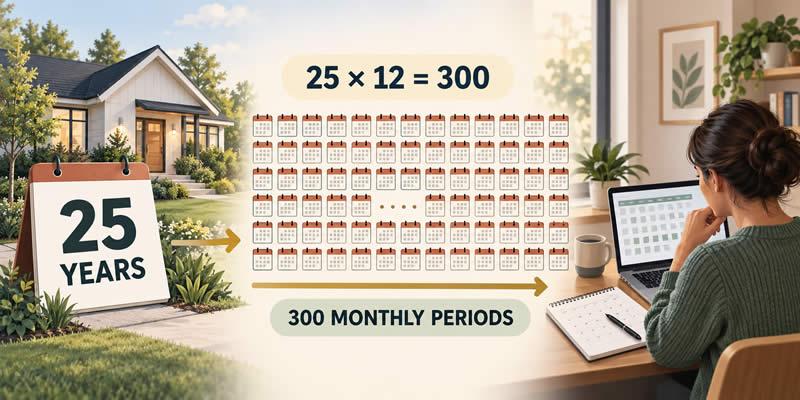
Mortgage offers often describe the commitment in long spans of time — 20, 25 or 30 years. Yet borrowers do not make one payment per year. Instead, the agreement is broken into monthly instalments, turning a long-term commitment into hundreds of scheduled payments that fit into a household budget.
Converting the term from years to months helps link the headline duration shown on a mortgage offer with the repayment schedule used in everyday financial planning.
From 25 Years to 300 Monthly Periods
Suppose a borrower chooses a 25‑year mortgage. To convert years to months, multiply the number of years by 12:
25 years × 12 = 300 months
If payments are made monthly and the term stays the same, the mortgage will normally contain 300 scheduled payment periods. A 30‑year mortgage contains 360 months:
30 years × 12 = 360 months
This conversion defines the length of the repayment schedule. It does not determine how much each monthly payment will be.
Why Lenders Use Both Years and Months
Years make long-term borrowing easier to describe. Saying "a 25‑year mortgage" is more intuitive than "a 300‑month mortgage."
Months are more practical for repayment. Salaries, bills, direct debits and household budgets are usually organised monthly, so a monthly mortgage payment fits naturally into regular spending.
MoneyHelper explains that a capital repayment mortgage typically uses monthly payments to repay both the borrowed capital and interest over the agreed term. An interest‑only mortgage works differently because its monthly payments usually cover interest only, with the capital requiring a separate repayment plan.
How the Term Affects the Payment Schedule
Extending a mortgage term increases the number of monthly payment periods. When the loan amount and interest rate remain the same, spreading repayment across more months generally reduces the monthly payment. The trade‑off is that interest may be charged for longer, increasing the total amount repaid.
For example:
- 20 years = 240 monthly periods
- 25 years = 300 monthly periods
- 30 years = 360 monthly periods
Moving from a 20‑year term to a 30‑year term adds 120 monthly periods. This may make the regular payment more manageable, but the overall borrowing cost should also be considered.
MoneyHelper similarly notes that a longer mortgage term can reduce monthly repayments while increasing the interest paid over the life of the loan.
The Mortgage Term and Fixed-Rate Deal Are Different
A 25‑year mortgage does not necessarily carry the same interest rate for all 25 years. Borrowers often choose a fixed‑rate deal lasting two, five or another specified number of years.
When that fixed‑rate period ends, the mortgage balance remains. Unless a new arrangement is made, the borrower may move to the lender's follow‑on rate. Alternatively, the borrower may select a new deal with the same lender or remortgage elsewhere, subject to eligibility, fees and product terms.
The mortgage term answers, "How long is the planned repayment period?" The fixed‑rate deal answers, "How long does this particular interest‑rate arrangement last?"
Using a Years to Months Converter
A years‑to‑months converter is helpful when a mortgage term is supplied in years but a repayment calculation requires the number of monthly periods:
- 10 years = 120 months
- 15 years = 180 months
- 20 years = 240 months
- 25 years = 300 months
- 30 years = 360 months
- 35 years = 420 months
- 40 years = 480 months
Once the term has been converted, the UnitConversionPlus Mortgage Calculator can be used to explore estimated repayments based on the mortgage amount, interest rate and term.
Calculator results are illustrations, not mortgage offers or personalised financial advice. Actual payments may differ depending on the lender's calculation method, product fees, rate changes, overpayments and other conditions. A lender or qualified mortgage adviser should confirm the figures before any financial commitment is made.
A Long-Term Loan Experienced One Month at a Time
The mortgage term describes the full journey in years, while the repayment schedule divides that journey into manageable monthly periods. Converting 25 years into 300 months shows how a long-term agreement becomes a sequence of individual payment dates.
The conversion itself is simple — years × 12 = months. Calculating the payment attached to each month is more complex because it depends on the loan amount, interest rate, mortgage type and product features.