Use this years to days converter to express a duration in years as an estimated number of days. The calculation is useful for long-term projects, scientific timelines and general time comparisons. Because calendar years may contain either 365 or 366 days, an exact date range can differ from an average conversion. The story of February 29 explains why leap days are added and how they keep the calendar closely aligned with Earth's seasonal cycle.
Year to Day Conversion Formula
The conversion formula is:
1 y = 365.25 d
Or simply:
y × 365.25 = d
This conversion uses fixed seconds-based factors: 1 y = 31,557,600 s and 1 d = 86,400 s.
Year to Day Conversion Table
| Years | Days |
|---|---|
| 1 year | 365.25 days |
| 2 years | 730.5 days |
| 3 years | 1,095.75 days |
| 4 years | 1,461 days |
| 5 years | 1,826.25 days |
| 6 years | 2,191.5 days |
| 7 years | 2,556.75 days |
| 8 years | 2,922 days |
| 9 years | 3,287.25 days |
| 10 years | 3,652.5 days |
| 15 years | 5,478.75 days |
| 20 years | 7,305 days |
| 25 years | 9,131.25 days |
| 30 years | 10,957.5 days |
| 40 years | 14,610 days |
| 50 years | 18,262.5 days |
| 75 years | 27,393.75 days |
| 100 years | 36,525 days |
| 500 years | 182,625 days |
| 1,000 years | 365,250 days |
| 10,000 years | 3,652,500 days |
These conversions use the 365.25-day year convention. Decimal-day results represent average durations. An exact calendar period contains a whole number of days and depends on the starting date, ending date and leap years included.
How Leap Years Keep the Calendar Aligned with the Seasons
Our calendar counts whole days, but Earth's seasonal cycle does not finish after an exact number of them. Each year leaves behind a small fraction of a day, and although the difference seems tiny, it accumulates over time. Leap years are the practical correction that prevents dates and seasons from slowly drifting apart.
This also explains why a years to days converter produces an average result, while the actual number of days between two calendar dates is always a whole number.
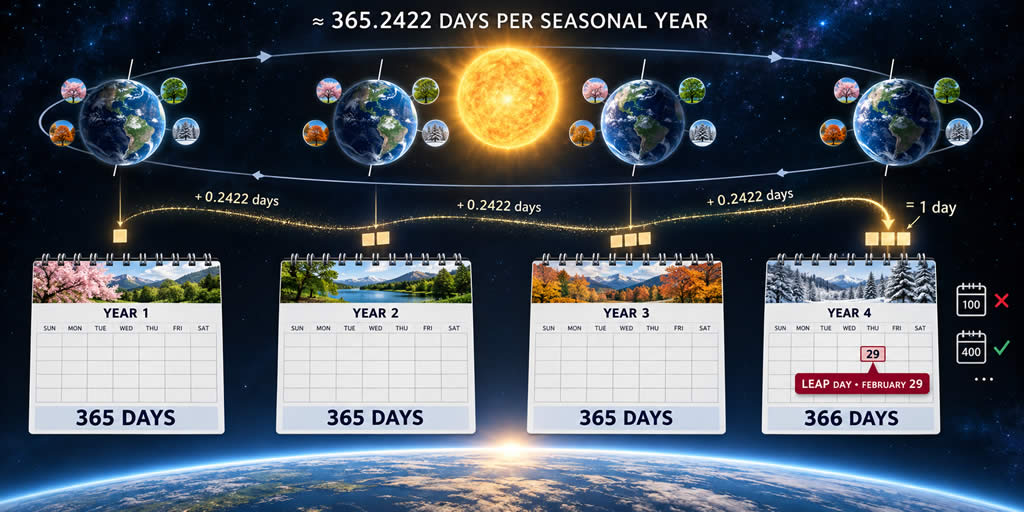
The Fraction Left Behind by a 365‑Day Calendar
The tropical year — the cycle that tracks the return of the seasons — lasts approximately 365.2422 days. A standard calendar year contains only 365 days, leaving a difference of:
365.2422 − 365 = 0.2422 days
That fraction is about 5 hours and 49 minutes. If every year contained only 365 days, the difference would grow:
- After 4 years, the gap would be close to 1 day.
- After 40 years, it would approach 10 days.
- After 100 years, it would reach roughly 24 days.
Seasonal dates would gradually shift. Leap days prevent most of this drift.
The Gregorian Leap‑Year Rules
The Gregorian calendar adds 29 February once every four years, but it also includes a century rule to avoid inserting too many leap days.
The rules are:
- Years divisible by 4 are normally leap years.
- Years divisible by 100 are normally common years.
- Century years divisible by 400 are leap years again.
This is why 2000 was a leap year, but 1900 was not — and 2100 will not be. The United States Naval Observatory explains how these rules keep the civil calendar closely aligned with the seasonal cycle.
Why Not Add One Day Every Four Years Forever?
Adding a leap day every four years produces an average year length of 365.25 days. That is slightly longer than the tropical year, so the calendar would eventually drift in the opposite direction.
The Gregorian century rules remove three leap days every 400 years. That 400‑year cycle contains 303 common years and 97 leap years:
(303 × 365) + (97 × 366) = 146,097 days
The average Gregorian year is therefore:
146,097 ÷ 400 = 365.2425 days
NIST distinguishes this Gregorian average from the astronomical Julian year, defined as exactly 365.25 days. Its time and frequency reference lists both definitions.
How Many Days Are in Several Calendar Years?
The exact number depends on which years are included. A typical four‑year period contains one leap day:
(3 × 365) + 366 = 1,461 days
However, this is not true for every four‑year interval. A period that includes the century year 2100 may contain no leap day because 2100 is not divisible by 400.
Across the full 400‑year Gregorian cycle, the count is exact:
400 Gregorian years = 146,097 days
Using a Years‑to‑Days Conversion
To convert years to days for general comparison, a converter may apply a stated average:
Days = years × days per year
If the converter uses the 365.25‑day convention, ten years becomes:
10 × 365.25 = 3,652.5 days
The decimal result is an average‑unit conversion. It does not claim that a real calendar interval contains half a day. An actual ten‑year period contains a whole number of days determined by its dates and the leap years within it.
When Exact Dates Matter
Average conversion is helpful for scientific comparisons, rough estimates and understanding long spans of time. Exact date counting is more appropriate for:
- Ages and birthdays
- Contracts and warranties
- Employment anniversaries
- Legal or financial deadlines
- Bookings and project schedules
In those situations, count from the actual start date to the actual end date rather than relying only on an average year length.
A Calendar Built from Whole Days
Leap years balance two patterns: human calendars require whole days, while the seasonal year includes a fraction of a day. The Gregorian rules distribute correction days across a 400‑year cycle so the civil calendar stays closely aligned with the seasons.
A years to days converter translates one time unit into another. The leap‑year system explains why the result may be an average — and why an exact calendar count still depends on the specific years being measured.