
Week to year conversions are useful for scheduling, science, computing, project planning, astronomy, historical periods, and everyday time calculations.
Week to Year Conversion Formula
The conversion formula is:
1 Week = 0.0191649555099247 y
Or simply:
Week × 0.0191649555099247 = y
This conversion uses fixed seconds-based factors: 1 Week = 604,800 s and 1 y = 31,557,600 s.
Week to Year Conversion Table
| Weeks | Years |
|---|---|
| 1 week | 0.019165 years |
| 10 weeks | 0.191650 years |
| 26 weeks | 0.498289 years |
| 52 weeks | 0.996578 years |
| 100 weeks | 1.916496 years |
| 1,000 weeks | 19.164956 years |
| 10,000 weeks | 191.649555 years |
These values use an average year of 365.25 days. Therefore, 52 weeks is slightly shorter than one average year; an average year contains approximately 52.18 weeks.
From Weekly Broadcasts to Decades of Television
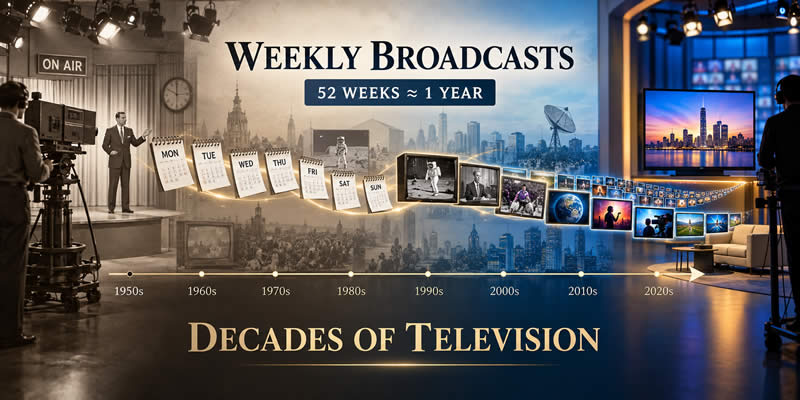
Television schedules are built one week at a time. A production team prepares the next interview, football programme or animated episode, and viewers return when the following broadcast appears. Repeat that cycle for thousands of weeks and an ordinary weekly show can become part of television history.
This is where a weeks to years converter becomes useful. A number like 3,000 weeks is hard to picture immediately, but expressing it as roughly 57.5 years makes the scale far easier to understand.
Meet the Press: A Weekly Format Across Generations
The American public‑affairs programme Meet the Press first aired on 6 November 1947 and later adopted a weekly schedule. Guinness World Records identifies it as the longest‑running television show .
Its longevity shows how weekly scheduling accumulates over time. Ten calendar years contain about 522 weeks, and 50 years contain roughly 2,609 weeks. These figures describe elapsed time, not the number of episodes produced.
To convert weeks to years using the average Gregorian year, divide the number of weeks by approximately 52.1775:
4,000 weeks ÷ 52.1775 ≈ 76.66 years
Dividing by 52 offers a quick mental estimate, but it is slightly less precise because a calendar year contains more than exactly 52 weeks.
Match of the Day: Seasons Within a Longer History
The BBC introduced Match of the Day in August 1964 as a weekly football highlights programme. In 2015, BBC Sport reported that it had been recognised by Guinness World Records as the world's longest‑running football television programme .
Football broadcasting shows why programme age and episode count are not interchangeable. A show may span many calendar years while following sporting seasons, pausing during breaks or changing its schedule. Sixty elapsed years equal about 3,131 weeks, but that does not mean 3,131 weekly episodes were produced.
The Simpsons: Weekly Episodes Do Not Fill Every Week
The Simpsons offers a similar example from scripted television. The characters first appeared in animated shorts in 1987, and the full series began in 1989. Guinness World Records recognises it as the longest‑running animated sitcom by episode count .
Episodes are usually released weekly during a season, but a season does not contain 52 new instalments. Production breaks and gaps between seasons mean that multiplying the number of years by 52 cannot determine the total number of episodes.
Three Ways to Measure a Television Programme
A long‑running series can be measured in several useful ways:
- Elapsed time — the calendar period between the programme's debut and a later date.
- Broadcast weeks — the weeks in which an episode was actually transmitted.
- Episode count — the number of individual programmes produced or aired.
These totals can differ dramatically. A weekly programme may remain part of television culture for 50 years without producing 2,600 original episodes. Conversely, a programme shown several times per week could reach a high episode count in a much shorter period.
Turning a Weekly Routine Into Television History
Long‑running programmes often outlast presenters, production methods and broadcasting technologies. A viewer may first encounter a show as a child and still recognise it decades later, even if its studio, format or audience has changed.
Converting weeks to years makes that passage of time easier to appreciate. The conversion does not reveal how many episodes were made or whether the schedule was uninterrupted. Instead, it translates a long sequence of calendar weeks into a familiar measure of television history.