Convert weeks to months using this simple calculator. It is particularly useful for understanding pregnancy timelines, which are normally recorded in weeks even though a typical 40-week pregnancy is commonly described as lasting about nine months.
Week to Month Conversion Formula
The conversion formula is:
1 Week = 0.23013698630137 Month
Or simply:
Week × 0.23013698630137 = Month
This conversion uses fixed seconds-based factors: 1 Week = 604,800 s and 1 Month = 2,628,000 s.
Weeks to Months Conversion Table
| Weeks | Months |
|---|---|
| 1 week | 0.23013698630137 months |
| 10 weeks | 2.3013698630137 months |
| 20 weeks | 4.6027397260274 months |
| 40 weeks | 9.2054794520548 months |
| 52 weeks | 11.9665753424658 months |
| 100 weeks | 23.013698630137 months |
| 1,000 weeks | 230.13698630137 months |
| 10,000 weeks | 2,301.3698630137 months |
These values use an average calendar month of approximately 30.4167 days. Conversions involving specific calendar dates may vary because months contain different numbers of days.
From 40 Weeks to About Nine Months: Understanding Pregnancy Time
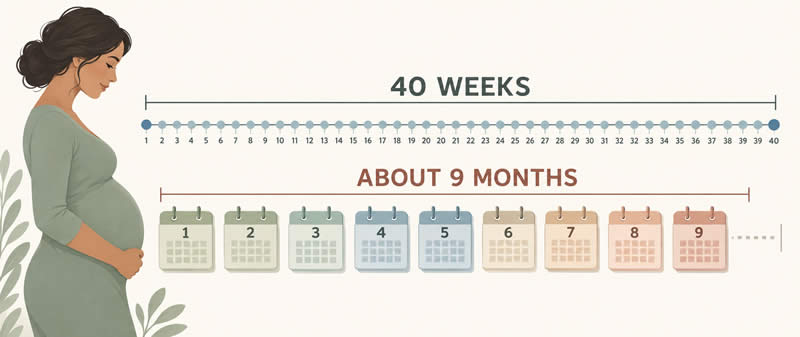
Friends and family often talk about pregnancy in months, while midwives, doctors and scan reports usually use weeks and days. This difference can make "about nine months" sound inconsistent next to an estimated pregnancy length of 40 weeks.
In reality, the two descriptions simply serve different purposes. Months are convenient for everyday conversation, but weeks provide a more consistent and medically useful timeline for appointments, scans and developmental milestones.
Why Pregnancy Records Use Weeks
Every week contains seven days, but calendar months vary — they can have 28, 29, 30 or 31 days. As a result, saying someone is "six months pregnant" is far less precise than recording a stage such as 26 weeks and 2 days.
Pregnancy dating usually begins on the first day of the last menstrual period. Because conception typically occurs later, the gestational timeline includes time before conception. This creates a standard starting point when the exact conception date is unknown.
The NHS due‑date guidance explains this convention and notes that a dating scan can provide a more accurate estimate of how many weeks pregnant someone is.
How 40 Weeks Becomes About Nine Months
A typical 40‑week pregnancy contains 280 days:
40 weeks × 7 days = 280 days
Calendar months do not have a fixed length, but their average length is roughly 30.4 days. Using that average:
280 days ÷ 30.4167 ≈ 9.2 months
In everyday conversation, this is rounded to about nine months. A weeks‑to‑months converter may show approximately 9.2 months, but the result should not be treated as an exact calendar measurement.
Why Dividing by Four Produces Ten Months
A common shortcut is to divide 40 weeks by four. This produces ten, but it counts ten periods of exactly 28 days:
40 weeks ÷ 4 weeks = 10 four‑week periods
A four‑week period is not the same as an average calendar month. Twelve four‑week periods equal only 336 days, which is shorter than a calendar year. This is why treating every four weeks as a "month" makes a pregnancy seem to last ten months.
The Due Date Is a Reference Point
Forty weeks is used to estimate a due date, but it does not predict the exact day of birth. According to the NHS , pregnancy normally lasts between 37 and 42 weeks from the first day of the last menstrual period.
The American College of Obstetricians and Gynecologists also describes an average pregnancy as 40 weeks when measured from that same starting point.
Using a Weeks to Months Conversion
Converting weeks to months can help people explain a pregnancy timeline to relatives, plan around an estimated due date or understand how far the pregnancy has progressed. A weeks‑to‑months converter is useful for this general comparison.
For maternity care, however, the recorded number of weeks and days is the more meaningful measurement. A conversion helps translate the timescale into familiar terms, but it does not replace a due date or assessment provided by a qualified healthcare professional.