Use this Seconds to Microseconds converter to translate audio durations, processing times and other short intervals into microseconds. One second equals exactly one million microseconds. In digital audio recorded at 48 kHz, that single second contains 48,000 samples, with approximately 20.833 microseconds between consecutive samples.
Second to Microsecond Conversion Formula
The conversion formula is:
1 s = 1,000,000 µs
Or simply:
s × 1,000,000 = µs
This conversion uses fixed seconds-based factors: 1 s = 1 s and 1 µs = 0.000001 s.
Common Second to Microsecond Conversions
| Seconds (s) | Microseconds (µs) |
|---|---|
| 1 s | 1,000,000 µs |
| 2 s | 2,000,000 µs |
| 3 s | 3,000,000 µs |
| 4 s | 4,000,000 µs |
| 5 s | 5,000,000 µs |
| 6 s | 6,000,000 µs |
| 7 s | 7,000,000 µs |
| 8 s | 8,000,000 µs |
| 9 s | 9,000,000 µs |
| 10 s | 10,000,000 µs |
| 15 s | 15,000,000 µs |
| 20 s | 20,000,000 µs |
| 25 s | 25,000,000 µs |
| 50 s | 50,000,000 µs |
| 75 s | 75,000,000 µs |
| 100 s | 100,000,000 µs |
Why 44,100 Hz? A Sample Rate Born from Videotape
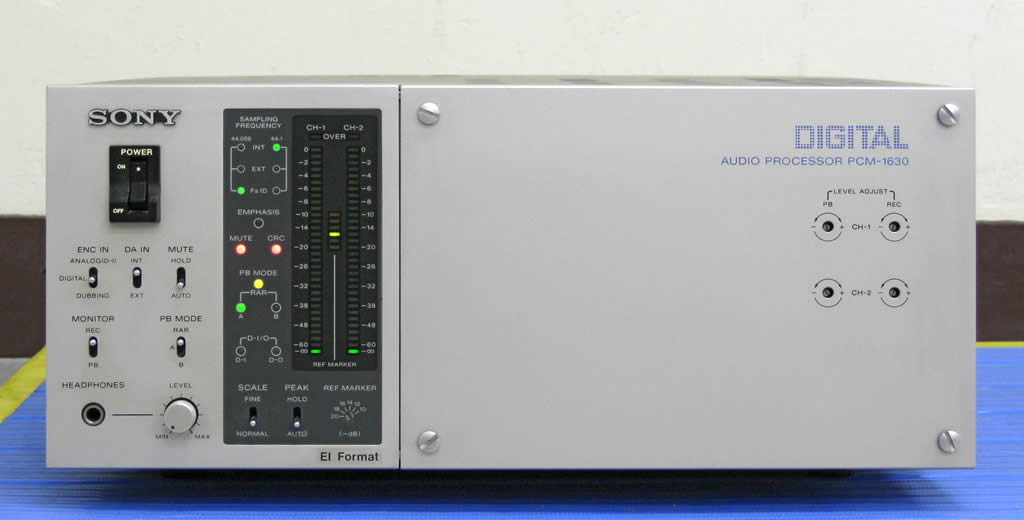
The specific number 44,100 looks arbitrary at first glance, but it has a genuinely surprising origin. The Nyquist–Shannon sampling theorem only requires that a sample rate be more than twice the highest frequency being recorded — since human hearing tops out around 20,000 Hz, that meant anything above roughly 40,000 Hz would do. Nothing in the theorem demands exactly 44,100.
The precise figure comes from an entirely different source: 1970s video technology. Before the CD existed, Sony's early PCM adaptors converted digital audio into a video signal so it could be recorded on ordinary U-Matic videotape — at the time, the only affordable way to transfer studio audio masters between a recording session and a CD manufacturer. The number of audio samples that could be encoded depended on the video format's own line count and frame rate:
PAL: 294 lines × 50 fields/second × 3 samples per line = 44,100 Hz
NTSC: 245 lines × 59.94 fields/second × 3 samples per line ≈ 44,056 Hz
When Sony and Philips settled on a single standard for the compact disc in the early 1980s, Sony's 44,100 Hz figure won out, and it has remained the audio-CD standard ever since. The 48 kHz rate used in professional and video production, by contrast, was chosen separately by engineers led by Bart Locanthi because it divides cleanly into common video frame rates like 24, 25 and 30 frames per second — a different practical requirement entirely, which is why two separate "standard" sample rates still coexist today.
One Second of Digital Audio Contains One Million Microseconds
A one-second sound may feel like a single continuous event. A spoken word, piano note or drumbeat appears to flow without interruption, but digital recording equipment represents that sound using a rapid sequence of measurements called samples.
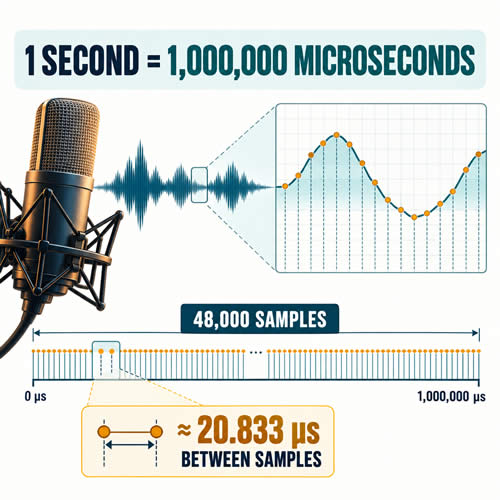
Each second contains exactly 1,000,000 microseconds. Dividing this interval into smaller parts helps explain how an audio interface records thousands of samples during a single second.
Turning a Sound Wave into Digital Samples
A microphone converts changes in air pressure into an electrical signal. An analogue-to-digital converter then measures that signal repeatedly and stores numerical values representing its changing level.
The number of measurements made each second is called the sample rate. Common audio sample rates include 44,100 samples per second, often written as 44.1 kHz, and 48,000 samples per second, written as 48 kHz.
At a sample rate of 48 kHz, one second is divided into 48,000 sampling intervals. First, use a Seconds to Microseconds converter to express one second in the smaller unit:
1 second = 1,000,000 microseconds
Dividing those microseconds by the number of samples gives the interval between successive sample times:
1,000,000 µs ÷ 48,000 ≈ 20.833 µs
The audio system therefore records a sample approximately every 20.833 microseconds. This does not mean each sample is a separate audible sound. The samples collectively describe the waveform that playback equipment reconstructs as continuous audio.
Comparing Common Sample Rates
Higher sample rates place the sample points closer together in time. The following examples show the approximate interval between samples:
| Sample rate | Samples per second | Approximate interval |
|---|---|---|
| 44.1 kHz | 44,100 | 22.676 µs |
| 48 kHz | 48,000 | 20.833 µs |
| 96 kHz | 96,000 | 10.417 µs |
| 192 kHz | 192,000 | 5.208 µs |
These figures describe the spacing of the sample times. They do not, by themselves, determine the complete quality of a recording. Microphone performance, analogue circuitry, bit depth, filtering, processing, compression and playback equipment also influence the result.
From One Second to a Complete Recording
Suppose a sound editor has a clip lasting 3.5 seconds. To convert seconds to microseconds, multiply by one million:
3.5 s × 1,000,000 = 3,500,000 µs
At 48,000 samples per second, the same clip contains:
3.5 s × 48,000 samples/s = 168,000 samples
The clip can therefore be described as 3.5 seconds long, as 3,500,000 microseconds long or as 168,000 sample intervals at 48 kHz. Each description is useful for a different purpose.
Why Audio Software Uses Smaller Time Units
Seconds are convenient for listeners and for describing the running time of a song, podcast or film soundtrack. Microseconds become useful when engineers examine timing differences that are much shorter than a listener would normally see on a playback counter.
Small units can help when analysing:
- Intervals between digital-audio samples
- Audio-interface input and output latency
- Timing differences between microphones
- Short delays applied during mixing
- Signal-processing and hardware response times
- Synchronisation between audio devices
For example, two microphones placed at different distances from a sound source receive the sound at slightly different times. Audio engineers may examine very small timing differences when aligning the recordings. The required adjustment could be far less than one millisecond and may be easier to express in microseconds.
The Same Duration on Two Different Scales
Converting seconds into microseconds does not add detail to the original recording or change its sample rate. It only expresses the same duration using a finer unit:
Microseconds = seconds × 1,000,000
A familiar second becomes one million smaller time units. Within that second, a digital audio system can schedule tens of thousands of sample measurements, process their values and later reproduce them as sound. The listener hears one continuous moment; the equipment manages it as a precisely timed sequence of microscopic intervals.