Convert a duration from seconds to hours. You can view the result as decimal hours or as a more familiar combination of hours, minutes, and seconds.
Seconds to Hours Conversion Formula
One hour contains exactly 3,600 seconds:
1 h = 3,600 s
This exact relationship is documented in the NIST Guide to the SI , which defines one minute as 60 seconds and one hour as 60 minutes, or 3,600 seconds. It is also listed in the International Bureau of Weights and Measures SI Brochure .
To convert seconds to hours, divide the number of seconds by 3,600:
Hours = seconds ÷ 3,600
Example: Convert 5,400 seconds to hours
Divide 5,400 by 3,600:
5,400 s ÷ 3,600 = 1.5 h
Therefore, 5,400 seconds equals 1.5 hours, or 1 hour and 30 minutes.
Converting Seconds to Hours, Minutes, and Seconds
A decimal-hour result is useful for calculations, but it may not be the easiest way to read a duration. You can separate the time into whole hours, minutes and seconds using the exact relationships 1 hour = 3,600 seconds and 1 minute = 60 seconds.
- Divide the total seconds by 3,600 and keep the whole-number result as the number of complete hours.
- Find the seconds remaining after the complete hours have been removed.
- Divide the remaining seconds by 60 and keep the whole-number result as the number of complete minutes.
- Any amount left after removing the complete minutes is the remaining number of seconds.
Example: Convert 10,000 seconds
There are two complete hours in 10,000 seconds:
2 × 3,600 = 7,200 seconds
Subtract the complete hours from the original duration:
10,000 − 7,200 = 2,800 seconds
The remaining 2,800 seconds contain 46 complete minutes:
46 × 60 = 2,760 seconds
Subtract those complete minutes:
2,800 − 2,760 = 40 seconds
Therefore:
10,000 seconds = 2 hours, 46 minutes and 40 seconds
For authoritative definitions and accepted symbols for the second, minute and hour, see the NIST guidance on time units .
Common Seconds to Hours Conversions
| Seconds (s) | Decimal hours (h) | Hours, minutes, and seconds |
|---|---|---|
| 1 s | 0.000278 h | 1 second |
| 60 s | 0.016667 h | 1 minute |
| 100 s | 0.027778 h | 1 minute 40 seconds |
| 300 s | 0.083333 h | 5 minutes |
| 600 s | 0.166667 h | 10 minutes |
| 900 s | 0.25 h | 15 minutes |
| 1,000 s | 0.277778 h | 16 minutes 40 seconds |
| 1,800 s | 0.5 h | 30 minutes |
| 3,600 s | 1 h | 1 hour |
| 5,400 s | 1.5 h | 1 hour 30 minutes |
| 7,200 s | 2 h | 2 hours |
| 9,000 s | 2.5 h | 2 hours 30 minutes |
| 10,000 s | 2.777778 h | 2 hours 46 minutes 40 seconds |
| 86,400 s | 24 h | 24 hours |
From 12 Seconds to Hours Aloft: The Growth of Powered Flight
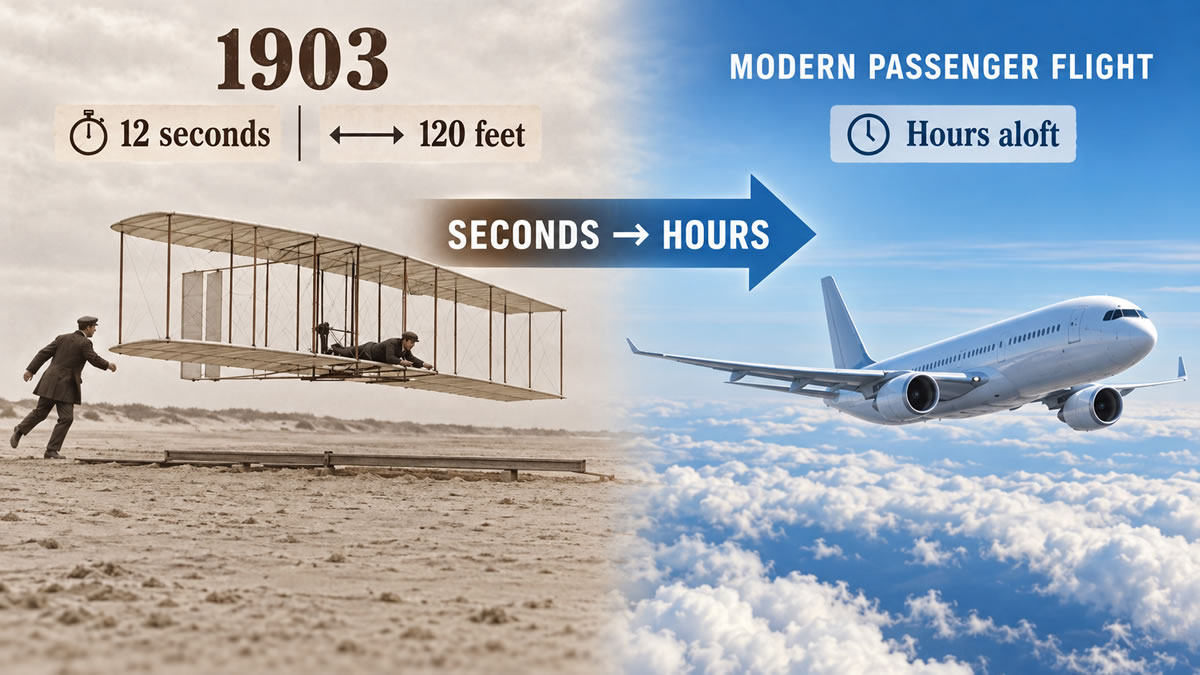
Passenger flights today are long enough for travellers to eat a meal, watch a film or rest before landing. The event that helped begin this era of aviation took place on a very different timescale: only 12 seconds.
That brief flight did not carry passengers between cities. It served as an engineering demonstration showing that a powered aeroplane could leave level ground, respond to its pilot and complete a controlled journey through the air.
Twelve Seconds on a Windy December Morning
On 17 December 1903, Orville and Wilbur Wright prepared their experimental Flyer on the sandy ground near Kitty Hawk, North Carolina. Orville lay across the lower wing to operate the controls, while Wilbur helped steady the machine as it moved along its launching rail.
At approximately 10:35 a.m., the aircraft lifted into the strong headwind. The US National Park Service records a duration of 12 seconds, a distance of 120 feet and an altitude of roughly eight feet.
The numbers were modest, but the experiment answered an important question. The Flyer was not simply carried by the wind or launched into an uncontrolled jump. Its engine supplied power, and its pilot was able to influence its movement while airborne.
Four Flights and Less Than Two Minutes in Total
The brothers made four successful flights that day, alternating as pilots. Each attempt became slightly longer as they gained experience with the sensitive controls.
- The first flight lasted 12 seconds and covered 120 feet.
- The second lasted about 12 seconds and covered approximately 175 feet.
- The third lasted 15 seconds and travelled about 200 feet.
- The fourth lasted 59 seconds and covered 852 feet.
Combined, the four flights accounted for approximately 98 seconds in the air—just 1 minute and 38 seconds. Even so, they produced practical knowledge about powered flight and aircraft control.
After the fourth landing, a gust caught the Flyer while it was on the ground and damaged it beyond immediate repair. The aircraft never flew again, but the Wright brothers continued developing more capable machines.
The Federal Aviation Administration identifies the Wrights' 1903 achievement as the beginning of the modern era of powered flight.
Converting 12 Seconds to Hours
Modern flights are usually described in hours, so placing the first flight in the same unit highlights its brevity. To convert seconds to hours, divide by 3,600:
Hours = seconds ÷ 3,600
For the first Wright Flyer journey:
12 ÷ 3,600 = 0.003333... hours
The first successful flight therefore lasted approximately 0.003333 hours. Because the decimal continues, it is best treated as an approximate value.
Passenger Journeys Changed the Useful Unit
Seconds were suitable for recording early experimental flights. As aircraft became capable of travelling between communities, countries and continents, hours became the more practical unit.
For illustration, a two‑hour flight lasts 7,200 seconds, while an eight‑hour flight lasts 28,800 seconds:
- 2 hours × 3,600 = 7,200 seconds
- 8 hours × 3,600 = 28,800 seconds
- 12 hours × 3,600 = 43,200 seconds
These are conversion examples, not schedules for specific routes. Published airline journey times may include taxiing and other ground operations, so they do not always represent airborne time alone.
| Example | Seconds | Hours |
|---|---|---|
| First Wright Flyer flight | 12 seconds | Approximately 0.003333 hours |
| Longest Wright Flyer flight that day | 59 seconds | Approximately 0.016389 hours |
| Illustrative two‑hour flight | 7,200 seconds | 2 hours |
| Illustrative eight‑hour flight | 28,800 seconds | 8 hours |
Why Aircraft Can Now Remain Airborne for Hours
The change from seconds to hours required progress across many areas of engineering. Engines became more powerful and dependable, aircraft structures became stronger without becoming excessively heavy, and designers learned more about stability, lift and aerodynamic efficiency.
Longer journeys also depend on developments outside the aircraft itself. Airports, navigation systems, weather forecasting, maintenance programmes and air‑traffic control all contribute to routine passenger travel.
A seconds to hours converter can place early and modern durations on the same numerical scale, but it cannot measure the historical importance of the first flight. The 12‑second journey mattered because it showed that a pilot‑controlled, engine‑powered aeroplane could work. The hours‑long flights familiar today developed from that small but decisive demonstration.