Use this seconds to days converter to express a duration in decimal days. Enter the number of seconds for an instant result based on 1 day = 86,400 seconds. You can also explore how liquid-fuel rocketry advanced from Robert Goddard's 2.5-second experimental flight to the eight-day Apollo 11 mission to the Moon and back.
Second to Day Conversion Formula
The conversion formula is:
1 s = 0.0000115740740740741 d
Or simply:
s × 0.0000115740740740741 = d
This conversion uses fixed seconds-based factors: 1 s = 1 s and 1 d = 86,400 s.
Seconds to Days Conversion Table
| Seconds (s) | Days (d) |
|---|---|
| 1 s | 0.00001157 d |
| 60 s | 0.00069444 d |
| 300 s | 0.00347222 d |
| 600 s | 0.00694444 d |
| 1,800 s | 0.02083333 d |
| 3,600 s | 0.04166667 d |
| 21,600 s | 0.25 d |
| 43,200 s | 0.5 d |
| 86,400 s | 1 d |
| 129,600 s | 1.5 d |
| 172,800 s | 2 d |
| 250,000 s | 2.89351852 d |
| 432,000 s | 5 d |
| 604,800 s | 7 d |
| 703,115 s | 8.13790509 d |
| 864,000 s | 10 d |
| 1,000,000 s | 11.57407407 d |
From 2.5 Seconds Above a Farm to Eight Days Around the Moon
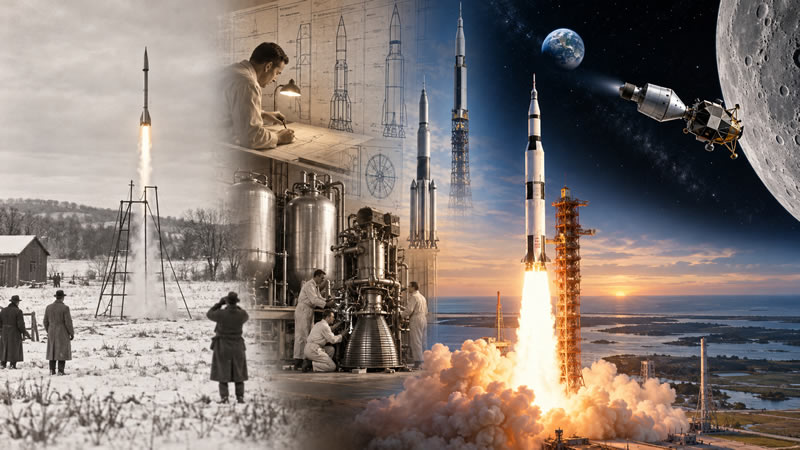
On 16 March 1926, Robert Goddard tested an experimental liquid‑propellant rocket on a snow‑covered farm near Auburn, Massachusetts. The vehicle was small, with exposed tanks, pipes and a combustion chamber mounted in a slender frame—very different from the large launch vehicles later used in space exploration.
The rocket remained airborne for only 2.5 seconds. Forty‑three years later, liquid‑propellant technology helped launch Apollo 11 on a lunar mission lasting more than eight days.
A Flight Shorter Than a Traffic Light Cycle
Goddard's rocket used gasoline and liquid oxygen stored in separate tanks. When combined for combustion, the engine produced enough thrust to lift the vehicle from the ground.
NASA's historical account notes that the rocket climbed about 41 feet (12.5 metres) and landed roughly 184 feet (56 metres) from the launch point.
Although modest, the experiment demonstrated that a liquid‑fuelled rocket could lift itself—a foundational step in modern propulsion research.
Goddard continued refining engine placement, pumps, steering and vehicle design. His work formed part of a wider international effort that eventually enabled large‑scale spaceflight.
The Same Principle, Not the Same Rocket
Goddard's early rocket did not evolve directly into the Saturn V. The two machines differed dramatically in size, materials, guidance systems and performance. Decades of research and thousands of specialists contributed to the technologies used in Apollo missions.
The link between them is the principle of liquid propulsion: storing fuel and oxidiser in tanks, supplying them to an engine and burning them to create a controlled exhaust flow.
Apollo 11's Saturn V used liquid oxygen and RP‑1 (a refined kerosene) in its first stage, and liquid oxygen with liquid hydrogen in its upper stages. Details appear in NASA's Apollo 11 press kit .
Minutes of Engine Operation Began a Journey of Days
The Saturn V did not operate throughout the lunar mission. Its three stages fired sequentially during launch, Earth‑orbit insertion and the manoeuvre that sent Apollo 11 toward the Moon. Each stage was discarded after completing its role.
The Apollo spacecraft then continued without continuous thrust. It coasted for much of the journey, entered lunar orbit, carried two astronauts to the surface and returned all three crew members to Earth.
NASA's mission overview gives the total duration as 8 days, 3 hours, 18 minutes and 35 seconds.
Expressing the Moon Mission in Seconds
The complete mission can be expressed in seconds:
- 8 days = 691,200 seconds
- 3 hours = 10,800 seconds
- 18 minutes = 1,080 seconds
- Remaining time = 35 seconds
Total mission time = 703,115 seconds
To convert seconds to days, divide by 86,400:
703,115 ÷ 86,400 ≈ 8.138 days
A seconds to days converter can perform this calculation instantly, although the decimal value does not show the remaining hours, minutes and seconds as clearly as the full mission duration.
Why the Comparison Matters
Goddard's 2.5‑second experiment and Apollo 11's eight‑day mission were fundamentally different. The first measured the entire flight of an experimental rocket; the second included launch, travel, lunar operations and return.
The comparison is not a performance contest. It highlights how an idea demonstrated for a few seconds became part of a system capable of supporting a journey lasting several days.
The first launch ended in a Massachusetts field. Apollo 11 ended with a command module descending into the Pacific Ocean after carrying its crew to the Moon and safely home. Between those moments lies one of the most significant periods of engineering development in modern history.