Use this milliseconds to seconds converter to divide any millisecond value by 1,000. The animation story below explains how frames displayed for only a few milliseconds combine into complete seconds of movement—for example, 30 frames lasting approximately 33.33 milliseconds each form one second of animation.
Millisecond to Second Conversion Formula
The conversion formula is:
1 ms = 0.001 s
Or simply:
ms × 0.001 = s
This conversion uses fixed seconds-based factors: 1 ms = 0.001 s and 1 s = 1 s.
Common Millisecond to Second Conversions
| Milliseconds | Seconds |
|---|---|
| 1 ms | 0.001 s |
| 5 ms | 0.005 s |
| 10 ms | 0.01 s |
| 16.67 ms | 0.01667 s |
| 20 ms | 0.02 s |
| 25 ms | 0.025 s |
| 33.33 ms | 0.03333 s |
| 40 ms | 0.04 s |
| 41.67 ms | 0.04167 s |
| 50 ms | 0.05 s |
| 100 ms | 0.1 s |
| 200 ms | 0.2 s |
| 250 ms | 0.25 s |
| 500 ms | 0.5 s |
| 750 ms | 0.75 s |
| 1,000 ms | 1 s |
| 1,500 ms | 1.5 s |
| 2,000 ms | 2 s |
| 2,500 ms | 2.5 s |
| 5,000 ms | 5 s |
| 10,000 ms | 10 s |
| 30,000 ms | 30 s |
| 60,000 ms | 60 s |
Values such as 16.67 ms, 33.33 ms and 41.67 ms are commonly encountered when discussing approximate frame durations at 60, 30 and 24 frames per second. To convert any millisecond value to seconds, divide it by 1,000.
How Milliseconds Turn Still Pictures into Seconds of Animation
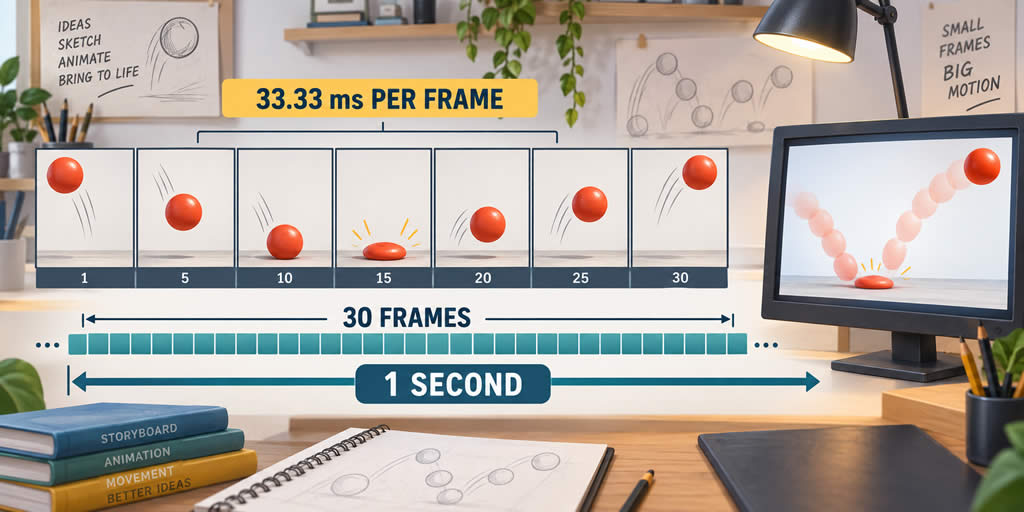
Pause an animation at any moment and the screen shows a single still image. Move forward one frame and the objects shift slightly. When many frames appear in rapid succession, those separate drawings blend into the smooth movement we recognise as animation.
A finished scene may last only a few seconds, but each frame is displayed for a tiny fraction of that time. These intervals are usually measured in milliseconds. A Milliseconds to Seconds converter links the two scales:
1,000 milliseconds = 1 second
Drawing a Ball That Appears to Bounce
Imagine an animator creating a short sequence of a ball falling toward the floor. The first drawing places the ball near the top of the frame. Each subsequent drawing moves it slightly lower. At the moment of impact, the ball may flatten briefly before rising again.
Viewed on paper, these are separate pictures. During playback, the software shows each drawing for a controlled interval before replacing it with the next one.
If the scene plays at 25 frames per second, one second is divided among 25 frames:
1,000 ms ÷ 25 frames = 40 ms per frame
Each image remains visible for 40 milliseconds. After 25 frames have been shown, one second of animation has passed.
Frame Rate Determines Frame Duration
Frame rate and frame duration describe the same timing from opposite directions. Frame rate counts how many images appear in one second, while frame duration measures how long each image stays on screen.
| Frame rate | Approximate time per frame | Frames displayed in one second |
|---|---|---|
| 12 fps | 83.33 ms | 12 frames |
| 24 fps | 41.67 ms | 24 frames |
| 25 fps | 40 ms | 25 frames |
| 30 fps | 33.33 ms | 30 frames |
| 50 fps | 20 ms | 50 frames |
| 60 fps | 16.67 ms | 60 frames |
Values such as 41.67 ms and 16.67 ms are rounded because the exact calculations produce repeating decimals. These figures are based on nominal frame rates; some video systems use fractional rates with slightly different durations.
Building Five Seconds from 150 Frames
Suppose the complete bouncing‑ball scene contains 150 frames and plays at 30 frames per second. Its duration is:
150 frames ÷ 30 fps = 5 seconds
Five seconds can also be expressed as 5,000 milliseconds:
5 seconds × 1,000 = 5,000 ms
To convert Milliseconds to Seconds, divide the millisecond value by 1,000:
Seconds = milliseconds ÷ 1,000
This conversion is useful when animation software reports transitions, pauses or sound cues in milliseconds while the overall scene is planned in seconds. For example, a 750 ms pause lasts 0.75 seconds:
750 ms ÷ 1,000 = 0.75 seconds
Playback Time and Production Time Are Different
A frame displayed for 40 milliseconds does not necessarily take 40 milliseconds to create. An artist might spend an hour drawing it. A computer‑generated frame with complex lighting or effects may also take far longer to render than viewers spend seeing it.
Frame duration describes playback time only. Drawing time measures the artist's work, while rendering time measures how long a computer needs to generate the image. Keeping these measurements separate avoids a common misunderstanding: a five‑second animation may require far more than five seconds to produce.
Why Timing Changes the Movement
If frames are shown too slowly, the ball may appear to jump between positions. When timed correctly, the motion looks continuous. Animators can hold a drawing for several frames to create a pause or place frames closer together to change the rhythm of the action.
Animation turns tiny intervals into a larger experience. Milliseconds control how long each picture appears, while seconds describe the duration perceived by the viewer. The images remain separate drawings, but precise timing allows them to form one moving story.