On 8 September 2026, a UK air-traffic system bug that existed for roughly one millisecond led to six hours of nationwide flight restrictions and more than two days of knock-on delays. Use the converter above for an instant millisecond-to-hour result, or the formula below to work it out by hand.
Millisecond to Hour Conversion Formula
The exact relationship is:
1 ms = 1 ÷ 3,600,000 h
Written as a decimal:
1 ms ≈ 0.000000277777777777778 h
To convert milliseconds to hours, divide by 3,600,000:
Hours = milliseconds ÷ 3,600,000
You can also multiply by the approximate decimal factor:
Hours ≈ milliseconds × 0.000000277777777777778
This conversion uses fixed relationships: 1 ms = 0.001 s and 1 h = 3,600 s. The prefix milli represents one-thousandth according to the NIST definitions of SI prefixes . The relationship 1 h = 3,600 s is documented in the NIST Guide to the SI .
Milliseconds to Hours Conversion Table
| Milliseconds (ms) | Hours (h) |
|---|---|
| 1 ms | 0.0000002778 h |
| 10 ms | 0.0000027778 h |
| 100 ms | 0.0000277778 h |
| 1,000 ms | 0.0002777778 h |
| 10,000 ms | 0.0027777778 h |
| 60,000 ms | 0.0166666667 h |
| 300,000 ms | 0.0833333333 h |
| 600,000 ms | 0.1666666667 h |
| 900,000 ms | 0.25 h |
| 1,800,000 ms | 0.5 h |
| 3,600,000 ms | 1 h |
| 7,200,000 ms | 2 h |
| 10,800,000 ms | 3 h |
| 21,600,000 ms | 6 h |
| 43,200,000 ms | 12 h |
| 86,400,000 ms | 24 h |
One Millisecond, Six Hours: The Software Fault That Disrupted UK Flights
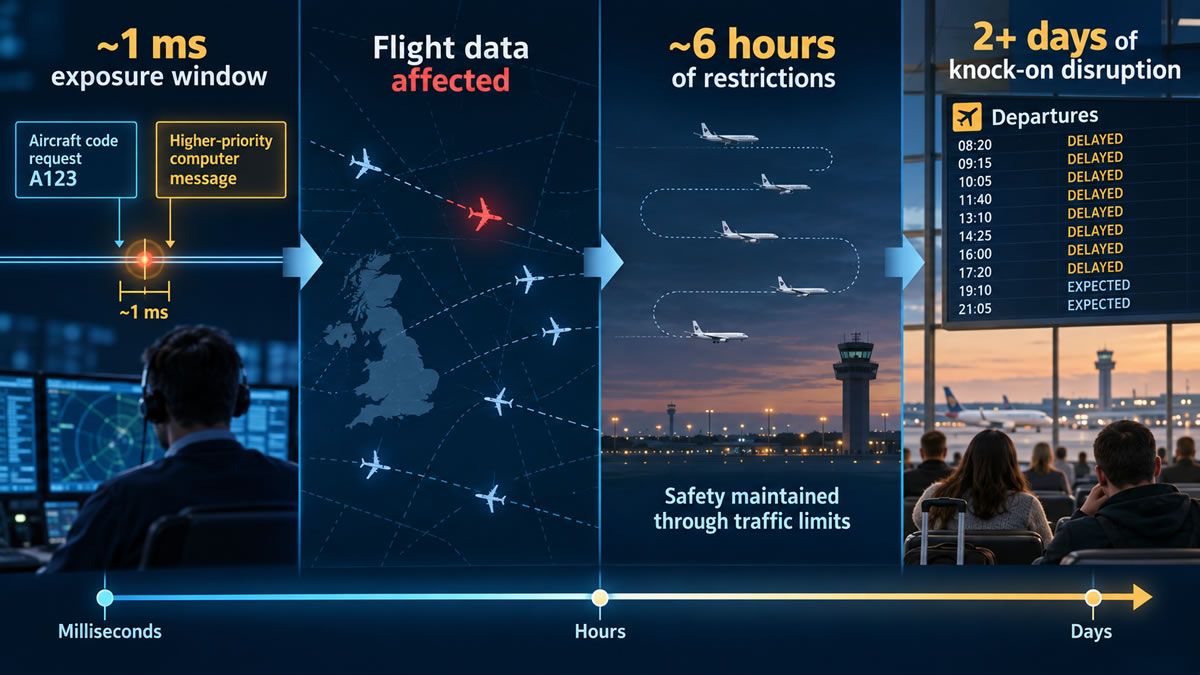
A millisecond passes too quickly for a person to notice, yet computer operations at this scale can influence events that last far longer. An incident affecting UK air traffic control on 8 September 2026 offers a clear real‑world example.
A rare software condition developed during an interval of roughly one millisecond. The resulting technical failure led to restrictions across UK airspace for around six hours, while disruption to passenger journeys continued for more than two days.
A Routine Request Met Another Task at Precisely the Wrong Moment
The National Airspace System used by NATS manages flight information and helps allocate identification codes to aircraft. These codes allow controllers to match radar displays with the correct flight records.
According to the preliminary NATS investigation , the system was processing a valid manual request for one of these codes when a higher‑priority message arrived. The software paused the first task, handled the urgent message and then returned to the original request.
Pausing one task to process another was normal behaviour. The issue appeared when the first task resumed. A defect in a small part of the program caused its associated data to be handled incorrectly, and that damaged information later interfered with additional flight‑data processing.
Investigators estimated that the vulnerable timing window was only about one millisecond wide. The report indicates that the failure would not have occurred if the priority message had arrived slightly earlier or later.
Converting One Millisecond to Hours
To appreciate how short this interval was, convert the millisecond value into hours:
1 millisecond = 0.001 seconds
1 hour = 3,600 seconds = 3,600,000 milliseconds
1 millisecond ≈ 0.0000002778 hours
The decimal contains six zeros before the first non‑zero digit. A millisecond to hour conversion therefore shows that one millisecond is only one 3.6‑millionth of an hour.
Importantly, the software outage itself did not last for a single millisecond. The millisecond describes the narrow timing window in which the underlying defect was triggered—not the full duration of the failure or recovery.
Why Controllers Had to Reduce Traffic
The damaged data did not cause an immediate nationwide shutdown. The seriousness of the problem became clear as communication between flight‑data systems grew unreliable and some automated information was no longer consistently available to controllers.
Air traffic control depends on dependable, up‑to‑date information. When some automated support became unavailable, traffic levels had to be reduced so controllers could continue working safely with fallback procedures.
The original technical problem affected London Area Control, which manages much of the higher‑altitude traffic over England and Wales. Wider restrictions were required while the national system was restarted and its flight information reloaded.
NATS states that safety was maintained throughout the incident. Reducing the number of aircraft was a protective response to the loss of normal system capability.
Six Hours Equal 21.6 Million Milliseconds
Air‑traffic restrictions remained in place for approximately six hours. Expressing that period in milliseconds gives:
6 × 60 × 60 × 1,000 = 21,600,000 milliseconds
The restriction period was therefore about 21.6 million times the length of a single millisecond. This comparison highlights the difference in scale; it does not imply that one faulty operation continued running for six hours.
| Event or period | Milliseconds | Hours |
|---|---|---|
| Estimated software exposure window | 1 ms | 0.0000002778 h |
| Approximate airspace restriction period | 21,600,000 ms | 6 h |
| Two days of continuing disruption | 172,800,000 ms | 48 h |
Why Delays Continued After the System Recovered
Airline schedules cannot simply resume at the point where they stopped. During a major restriction, aircraft may be diverted or remain at their departure airports. Crews can reach working‑time limits, passengers miss connections and later flights lose their assigned aircraft or airport slots.
This creates a chain of operational challenges. Even after airspace restrictions are removed, airlines must reposition aircraft, arrange replacement crews and rebuild schedules across multiple airports and countries.
The BBC reported that more than 2,000 flights were cancelled and hundreds of thousands of passengers were affected. NATS said its own operations returned to normal that evening, although the accumulated disruption took more than two days to clear.
Investigation and Passenger Protection
The report published by NATS is preliminary, meaning its findings may be refined by the complete investigation. A permanent correction must also be tested before it can be introduced into a safety‑critical system.
The UK government asked the Civil Aviation Authority to conduct an independent review of the incident and consider the resilience of the air‑traffic service. The Civil Aviation Authority's statement also reminded airlines that they must provide appropriate care to passengers affected by delays and cancellations.
What the Millisecond‑to‑Hour Comparison Teaches Us
Complex transport networks depend on many computers, people and organisations working in sequence. A brief digital event can interrupt that sequence, but restoring the wider network requires far more than correcting one value or restarting one program.
The incident therefore offers an unusual practical example for a millisecond to hour converter. One millisecond equals approximately 0.0000002778 hours, yet a defect exposed during such a short interval was followed by around six hours of restrictions and days of timetable recovery.
The conversion does not measure the technical severity of the defect. Instead, it highlights the difference between the timescale of the trigger and the timescale of its real‑world consequences.