Use this months to years converter to turn any number of months into decimal years. It is especially useful for children's ages, which are commonly recorded in months during infancy and early toddlerhood before years become the more convenient unit.
Month to Year Conversion Formula
The conversion formula is:
1 Month = 1/12 y ≈ 0.0833333333333333 y
Or simply:
Month × 0.0833333333333333 = y
This conversion uses fixed seconds-based factors: 1 Month = 2,629,800 s and 1 y = 31,557,600 s — twelve of these average months make exactly one year.
Months to Years Conversion Table
| Months | Years |
|---|---|
| 1 month | 0.083333 years |
| 6 months | 0.5 years |
| 10 months | 0.833333 years |
| 12 months | 1 year |
| 18 months | 1.5 years |
| 24 months | 2 years |
| 36 months | 3 years |
| 48 months | 4 years |
| 72 months | 6 years |
| 100 months | 8.333333 years |
| 120 months | 10 years |
| 240 months | 20 years |
| 1,000 months | 83.333333 years |
| 10,000 months | 833.333333 years |
To convert months to years, divide the number of months by 12.
Why a Baby's Age Begins in Months and Gradually Changes to Years
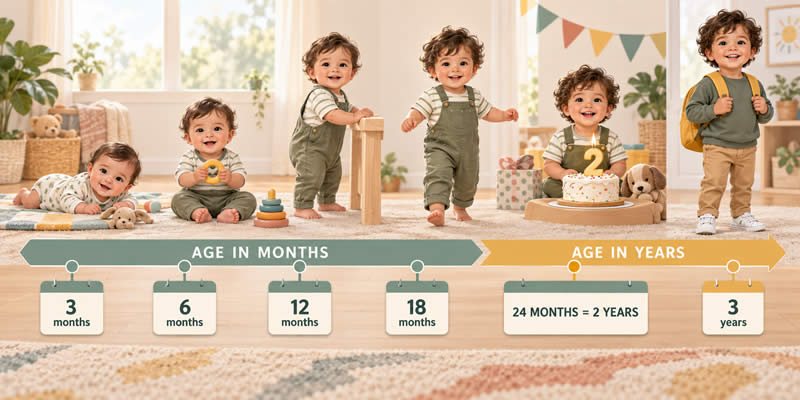
A newborn's hospital record may list an age in hours or days. Soon after, families begin counting in months: three months, six months, nine months and eventually 18 months. Once a child passes the second birthday, most people stop using month‑based ages and switch to years instead.
Nothing special happens at 24 months. The shift simply reflects which unit communicates the child's age most clearly. Months are helpful when small differences matter; years become more practical as the child grows.
Why "Under One Year" Isn't Precise Enough
A two‑month‑old and an 11‑month‑old are both younger than one year, but the difference between them is enormous relative to their short lives. Calling both children "zero years old" hides almost an entire year of development.
Months offer a useful middle ground between counting every day and waiting for the next birthday. Families rely on month‑based ages when arranging appointments, buying age‑labelled products, completing nursery forms or simply telling relatives how old the baby is.
Child‑development guidance is also organised into short age intervals. The CDC milestone checklists use ages such as 2, 4, 6, 9, 12, 15 and 18 months. These are general reference points, not strict deadlines, and children may progress at different rates.
Month Counting Continues After the First Birthday
Turning one does not immediately end month‑based counting. A child who has just celebrated a first birthday may be described as 12 or 13 months old, while a child nearing the second birthday may be 22 or 23 months old.
If both were described only as "one year old," a meaningful difference would disappear. Converting their ages shows why months remain helpful:
13 months ÷ 12 ≈ 1.08 years
23 months ÷ 12 ≈ 1.92 years
These decimal values are mathematically correct, but they sound far less natural than simply saying 13 months or 23 months.
The Change Around the Second Birthday
At 24 months, the conversion reaches a whole number:
24 months ÷ 12 = 2 years
From this point, families typically use expressions such as "two years old," "two and a half," or "almost three." Month‑based ages may still appear in healthcare, research or other contexts where precision matters.
The transition is gradual rather than fixed. The CDC developmental resources include both a two‑year checklist and a 30‑month checklist before moving to yearly ages such as three, four and five.
How to Convert Months to Years
To convert months to years, divide the number of months by 12:
Years = months ÷ 12
A months‑to‑years converter is helpful when a form requests years but an age has been recorded in months. Common conversions include:
- 3 months = 0.25 years
- 6 months = 0.5 years
- 12 months = 1 year
- 18 months = 1.5 years
- 24 months = 2 years
- 30 months = 2.5 years
- 36 months = 3 years
In everyday speech, mixed expressions often sound more natural than decimals. For example, 30 months is usually described as "two and a half years" rather than "2.5 years."
The Measurement Changes — Not the Child
Counting a young child's age in months acknowledges that each month represents a noticeable portion of their life. As the child grows, a one‑month difference becomes less significant, and years provide a simpler way to communicate age.
Moving from 24 months to two years does not change the child's actual age. It simply replaces a detailed unit with a broader one — just as a long distance might be expressed in kilometres instead of metres.