
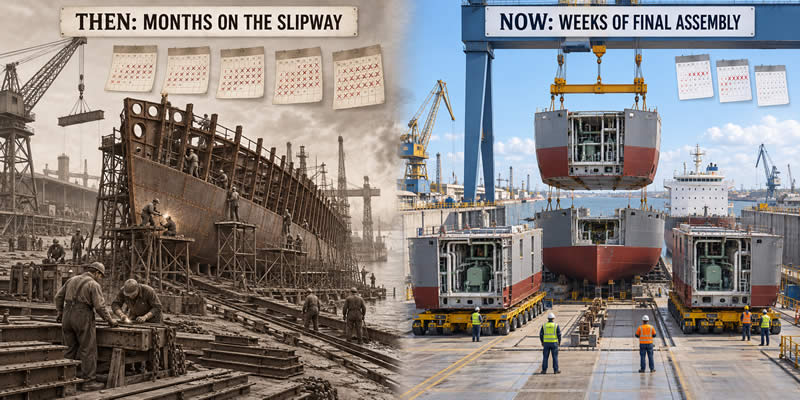
Use this months to weeks converter to compare durations using the average calendar month. See how modern shipyards prepare large vessel sections in parallel, allowing final structural assembly to take weeks instead of keeping a traditional slipway occupied for months.
Month to Week Conversion Formula
The conversion formula is:
1 Month = 4.3452380952381 Week
Or simply:
Month × 4.3452380952381 = Week
This conversion uses fixed seconds-based factors: 1 Month = 2,628,000 s and 1 Week = 604,800 s.
Months to Weeks Conversion Table
| Months | Weeks |
|---|---|
| 1 month | 4.345238 weeks |
| 2 months | 8.690476 weeks |
| 3 months | 13.035714 weeks |
| 4 months | 17.380952 weeks |
| 5 months | 21.726190 weeks |
| 6 months | 26.071429 weeks |
| 9 months | 39.107143 weeks |
| 10 months | 43.452381 weeks |
| 12 months | 52.142857 weeks |
| 18 months | 78.214286 weeks |
| 24 months | 104.285714 weeks |
| 36 months | 156.428571 weeks |
| 48 months | 208.571429 weeks |
| 60 months | 260.714286 weeks |
| 100 months | 434.523810 weeks |
| 1,000 months | 4,345.238095 weeks |
| 10,000 months | 43,452.380952 weeks |
These results use an average month of approximately 30.4167 days, giving approximately 4.345238 weeks per month. Date-based results can differ because individual calendar months contain between 28 and 31 days.
When Ship Construction Shifted from Months on the Slipway to Weeks of Assembly
In older shipyards, a new vessel stayed in one place while its structure slowly rose from the keel. Teams added frames, plates, decks and machinery as space became available. Because everything happened in a single sequence, the slipway could remain occupied for many months before the hull was ready to launch.
Modern shipyards work differently. Instead of waiting for one hull to grow step by step, large sections of the ship are manufactured in separate workshops. Once those sections are complete, cranes bring them together at the dock, creating a recognisable vessel in a much shorter period — sometimes measured in weeks.
The Older Sequential Method
Traditional steel shipbuilding relied on a long chain of dependent tasks. A deck could not be installed until its supporting structure was finished. Pipefitters and electricians often had to wait for access to enclosed spaces, and heavy machinery could be added only after the surrounding hull was ready.
This meant that adding more workers did not always make the project faster. Hundreds of people might be involved, but their tasks still had to follow a practical order. The unfinished vessel occupied valuable space throughout much of the process.
If the main structural work took six months, its approximate duration in weeks would be:
6 average months × 4.345238 ≈ 26.07 weeks
Modern Ships Arrive at the Dock in Pieces
Modular construction divides a ship into large blocks. One workshop may fabricate the bow while other teams prepare the stern, machinery spaces, cargo sections or accommodation block. Pipes, cables, ventilation ducts and equipment foundations can be installed before these blocks leave the workshop.
Because the blocks are produced concurrently, several months of work overlap. Special transporters move the finished sections to the building dock, where powerful cranes position them. Workers then align the structures, weld the boundaries and connect systems that continue from one block into another.
The United States Navy notes that modular construction allows fabrication to begin months before the traditional keel‑laying milestone. The UK Ministry of Defence has similarly documented how large carrier blocks were manufactured at different shipyards and transported to Rosyth for assembly.
Months of Work Can Produce Weeks of Visible Assembly
Imagine four hull blocks that each require roughly three months to manufacture. Producing them one after another would represent twelve months of elapsed work:
4 blocks × 3 months = 12 months
If the shipyard has enough workers, workshops and equipment to build all four blocks at the same time, much of that fabrication occurs during the same three‑month period. Joining the prepared blocks might then take several additional weeks.
This is why photographs can show an empty dock followed only weeks later by what appears to be an almost complete ship. The vessel was not created from scratch during those weeks — its major sections had already absorbed months of labour elsewhere in the yard.
Comparing the Two Timescales
A months‑to‑weeks converter makes it easier to compare an older slipway schedule with a modern assembly period. For example:
6 months ≈ 26.07 weeks
A modern modular assembly stage might occupy 6 to 8 weeks
The second figure is an illustrative example rather than a standard for every vessel. Actual schedules depend on the ship's size, complexity, design, workforce, facilities and available equipment.
The Ship Is Not Finished When the Blocks Meet
A joined hull still requires extensive work. Shipyard teams connect electrical, mechanical and safety systems, finish internal spaces and inspect thousands of components. Harbour tests and sea trials then verify propulsion, steering, navigation, communications and safety equipment under real operating conditions.
It is therefore misleading to suggest that modern ships are "built in a few weeks." The more accurate explanation is that older methods required months of sequential work on the slipway, while modern prefabrication reduces the final structural assembly to weeks.
When we convert months to weeks, the improvement becomes clear. Modern shipyards save time not by eliminating work, but by completing more of it simultaneously and joining prepared sections only when they are ready.