Use this Months to Hours Converter to estimate operating time for space missions, data centres, machinery, research projects and other long-running activities. It converts each average Gregorian month to 730.5 hours. Because calendar months vary in length, use actual start and end dates when calculating contracts, billing periods or exact deadlines.
Month to Hour Conversion Formula
The conversion formula is:
1 Month = 730.5 h
Or simply:
Month × 730.5 = h
This conversion uses fixed seconds-based factors: 1 Month = 2,629,800 s and 1 h = 3,600 s.
Months to Hours Conversion Table
These conversions use an average Gregorian month of 730.5 hours. Results are estimates because calendar months vary from 28 to 31 days.
| Months | Hours |
|---|---|
| 1 month | 730.5 hours |
| 2 months | 1,461 hours |
| 3 months | 2,191.5 hours |
| 4 months | 2,922 hours |
| 5 months | 3,652.5 hours |
| 6 months | 4,383 hours |
| 7 months | 5,113.5 hours |
| 8 months | 5,844 hours |
| 9 months | 6,574.5 hours |
| 10 months | 7,305 hours |
| 11 months | 8,035.5 hours |
| 12 months | 8,766 hours |
| 18 months | 13,149 hours |
| 24 months | 17,532 hours |
| 36 months | 26,298 hours |
| 60 months | 43,830 hours |
| 100 months | 73,050 hours |
| 120 months | 87,660 hours |
How a Mars Mission Turns Months of Travel into Thousands of Hours
A trip to Mars is often described as lasting several months. That summary helps the public picture the journey, but mission teams rely on a far more detailed timeline. When seven months are expressed as thousands of hours, the scale of continuous spacecraft operation becomes much easier to appreciate.
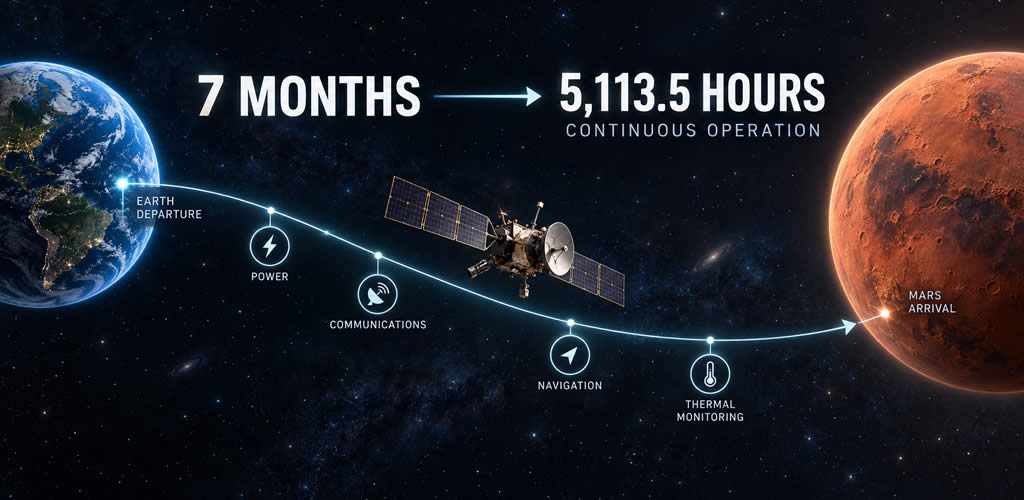
NASA notes that a journey to Mars typically takes seven to ten months, depending on the spacecraft and its trajectory. Throughout that time, onboard systems must operate reliably without any possibility of in‑flight repairs.
Seven Months Become More Than 5,000 Hours
This Months to Hours converter uses an average Gregorian month of 30.4375 days, equal to 730.5 hours. A seven‑month estimate can therefore be converted as:
7 months × 730.5 hours = 5,113.5 hours
A journey that sounds simple when described as "seven months" actually represents more than 5,000 hours of power management, thermal control, navigation and communication.
Perseverance: From a Rounded Description to an Exact Timeline
NASA's Perseverance rover launched on 30 July 2020 and landed on Mars on 18 February 2021. The mission is often described as a seven‑month trip, but counting the exact elapsed days between those two dates gives 203 days, consistent with NASA's own mission overview, which describes the cruise as lasting "about six-and-a-half months."
Converted into hours, that exact duration becomes:
203 days × 24 hours = 4,872 hours
This number is lower than the 5,113.5‑hour estimate produced from seven average months. There is no conflict: "seven months" is a rounded public description, while 203 days is the precise elapsed time.
Calendar months vary from 28 to 31 days. Average‑month conversions are useful for estimates and comparisons, but exact departure and arrival dates should be used when precision matters.
What Happens During Those Thousands of Hours?
Interplanetary cruise is an active phase of a mission. Controllers monitor spacecraft health while onboard systems regulate temperature, distribute electrical power and maintain communications. Teams also analyse tracking data and may command trajectory corrections to ensure the spacecraft reaches its intended destination.
Some operations occur at scheduled times after launch. Others repeat throughout the flight. Hours provide a practical unit for organising these events, estimating equipment use and recording how long each system has operated.
The Destination Is Moving
A spacecraft cannot aim at the position where Mars appears on launch day. Earth and Mars continue moving around the Sun, so planners design a route toward the position Mars will occupy months later.
NASA explains that favourable launch opportunities occur about once every 26 months. These windows allow a more energy‑efficient journey. The chosen launch date and trajectory help determine how many months — and therefore how many hours — the cruise will require.
Using the Converter: Months to Hours
To convert an estimated number of months to hours, multiply by 730.5:
Hours = months × 730.5
For an estimated eight‑month mission:
8 months × 730.5 = 5,844 hours
The calculation does not predict the spacecraft's exact arrival date. Instead, it translates a broad duration into a smaller unit that is useful for comparisons, operating records and early planning.
Describing a Mars mission in months helps people picture the length of the voyage. Expressing it in hours reveals another side of the story: a robotic explorer must remain powered, monitored and on course for thousands of consecutive hours before it can begin working on another planet.