Use the instant converter above for a direct minutes-to-weeks result, then continue with the planner below to arrange a large minute total across recurring sessions. It estimates weekly commitments, missed time, completion dates and the pace required to meet a deadline, while the eclipse example demonstrates why active preparation time and elapsed calendar time are different measurements.
Minutes to Weeks Completion Planner
Enter the total work or learning time, any minutes already completed, the length of one session and the number of sessions planned each week. The calculator can estimate a finish or work backwards from a deadline. It also allows for missed sessions, compares alternative schedules and updates instantly.
10,000 minutes require 167 one-hour sessions: 33 complete weeks and 2 sessions in the following week.
0 of 10,000 minutes completed
- Scheduled completion
- Week 34
- Estimated completion week begins
- —
How the completion plan was calculated
| Schedule | Weekly minutes | Estimated duration |
|---|
Planning note: A week is treated as exactly 10,080 minutes. Scheduled results are estimates: missed sessions are distributed as an average, and a completion date cannot be exact without selecting particular activity days.
How to Convert Minutes to Weeks
A standard week contains seven days, each day contains 24 hours and each hour contains 60 minutes:
1 week = 7 × 24 × 60 = 10,080 minutes
Divide the minute value by 10,080:
Weeks = minutes ÷ 10,080
For example, 20,160 ÷ 10,080 = 2 weeks. This is a fixed elapsed-time conversion. It is different from asking how many calendar weeks a recurring schedule will require.
Continuous Time Versus Scheduled Weeks
Ten thousand minutes equals approximately 0.9921 continuous weeks because it is slightly less than the 10,080 minutes in one uninterrupted week. However, completing those minutes through five one-hour sessions per week takes 167 sessions and extends into schedule week 34. Both answers are correct, but they describe different questions.
Minutes to Weeks Conversion Table
| Minutes | Hours | Weeks |
|---|---|---|
| 60 min | 1 h | 0.005952 weeks |
| 300 min | 5 h | 0.029762 weeks |
| 600 min | 10 h | 0.059524 weeks |
| 1,000 min | 16.6667 h | 0.099206 weeks |
| 1,440 min | 24 h | 0.142857 weeks |
| 2,880 min | 48 h | 0.285714 weeks |
| 5,000 min | 83.3333 h | 0.496032 weeks |
| 10,000 min | 166.6667 h | 0.992063 weeks |
| 10,080 min | 168 h | 1 week |
| 20,160 min | 336 h | 2 weeks |
| 40,320 min | 672 h | 4 weeks |
Minutes of an Eclipse, Weeks of Preparation
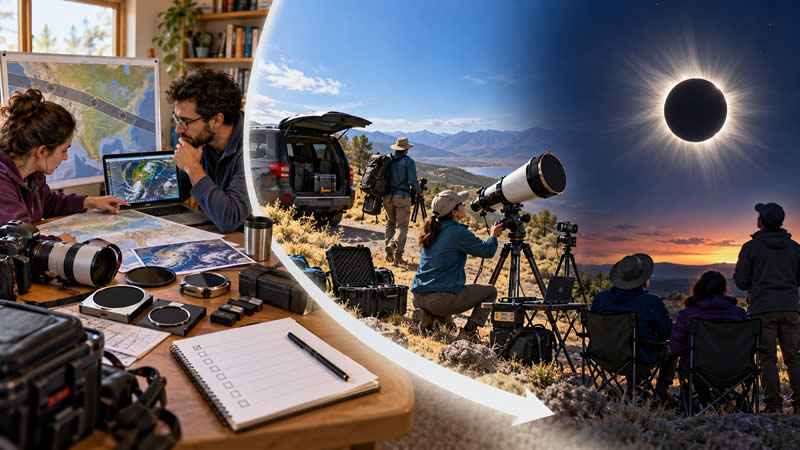
Totality during a total solar eclipse may last only seconds or a few minutes at a particular location. For an observing team, that brief interval may be preceded by weeks of site research, travel arrangements, equipment checks and carefully timed practice.
Comparing the Preparation Window with Totality
Imagine that a team begins planning four weeks before an eclipse and expects about three minutes of totality at its chosen location. Four elapsed weeks equal:
4 × 10,080 = 40,320 minutes
The elapsed preparation window is therefore 13,440 times as long as the three-minute event. This dramatic ratio compares calendar duration—not active labour. If the group practises for 90 minutes on 14 days, its active preparation is 1,260 minutes, or 0.125 continuous weeks.
This distinction is exactly what the planner demonstrates. A minute total can be converted directly into uninterrupted weeks, or distributed through recurring sessions across a much longer calendar period.
Why Rehearsal Matters
Cameras, telescopes and timing routines should be tested before the event. The American Astronomical Society recommends practising eclipse photography in advance while following the required solar-filter precautions. A timed rehearsal can reveal a loose cable, an inaccessible control or a checklist that takes longer than expected.
Weather remains uncertain, so planners may investigate backup locations and safe travel options. Preparation cannot guarantee clear skies, but it can reduce avoidable problems during a short observation window that cannot be restarted.
Solar-Eclipse Safety Comes Before the Schedule
Except during the brief total phase of a total solar eclipse, NASA states that it is unsafe to look directly at the Sun without specialised solar-viewing protection. Partial and annular eclipses have no safe unfiltered viewing period. Cameras, binoculars and telescopes require appropriate solar filters secured over the front of their optics; ordinary sunglasses are not suitable.
Anyone planning an observation should follow current guidance for the exact event and location. A time conversion or rehearsal checklist cannot determine when eye protection may safely be removed or replaced.