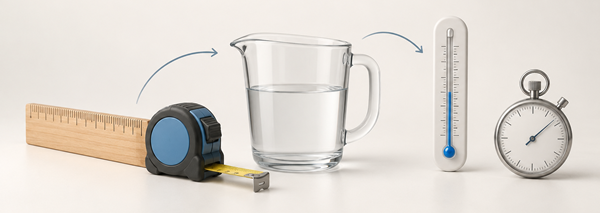
Use this minutes-to-seconds converter to express a time measurement in seconds. The conversion is based on the exact relationship between minutes and seconds.
Minutes to Seconds Conversion Formula
Every minute contains exactly 60 seconds:
1 min = 60 s
To convert minutes to seconds, multiply the number of minutes by 60:
Seconds = Minutes × 60
For example, to convert 4 minutes to seconds, calculate 4 × 60 = 240 seconds.
Minutes to Seconds: How Our Everyday Time Units Developed
A minute feels like a natural part of a clock, but neither minutes nor seconds began with mechanical timepieces. Their story developed through astronomy, mathematics and language long before clocks could measure such short intervals accurately. That history also explains why a modern Minutes to Seconds Converter uses 60 rather than a decimal factor such as 10 or 100.
Why time is divided into groups of 60
The numerical framework is commonly connected with ancient Mesopotamian mathematics. Babylonian scholars used a sexagesimal, or base-60, number system for calculations involving astronomy and geometry. Sixty was especially useful because it can be divided evenly by 2, 3, 4, 5, 6, 10, 12, 15, 20 and 30, making many fractions easier to express.
This mathematical tradition passed through later Greek, Arabic and Latin scholarship. Astronomers divided angles into progressively smaller parts, and the same pattern was eventually used to describe portions of an hour. The modern clock therefore preserves a very old mathematical convention: an hour contains 60 minutes, and each minute contains 60 seconds.
This base-60 relationship is the foundation of every Minutes to Seconds conversion. To convert minutes to seconds, the number of minutes is multiplied by 60.
Where the words "minute" and "second" came from
Medieval Latin scholars referred to a first small division as pars minuta prima, meaning approximately "first diminished part." This expression supplied the name minute.
Dividing that small part once more produced the pars minuta secunda, or "second diminished part." The final word of that expression became the English name second. The names therefore describe the first and second successive divisions by 60.
1 hour = 60 minutes = 3,600 seconds
Clocks had to catch up with the mathematics
Astronomers could calculate with minutes and seconds before ordinary clocks could display them reliably. Early public clocks were useful for identifying the hour but were not accurate enough for a second hand to provide meaningful information.
Improvements in gears, escapements and clock construction gradually made minute hands practical. Pendulum clocks introduced during the seventeenth century produced much more regular timekeeping, making the measurement of seconds useful in observatories, laboratories and eventually homes.
How the second became an atomic unit
Time was once tied directly to Earth's motion. A second was treated as a fraction of a day, but Earth does not rotate at a perfectly uniform rate. That variation is small in everyday life, yet it matters when navigation, communications and scientific experiments require extremely stable time.
The modern definition instead fixes the frequency associated with a particular transition in an unperturbed caesium-133 atom at exactly 9,192,631,770 hertz. Atomic clocks realise the second by tuning an electronic oscillator to this atomic resonance. The complete definition is published by the International Bureau of Weights and Measures .
The second is an SI base unit. The minute is not an SI unit, but it is accepted for use with the SI and is defined as exactly 60 seconds, as shown in the BIPM SI Brochure .
Minutes and seconds now organise everyday activities ranging from cooking, exercise and examinations to transport schedules, music and video. Whenever people convert minutes to seconds, they are using a relationship inherited from an ancient counting system and maintained by one of the most precise standards in modern science.
Minutes to Seconds Conversion Table
The following table shows common Minutes to Seconds values. Because one minute contains exactly 60 seconds, multiply the duration in minutes by 60.
Seconds = minutes × 60
| Minutes (min) | Seconds (s) |
|---|---|
| 0.1 min | 6 s |
| 0.25 min | 15 s |
| 0.5 min | 30 s |
| 0.75 min | 45 s |
| 1 min | 60 s |
| 1.5 min | 90 s |
| 2 min | 120 s |
| 3 min | 180 s |
| 5 min | 300 s |
| 10 min | 600 s |
| 15 min | 900 s |
| 20 min | 1,200 s |
| 30 min | 1,800 s |
| 45 min | 2,700 s |
| 60 min | 3,600 s |
| 90 min | 5,400 s |
| 120 min | 7,200 s |
A Real-Life Minutes to Seconds Conversion in Olympic Swimming
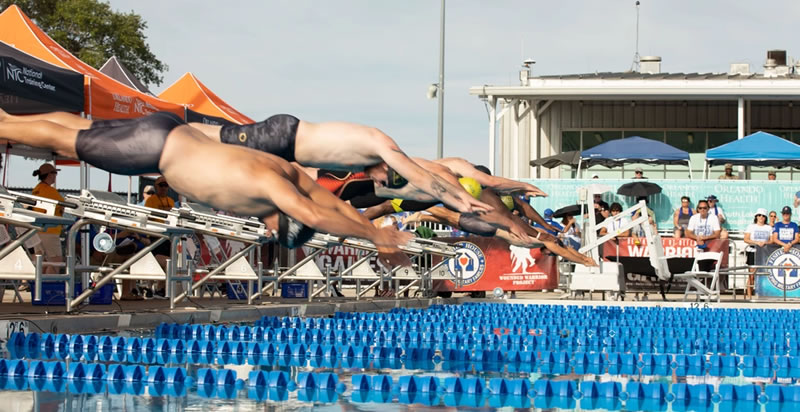
Olympic swimming provides an interesting real-life reason to convert minutes to seconds. At the first modern Olympic Games in 1896, Alfréd Hajós won the men's 100-metre freestyle in 1 minute 22.2 seconds. Writing the entire result in seconds makes it easier to compare with a modern race completed in less than one minute.
The Minutes to Seconds conversion begins by changing the complete minute into 60 seconds and then adding the remaining 22.2 seconds:
60 seconds + 22.2 seconds = 82.2 seconds
That early Olympic race was held in the open water of the Bay of Zea, rather than in a modern competition pool. The historical result of 1:22.2 is recorded by Olympedia and in World Aquatics Olympic statistics .
At the Paris 2024 Olympic Games, Pan Zhanle completed the same nominal distance in 46.40 seconds. Expressed as decimal minutes, his result was:
46.40 seconds ÷ 60 ≈ 0.7733 minutes
A Minutes to Seconds Converter lets both performances be compared using the same unit: 82.2 seconds for Hajós and 46.40 seconds for Pan. The numerical difference is:
82.2 seconds − 46.40 seconds = 35.8 seconds
This should not be treated as a controlled comparison between two swimmers. Hajós raced in open water, while Pan competed in a modern 50-metre pool under contemporary conditions. Training methods, stroke technique, pool design, starting equipment, clothing, officiating and electronic timekeeping also changed during the intervening 128 years.
Pan's official 46.40-second result is documented by World Aquatics . Together, these results provide a memorable example of how converting a mixed time into seconds can make performances from different periods easier to read and compare.