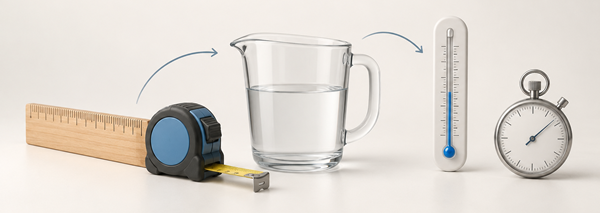
Convert minutes to average months for space missions, long projects, maintenance periods and other extended timelines. Enter a value for an instant result, review the formula and conversion table, and discover how minutes of rocket launch activity can begin a journey lasting months before a spacecraft reaches Mars.
Minute to Month Conversion Formula
The conversion formula is:
1 min = 0.0000228310502283105 Month
Or simply:
min × 0.0000228310502283105 = Month
This conversion uses fixed seconds-based factors: 1 min = 60 s and 1 Month = 2,628,000 s.
Common Minute to Month Conversions
| Minutes | Months |
|---|---|
| 1 min | 0.0000228311 months |
| 5 min | 0.0001141553 months |
| 10 min | 0.0002283105 months |
| 50 min | 0.0011415525 months |
| 100 min | 0.0022831050 months |
| 500 min | 0.0114155251 months |
| 1,000 min | 0.0228310502 months |
| 5,000 min | 0.1141552511 months |
| 10,000 min | 0.2283105023 months |
These values use an average month of 730 hours, equal to 43,800 minutes. Calendar months vary from 28 to 31 days.
Minutes to Launch, Months to Reach Mars
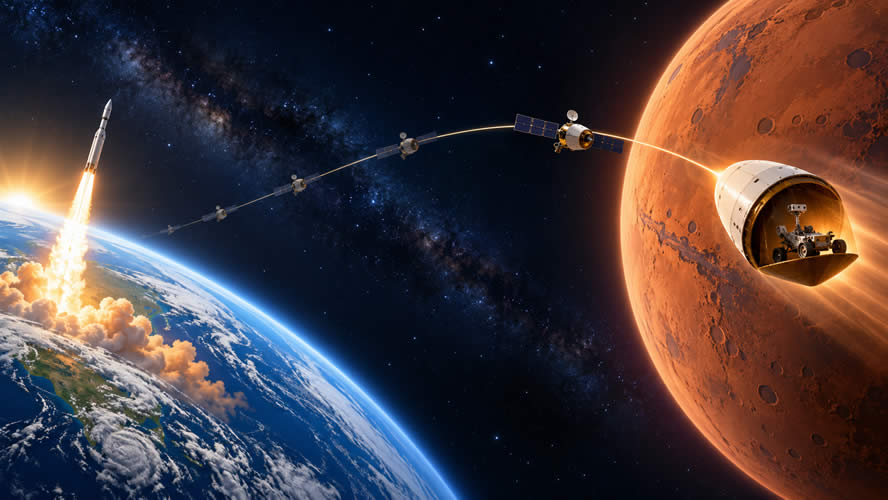
A rocket launch is one of the most dramatic parts of a Mars mission, but it is also one of the shortest. Engines ignite, the vehicle rises through the atmosphere and its stages separate according to a carefully timed sequence. Within minutes, the spacecraft is travelling away from Earth. Reaching Mars, however, takes months.
The First Hour of a Much Longer Journey
NASA’s Perseverance rover launched on 30 July 2020 aboard an Atlas V rocket. The spacecraft and the rocket’s upper stage remained connected for approximately 50 to 60 minutes after liftoff. Once they separated, Perseverance continued towards Mars independently.
That first hour involved enormous speed, heat and mechanical force, but it represented only the opening of the journey. Perseverance required 203 days to travel from Earth to Mars—a little under seven average months.
NASA describes this extended period as the cruise phase. During the cruise, mission controllers monitored the spacecraft, checked its systems and used planned trajectory corrections to keep it heading towards the correct arrival point. More information is available in NASA’s Mars 2020 launch mission overview .
Converting Minutes into Months
Comparing a launch measured in minutes with a voyage measured in months requires an agreed definition of a month. Calendar months have different lengths, so this converter uses an average month of 730 hours.
1 average month = 730 hours = 43,800 minutes
To convert minutes to average months, divide the number of minutes by 43,800:
Months = minutes ÷ 43,800
Under this definition, a seven-month journey contains approximately:
7 × 43,800 = 306,600 minutes
By comparison, a 60-minute launch and separation sequence equals:
60 ÷ 43,800 ≈ 0.00137 months
A minutes to months converter makes the contrast clear: the spacecraft can leave its launch vehicle within about an hour, yet hundreds of thousands of additional minutes pass before it reaches Mars. People searching for a converter minutes to months can use this relationship for mission timelines, long projects and other durations that cross from small time units into much larger ones.
Why Does the Journey Take So Long?
A spacecraft does not travel towards the place where Mars appears at the moment of launch. Earth and Mars are both moving around the Sun, so engineers plan a curved path that meets Mars at a future position. Launch dates are selected when the planets and the spacecraft’s possible trajectory are favourably aligned.
The spacecraft must also arrive with the correct position and direction for its planned entry or orbital manoeuvre. Flying faster is not the only consideration: the available launch energy, spacecraft mass, fuel, navigation requirements and intended arrival date all influence the route.
Months of Travel End in Minutes of Landing
After its long cruise, Perseverance reached Mars on 18 February 2021. Entry, descent and landing then unfolded in approximately seven minutes. The spacecraft had to slow from interplanetary speed, pass through the atmosphere and place the rover safely on the surface.
Because signals take time to travel between Mars and Earth, the spacecraft could not wait for controllers to respond to every event. The landing sequence was performed autonomously using commands and software prepared before arrival. NASA provides an illustrated account in its Perseverance entry, descent and landing profile .
The mission therefore contains two striking time contrasts. It takes minutes to leave Earth and minutes to descend onto Mars, but the distance between those events is crossed over many months. Converting the entire timeline into minutes reveals the scale of the journey hidden between launch and landing.