Convert a duration from hours to seconds. This is useful when a calculation, timer, experiment, or computer program needs time expressed in seconds.
Hours to Seconds Formula
One hour contains 60 minutes, and each minute contains 60 seconds:
1 h = 60 min × 60 s/min = 3,600 s
This is an exact relationship. The NIST Guide to the SI lists one minute as 60 seconds and one hour as 60 minutes, or 3,600 seconds. The same relationships are documented in the International Bureau of Weights and Measures SI Brochure .
To convert hours to seconds, multiply the number of hours by 3,600:
Seconds = hours × 3,600
Written as a unit conversion:
Hours × (3,600 seconds ÷ 1 hour) = seconds
Example: Convert 2.5 hours to seconds
Multiply 2.5 by 3,600:
2.5 h × 3,600 s/h = 9,000 s
Therefore, 2.5 hours equals exactly 9,000 seconds.
Converting Hours and Minutes to Seconds
If a duration includes both hours and minutes, convert each part separately and then add the results.
Example: Convert 1 hour and 20 minutes
First, convert the hour:
1 × 3,600 = 3,600 seconds
Next, convert the 20 minutes:
20 × 60 = 1,200 seconds
Add the two results:
3,600 + 1,200 = 4,800 seconds
Hours to Seconds Conversion Table
| Hours (h) | Seconds (s) |
|---|---|
| 0.1 h | 360 s |
| 0.25 h | 900 s |
| 0.5 h | 1,800 s |
| 0.75 h | 2,700 s |
| 1 h | 3,600 s |
| 1.5 h | 5,400 s |
| 2 h | 7,200 s |
| 2.5 h | 9,000 s |
| 3 h | 10,800 s |
| 4 h | 14,400 s |
| 5 h | 18,000 s |
| 8 h | 28,800 s |
| 10 h | 36,000 s |
| 12 h | 43,200 s |
| 24 h | 86,400 s |
| 48 h | 172,800 s |
| 72 h | 259,200 s |
Payday Before Payroll Software: From Hours of Arithmetic to Seconds of Processing
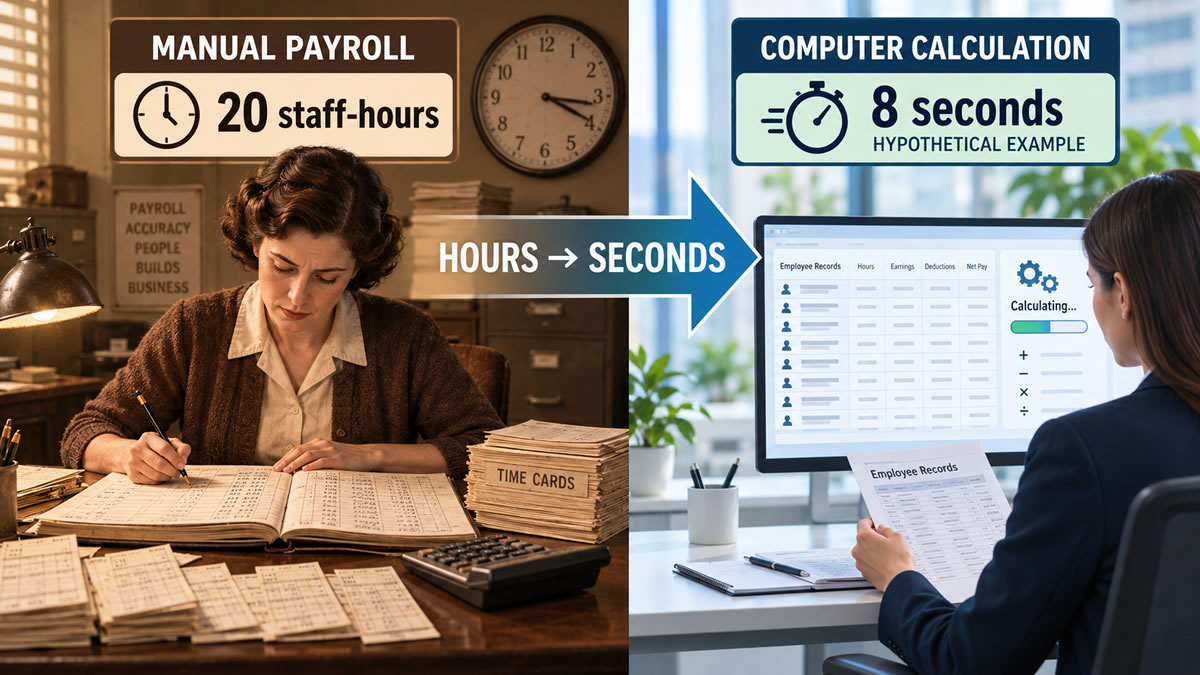
Imagine a payroll office preparing for payday. Across the desks are employee time cards, overtime records, bonus notes and deduction tables. Every worker must receive the correct amount, but each record has to be examined and calculated separately.
Before computerised payroll, much of this work was completed manually. A clerk might begin with an employee's ordinary hours, add overtime at the appropriate rate, include any additional payments and subtract the required deductions. The result would then be entered into a ledger or transferred to a payslip.
Calculating one employee's pay might not take long. Repeating the process accurately across an entire workforce was the real challenge.
Two Minutes per Employee Quickly Become Staff-Hours
Consider a hypothetical factory employing 600 people. If checking and calculating each employee's record takes an average of two minutes, the complete workload would be:
600 × 2 minutes = 1,200 minutes
Convert those minutes into hours:
1,200 ÷ 60 = 20 staff-hours
One clerk working consecutively would need approximately 20 hours. A team of four could divide the work and potentially complete it in about five hours, although the payroll would still consume approximately 20 combined staff-hours.
Real payroll work could take longer. Missing time cards had to be found, unclear entries investigated and corrections carried through to later totals. The completed figures also needed to be reviewed before payment could be approved.
What Payroll Software Does Differently
Payroll software does not read paper records individually like a clerk. It receives structured information and repeatedly applies stored rules: add the working hours, apply the relevant pay rate, calculate the deductions and save the result.
Once accurate employee data and payroll rules are available, a computer can perform the arithmetic for hundreds of records within a short time. To illustrate the difference in scale, suppose a particular system completes the calculation stage for all 600 employees in eight seconds.
This eight-second figure is a hypothetical teaching example, not a measured performance claim about a particular payroll product.
Converting the Manual Workload to Seconds
To compare the two example durations, first convert 20 hours to seconds:
20 × 60 × 60 = 72,000 seconds
Then compare 72,000 seconds with the hypothetical eight-second calculation:
72,000 ÷ 8 = 9,000
In this simplified model, the computer calculation is 9,000 times faster than one person performing the estimated manual work consecutively.
This ratio should not be interpreted as a universal payroll benchmark. Processing speed varies with the software, hardware, integrations, number of employees and complexity of the payroll rules. The manual estimate also includes checking each record, while the computer example represents only the calculation stage.
An Eight-Second Calculation Is Not an Eight-Second Payroll
The calculation engine handles only one part of payroll. Working hours, pay rates and employee details must first be collected and checked. Afterwards, payroll staff still need to investigate unusual results, approve totals and arrange the transfer of money.
A computer cannot independently determine whether every input is sensible. If an employee is accidentally recorded as working 180 hours instead of 18, the software may produce a mathematically consistent but incorrect payment. Automated checks can flag unusual values, but a person must normally investigate and correct the source information.
Modern payroll therefore combines two different strengths. Computers perform repetitive calculations quickly and consistently, while people review exceptions, correct inaccurate records and take responsibility for approving the results.
Why Use an Hours to Seconds Conversion?
Manual payroll work is naturally described in hours because people process records one at a time. Computer execution is often described in seconds because electronic calculations happen on a much shorter timescale.
To convert hours to seconds, multiply the number of hours by 3,600. The NIST Guide to the SI confirms that one hour equals 3,600 seconds.
An hours to seconds converter places both durations on the same scale. Comparing 20 hours with eight seconds gives a general impression of the difference, but comparing 72,000 seconds with eight seconds makes the numerical relationship clear.
Payroll software did not remove the responsibility involved in paying employees. It reduced much of the repetitive arithmetic from a task measured in staff-hours to one measured in processing seconds, leaving payroll professionals to concentrate on verification, exceptions and approval.