Use the instant converter above to change whole or decimal hours into minutes. Then continue with the planner below to divide that time into appointments, lessons or work sessions, allow for breaks and reserved time, measure daily utilisation and build a one-day timetable. The guide also uses phone charging to show why a duration may be described in hours in one context and minutes in another.
Hours to Minutes Schedule and Session Planner
Converting available hours to minutes makes it easier to arrange activities that have a fixed duration. Enter the daily time available, the number of days, the length of each session and the break required between sessions. Results update instantly.
7 sessions fit into an 8-hour day after reserving 30 minutes, with 45 schedulable minutes unused.
- Scheduled time
- 6 hours 45 minutes
- Unused schedulable time
- 45 minutes
How the planner calculated the result
One-day session timeline
Swipe sideways to view the complete timeline.
| Session | Start | Finish | Break after |
|---|
Reserved and unused time are not positioned on this timeline. Place those periods where they belong in the real day—for example, lunch may occur between two sessions rather than before the first one.
Planning note: This is a capacity estimate. Real schedules may also require setup, cleaning, travel, meal breaks, overruns or different opening hours. Add those periods to the session or break fields where appropriate.
How to Convert Hours to Minutes
One hour contains exactly 60 minutes. Multiply the number of hours by 60:
Minutes = hours × 60
For example, 2.5 hours × 60 = 150 minutes. If a duration already contains additional minutes, convert the hours first and add the remainder. Three hours and 20 minutes becomes (3 × 60) + 20 = 200 minutes.
Why Decimal Hours Can Be Misread
A decimal fraction of an hour is based on 60 minutes, not 100. Consequently, 2.30 hours is not 2 hours 30 minutes:
0.30 × 60 = 18 minutes
The correct interpretation is 2 hours 18 minutes, or 138 minutes in total.
Hours to Minutes Conversion Table
| Hours | Minutes | Readable duration |
|---|---|---|
| 0.25 h | 15 min | 15 minutes |
| 0.5 h | 30 min | 30 minutes |
| 0.75 h | 45 min | 45 minutes |
| 1 h | 60 min | 1 hour |
| 1.25 h | 75 min | 1 hour 15 minutes |
| 1.5 h | 90 min | 1 hour 30 minutes |
| 1.75 h | 105 min | 1 hour 45 minutes |
| 2 h | 120 min | 2 hours |
| 2.5 h | 150 min | 2 hours 30 minutes |
| 3.5 h | 210 min | 3 hours 30 minutes |
| 4 h | 240 min | 4 hours |
| 6 h | 360 min | 6 hours |
| 8 h | 480 min | 8 hours |
| 12 h | 720 min | 12 hours |
| 24 h | 1,440 min | 1 day |
From an Hours-Long Charge to a Short Morning Top-Up
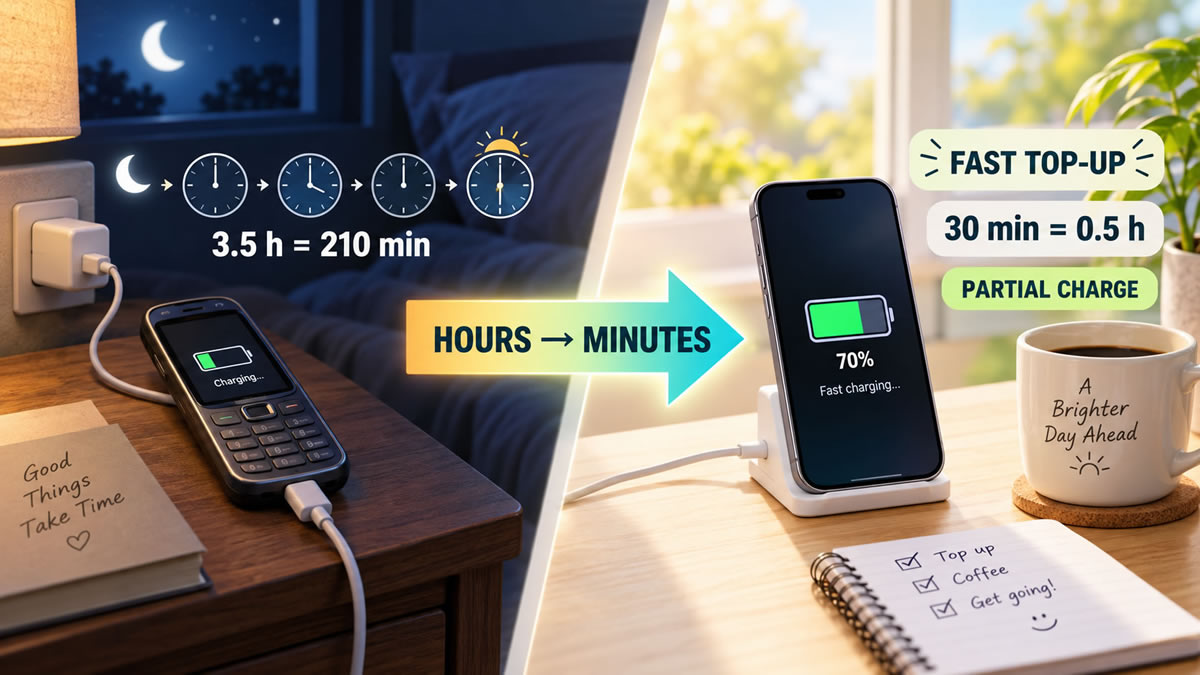
Phone charging offers a familiar example of why the same duration may be expressed in hours or minutes. A long session is naturally described as 3.5 hours, while a short top-up is easier to understand as 20 or 30 minutes.
A Longer Charging Session
Consider an illustrative older phone-and-charger combination requiring 3.5 hours for a charging session. Converting the duration gives:
3.5 × 60 = 210 minutes
A 210-minute wait is inconvenient during a busy morning but easy to place inside an overnight routine. This is an example rather than a specification for every older device: actual time depends on battery capacity, starting charge, charger output, cable, temperature and use during charging.
A Modern Partial Fast Charge
Apple states that compatible iPhone models can reach approximately 50% battery in around 30 minutes with suitable equipment and under its stated test conditions. Thirty minutes equals 0.5 hour.
This does not mean every phone becomes completely charged in half an hour. It describes a partial charge on compatible hardware, and actual results vary with the model, adapter, settings, use and environment. The useful comparison is therefore one of available time: a top-up measured in minutes can fit into a morning routine that cannot accommodate a multi-hour session.
Why Charging Time Is Not a Simple Linear Estimate
A phone controls how much power it accepts. USB Power Delivery allows a compatible device and power source to manage delivery, but the connector shape alone does not guarantee a particular charging rate. The phone, adapter and cable must support the relevant method and power level.
Charging can also slow as the battery fills or if temperature conditions require protection. Therefore, a claim of 50% in 30 minutes should not be doubled into an unsupported promise of 100% in 60 minutes.
| Charging period | Hours | Minutes |
|---|---|---|
| Long illustrative session | 3.5 h | 210 min |
| Two-hour session | 2 h | 120 min |
| One-hour top-up | 1 h | 60 min |
| Half-hour top-up | 0.5 h | 30 min |
| Short top-up | 0.25 h | 15 min |
Converting hours to minutes standardises the time values; it does not by itself measure energy delivered or battery percentage gained. A controlled comparison would also need the same phone, battery condition, starting and target percentages, charger, cable, temperature and workload.