
Use this Days to Years converter to express a large number of days as an equivalent duration in years. The conversion is useful for long-running projects, scientific missions, historical records and other timelines initially recorded in days. NASA's Opportunity rover provides a remarkable example: a mission planned for 90 Martian sols ultimately produced approximately 5,250 Earth days, or 14.37 years, of surface operations.
Day to Year Conversion Formula
The conversion formula is:
1 d = 0.0027378507871321 y
Or simply:
d × 0.0027378507871321 = y
This conversion uses fixed seconds-based factors: 1 d = 86,400 s and 1 y = 31,557,600 s.
Day to Year Conversion Table
| Days | Years |
|---|---|
| 1 day | 0.002738 years |
| 10 days | 0.027379 years |
| 30 days | 0.082136 years |
| 60 days | 0.164271 years |
| 90 days | 0.246407 years |
| 100 days | 0.273785 years |
| 180 days | 0.492813 years |
| 365 days | 0.999316 years |
| 366 days | 1.002053 years |
| 730 days | 1.998631 years |
| 1,000 days | 2.737851 years |
| 1,095 days | 2.997947 years |
| 1,825 days | 4.996578 years |
| 3,650 days | 9.993155 years |
| 5,250 days | 14.373717 years |
| 10,000 days | 27.378508 years |
These values use an average year of 365.25 days. An exact calendar interval can differ because common years contain 365 days and leap years contain 366 days.
Opportunity: The 90‑Day Mars Rover That Worked for More Than 14 Years
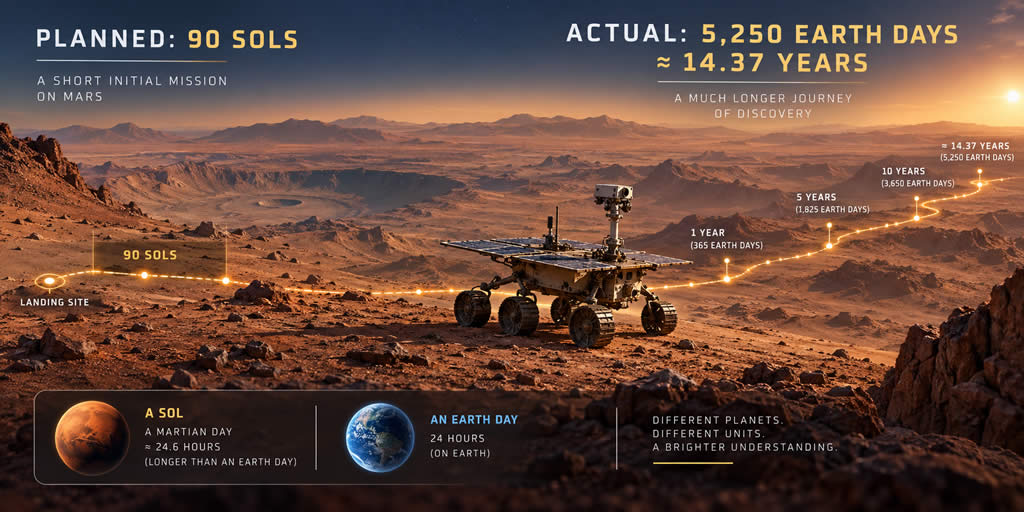
NASA launched the Opportunity rover with a primary mission measured in days. Its job was to study Martian rocks and soil for clues about ancient water activity. If everything went well, the rover needed to operate for 90 Martian days.
Opportunity far exceeded that expectation. It continued exploring long after its planned timeline, eventually reaching an operating history that could no longer be described meaningfully in days alone. A mission designed for a single season of work grew into more than 14 Earth years of discovery.
Martian Days and Earth Days Are Different
A Martian solar day is called a sol. Each sol lasts about 24 hours and 39 minutes — roughly 39 minutes longer than an Earth day.
Opportunity's original target was 90 sols. NASA's Jet Propulsion Laboratory notes that this duration is equivalent to approximately 92.4 Earth days .
This difference matters when using a Days to Years converter. A mission measured in sols must first be translated into Earth days before it can be compared with Earth years.
From 90 Sols to 5,110 Sols
Opportunity landed in Meridiani Planum in January 2004. After completing its initial assignment, the rover remained capable of driving, taking photographs and analysing new geological targets.
Engineers continued planning safe routes and managing the rover's limited solar power, while scientists selected fresh areas for exploration. Instead of stopping after 90 sols, Opportunity ultimately accumulated 5,110 sols.
NASA records this operating period as approximately 5,250 Earth days .
Converting Opportunity's Days Into Years
To convert days to years using an average year of 365.25 days, divide the number of Earth days by 365.25:
5,250 days ÷ 365.25 ≈ 14.37 years
Expressed another way, Opportunity's active surface mission lasted roughly 14 years and 135 days when the fractional year is converted using the same average‑day convention.
Each measurement serves a different purpose. 5,250 days shows the mission's duration in a precise unit, while 14.37 years makes its extraordinary length easier to appreciate.
How the Rover Survived Beyond Its Planned Mission
Opportunity generated electricity through solar panels. The mission team had to balance driving, communication, scientific observations and heating against the limited power available from sunlight.
Dust gradually accumulated on the panels, but occasional Martian winds cleared some of it and improved their performance. These favourable events helped extend the mission, while careful route planning and power management allowed the rover to continue working despite its age.
Longevity did not mean Opportunity remained unchanged. Components aged, available energy fluctuated and each movement had to be planned with the rover's condition in mind. Its long life was the result of robust engineering, environmental assistance and sustained effort from the mission team.
A Dust Storm Brought the Exploration to an End
A massive Martian dust storm developed in 2018, severely reducing the sunlight reaching Opportunity's solar panels. The rover sent its final signal on 10 June 2018.
NASA attempted to re‑establish contact for several months before declaring the mission complete on 13 February 2019. Because the announcement occurred more than 15 years after landing, some accounts describe the overall mission as lasting 15 years.
Both descriptions are accurate when their meanings are clear:
- Approximately 14.37 years describes the 5,250 Earth days of surface operation.
- More than 15 calendar years describes the period from landing to NASA's formal conclusion.
What Opportunity Added to Mars Science
Opportunity travelled more than 28 miles across Mars — far beyond its original distance target of about 1,100 yards. Its study of rocks, minerals and landscape features provided evidence that liquid water once influenced parts of ancient Mars.
NASA's Opportunity mission overview documents the rover's route, discoveries and engineering achievements.
Why This Mission Belongs in a Days‑to‑Years Conversion
A unit conversion does not change the amount of time that passed — it changes the scale used to describe it. Opportunity's operating life can be stated as 5,250 Earth days, but most readers can picture 14.37 years more easily.
This is where a Days to Years converter becomes helpful: it turns a large daily total into a duration that is easier to compare with careers, projects and historical events. In Opportunity's case, the conversion highlights how a mission planned for a few months became more than a decade of exploration.