
Convert days to weeks for renovation schedules, delivery times, project plans and other everyday timelines. Enter a number of days for an instant result, or explore the formula, conversion table and practical home-renovation example below.
Day to Week Conversion Formula
The conversion formula is:
1 d = 0.142857142857143 Week
Or simply:
d × 0.142857142857143 = Week
This conversion uses fixed seconds-based factors: 1 d = 86,400 s and 1 Week = 604,800 s.
Days to Weeks Conversion Table
| Days | Weeks |
|---|---|
| 1 day | 0.1429 weeks |
| 7 days | 1 week |
| 14 days | 2 weeks |
| 21 days | 3 weeks |
| 28 days | 4 weeks |
| 35 days | 5 weeks |
| 42 days | 6 weeks |
| 49 days | 7 weeks |
| 56 days | 8 weeks |
| 70 days | 10 weeks |
| 84 days | 12 weeks |
| 140 days | 20 weeks |
| 182 days | 26 weeks |
| 280 days | 40 weeks |
| 350 days | 50 weeks |
| 364 days | 52 weeks |
| 700 days | 100 weeks |
How Days of Renovation Work Become a Project Lasting Weeks
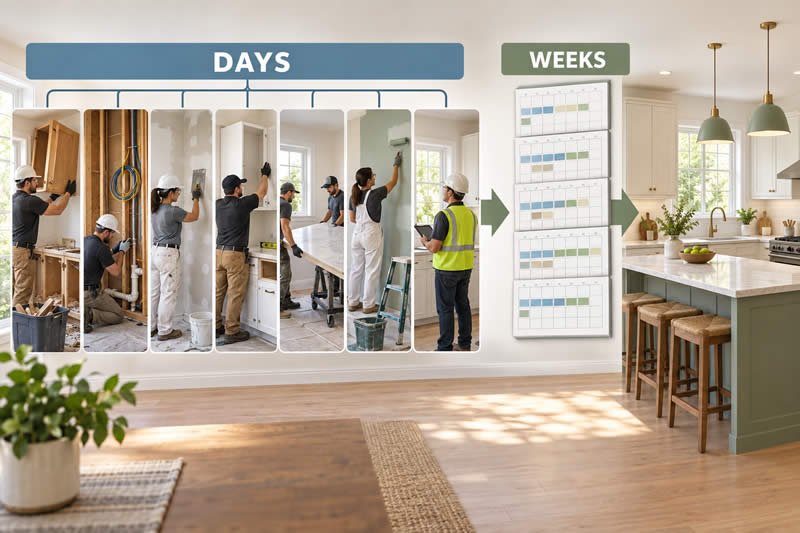
Renovation projects are built from many small pieces. One task might take a single day, another might require several days, and some materials may need time to arrive or be fabricated. Once all of these individual steps are arranged in the correct order, the full programme is usually described in weeks rather than days.
Take a kitchen renovation as an example. Removing the old units may be finished quickly, but new cabinets cannot be installed until the room is prepared. The worktop may then depend on measurements taken only after those cabinets are fixed in place. Each stage adds days to the calendar, even if the team is not working continuously.
A Renovation Is a Chain of Tasks
The example below shows how a builder might divide a project into daily activities. These durations are illustrative rather than guaranteed; every home, design and contractor schedule is different.
| Stage | Example duration |
|---|---|
| Removing the existing kitchen | 2 working days |
| Preparing plumbing and electrical services | 4 working days |
| Repairing walls and preparing the floor | 3 working days |
| Plastering and allowing surfaces to dry | 5 calendar days |
| Installing the cabinets | 5 working days |
| Measuring and fitting the worktop | 4 working days |
| Decorating, testing and completing details | 4 working days |
Altogether, these example stages contain 27 task days. That does not mean the kitchen will be finished 27 calendar days after work begins. Some days represent active labour, while others involve drying time, fabrication, or waiting for the next trade to arrive.
Why Task Days Spread Across the Calendar
Renovation tasks are linked by dependencies. A decorator cannot finish a newly repaired wall until it is dry, and a made‑to‑measure component cannot be produced until accurate measurements are available.
Availability also shapes the schedule. A plumber may complete one stage on Tuesday, while the electrician is booked for Thursday. A weekend may fall between them, or a delivery may be scheduled later than expected. These intervals extend the project without adding extra working days.
This is how 27 days of listed activities can occupy 42 calendar days from the first morning of work to final completion.
How to Convert Days to Weeks
To convert days to weeks, divide the number of calendar days by seven:
Weeks = days ÷ 7
For a project lasting 42 calendar days:
42 days ÷ 7 = 6 weeks
A days‑to‑weeks converter provides the same result instantly. Unless stated otherwise, this standard conversion uses seven‑day calendar weeks.
Working Days Need Separate Treatment
Calendar days and working days measure different things. Dividing 27 working days by seven would incorrectly treat weekends as working time. If the team normally works Monday to Friday, the active workload can be expressed as:
27 working days ÷ 5 = 5.4 working weeks
This shows how many five‑day working weeks the tasks represent. It still does not reveal the finish date, because availability, dependencies and non‑working intervals may spread those days across a longer period.
Deliveries Add Their Own Days
Renovation materials rarely arrive all at once. Cabinets, appliances, flooring and worktops may come from different suppliers on different dates. Some bespoke items can be ordered only after an earlier stage confirms their final dimensions.
If fabrication requires three days after measurement, those days become part of the elapsed programme. Other tasks may continue during that interval, but completion still depends on the item arriving and being installed.
Reading the Project in Two Ways
The daily schedule helps the builder coordinate trades, deliveries and access to the property. The weekly schedule helps the homeowner plan for disruption, temporary facilities and the expected completion period.
A project lasting six weeks is not one uninterrupted block of construction. It is a sequence of working days, waiting periods, deliveries and handovers. Converting days to weeks shows how those individual entries combine into the overall renovation timeline.