
Use this days to hours converter to change any duration from days into hours. Enter the number of days to receive the result instantly, based on 1 day = 24 hours.
Day to Hour Conversion Formula
The conversion formula is:
1 d = 24 h
Or simply:
Hours = days × 24
This conversion uses fixed time-unit relationships: 1 d = 86,400 s and 1 h = 3,600 s. The day and hour are non-SI units accepted for use with the International System of Units.
These definitions are documented in the NIST Guide to the SI and the BIPM SI Brochure . Both references specify that one hour equals 3,600 seconds and one day equals 24 hours, or 86,400 seconds.
Days to Hours Conversion Table
| Days | Hours |
|---|---|
| 0.25 d | 6 h |
| 0.5 d | 12 h |
| 1 d | 24 h |
| 2 d | 48 h |
| 3 d | 72 h |
| 4 d | 96 h |
| 5 d | 120 h |
| 7 d | 168 h |
| 10 d | 240 h |
| 14 d | 336 h |
| 30 d | 720 h |
| 60 d | 1,440 h |
| 90 d | 2,160 h |
| 365 d | 8,760 h |
London to New York: When a Journey Changed from Days to Hours
A modern traveller can leave London in the morning and arrive in New York later the same local day. A westbound flight typically lasts around eight hours, although winds, routing and airport operations can influence the exact duration.
Earlier travellers measured the same route very differently. Before commercial aviation, crossing the Atlantic meant spending days or weeks aboard a ship. Comparing these journeys provides a clear reason to convert days to hours: it places historical sea voyages and modern flights on the same time scale.
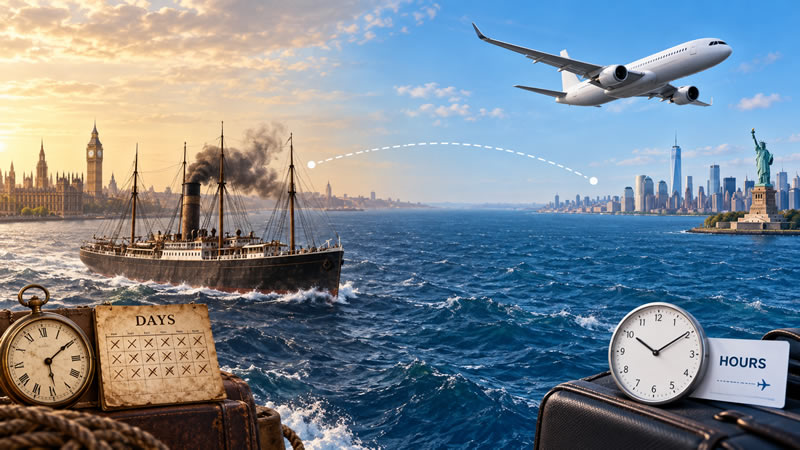
Crossing the Atlantic Under Sail
A traveller leaving London during the age of sail first needed to reach a departure port. The ocean crossing then depended on the ship, wind, currents, season and weather. A departure date could be planned, but the arrival remained uncertain.
Research from Royal Museums Greenwich notes that New York–Liverpool packet ships recorded crossings ranging from roughly 21 to 29 days in the early nineteenth century. Travel between London and the port, plus onward travel after arrival, added further time.
Passengers lived aboard the ship throughout the journey. They slept, ate and passed their days at sea while the vessel moved at a pace shaped partly by the weather. A storm or unfavourable wind could delay arrival by several days.
Steam Introduced More Predictable Schedules
Steamships reduced reliance on wind. In 1838, Isambard Kingdom Brunel's Great Western crossed from Bristol to New York in about 15.5 days. It remained a long journey, but it demonstrated that large steam-powered ships could operate successfully across the Atlantic.
The Royal Museums Greenwich account of the transition from sail to steam explains how steam power made dependable arrival schedules more achievable. As engines and ship design improved, ocean liners offered faster and more regular services.
The full London-to-New York journey still involved more than the ocean passage. Travellers needed transport to the port, time for boarding and immigration, and onward travel after arrival.
Putting a 15.5-Day Crossing into Hours
A days to hours converter helps compare historical journeys with modern flights. One day contains exactly 24 hours:
Hours = days × 24
For the Great Western example:
15.5 days × 24 = 372 hours
If a present-day nonstop flight takes about eight hours, the historical crossing lasted more than 46 times as long:
372 hours ÷ 8 hours = 46.5
This comparison is illustrative. Ship crossings varied with operating and weather conditions, and modern flight times also vary. The calculation simply places both journeys in hours so their durations can be compared directly.
The First Atlantic Flights Were Still Adventures
Aviation did not transform the route immediately. Early transatlantic aircraft had limited range and reliability, and some journeys required multiple stops.
The Smithsonian National Air and Space Museum records that the first completed transatlantic flight in 1919 took place in several stages over 24 days. Soon after, John Alcock and Arthur Brown completed a nonstop crossing in roughly 16 hours.
These pioneering flights were very different from scheduled passenger services. Crews faced navigation challenges, changing weather and aircraft that lacked the comfort and systems of modern airliners. Even so, they showed that the Atlantic could be crossed in hours rather than weeks.
Jet Aircraft Made Same-Day Arrival Routine
Commercial aircraft gradually became faster, more reliable and capable of flying longer distances. Jet engines, pressurised cabins, improved navigation and airport infrastructure helped turn the London–New York route into a routine nonstop service.
Travelling west also creates a time-zone effect. New York is several hours behind London, so a passenger may arrive on the same calendar day even after spending many hours in the air. The time difference does not shorten the flight; it simply changes the local time shown on arrival.
Concorde Reduced the Crossing Even Further
Supersonic Concorde briefly made the Atlantic seem smaller still. British Airways reports that a typical London–New York Concorde flight took a little under three and a half hours. Its fastest New York–London crossing, recorded in 1996, lasted 2 hours, 52 minutes and 59 seconds.
Details of these times appear in the British Airways history of Concorde . Concorde is no longer in passenger service, so current travellers typically make the crossing aboard subsonic aircraft.
Why the Days-to-Hours Conversion Matters
A days to hours conversion does more than replace one unit with another. In this story, it highlights the scale of technological change. A 15.5‑day steamship passage becomes 372 hours, which can be compared directly with an approximately eight‑hour modern flight.
The route still crosses the same ocean, but the traveller's relationship with time has changed. What was once an extended period of life aboard a vessel has become part of a single day. Converting the historical journey from days to hours makes that transformation easy to see.