Convert speeds from kilometres per hour to miles per hour. This is useful when driving abroad, reading vehicle specifications or comparing running and cycling speeds.
km/h to MPH Formula
One kilometre per hour equals approximately 0.6213711922 miles per hour:
1 km/h ≈ 0.6213711922 mph
To convert km/h to mph, multiply the speed by 0.6213711922:
Speed in mph = speed in km/h × 0.6213711922
Written with units:
km/h value × (0.6213711922 mph ÷ 1 km/h) = mph value
Example: Convert 100 km/h to mph
Multiply 100 by the conversion factor:
100 km/h × 0.6213711922 = 62.13711922 mph
Therefore, 100 km/h is approximately 62.14 mph.
Conversion-factor reference
The NIST Guide to the SI conversion factors lists one mile per hour as exactly 1.609344 kilometres per hour. Reversing that relationship gives approximately 0.6213711922 mph for one km/h.
The conversion can therefore also be performed by dividing by 1.609344:
Speed in mph = speed in km/h ÷ 1.609344
NIST identifies the kilometre per hour as a commonly used unit for vehicular speed in its guidance on SI-derived units .
km/h to mph Conversion Table
| Kilometres per Hour (km/h) | Miles per Hour (mph) |
|---|---|
| 5 km/h | 3.11 mph |
| 10 km/h | 6.21 mph |
| 20 km/h | 12.43 mph |
| 30 km/h | 18.64 mph |
| 50 km/h | 31.07 mph |
| 60 km/h | 37.28 mph |
| 80 km/h | 49.71 mph |
| 90 km/h | 55.92 mph |
| 100 km/h | 62.14 mph |
| 110 km/h | 68.35 mph |
| 120 km/h | 74.56 mph |
| 130 km/h | 80.78 mph |
How Dual-Scale Speedometers Help International Drivers
Road signs can change their measurement language at a national border even when the car, driver and physical speed remain exactly the same. A driver leaving the United States for Canada, for example, moves from speed limits expressed in miles per hour to signs displaying kilometres per hour.
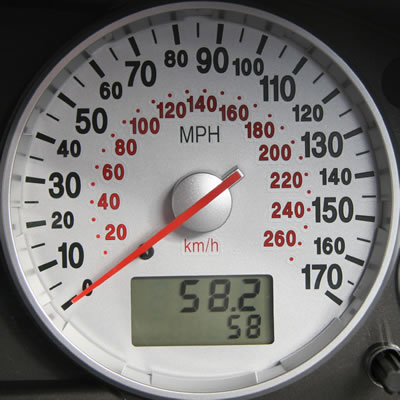
A dual-scale speedometer reduces the need for mental arithmetic by displaying mph and km/h together. Instead of converting every road sign while driving, the driver can look at the scale that matches the local signs.
One Needle, Two Readings
On an analogue dashboard, one set of numbers is usually more prominent. A vehicle produced primarily for the United States may display mph in larger figures and place km/h on a smaller inner scale. A model intended for a metric market may give km/h the more prominent position.
The needle does not make two separate measurements. Its position corresponds to both scales simultaneously. If it points to 60 mph on one scale, it will also indicate approximately 97 km/h on the other.
This arrangement is useful because the driver can read the locally used unit directly. There is no need to operate a calculator or attempt a detailed conversion in moving traffic.
Crossing from the United States into Canada
Imagine a driver approaching the Canadian border in a car whose main speedometer scale uses mph. Before the crossing, a sign showing 65 means 65 mph. After entering Canada, a sign displaying 100 represents 100 km/h instead.
Although 100 appears to be the larger number, the corresponding speed is only about 62 mph:
100 km/h × 0.621371 ≈ 62.14 mph
The driver can locate 100 on the smaller km/h scale and keep the needle at or below that point. The dual display prevents the visual size of the number from being mistaken for the vehicle’s relative speed.
On the return journey, the situation is reversed. A US sign showing 65 mph represents approximately 104.61 km/h:
65 mph × 1.609344 = 104.60736 km/h
The official relationship is exact: 1 mile equals 1.609344 kilometres. This conversion factor is documented in the NIST Guide to the SI .
Travelling Between Continental Europe and the UK
The same unit change can occur without leaving Europe. A driver travelling from France to the United Kingdom moves from roads signed in km/h to roads whose speed limits are expressed in mph.
The UK Department for Transport’s speed-sign guidance confirms that British speed-limit signs represent miles per hour. The circular signs normally show only a number, so visiting drivers must know which unit the country uses.
A driver familiar with a 50 km/h urban limit might encounter a British sign showing 30. These values are close equivalents:
30 mph × 1.609344 ≈ 48.28 km/h
Likewise, the UK motorway limit of 70 mph for cars under ordinary conditions corresponds to approximately 112.65 km/h. The current limit still depends on the road, vehicle and displayed signs, and a legal maximum is not a promise that the speed is safe in poor weather, heavy traffic or other difficult conditions.
Digital Dashboards Can Change Their Primary Unit
Digital instrument panels often replace the permanently printed second scale with a selectable display. Through the vehicle settings, a driver may be able to change the main reading from mph to km/h before crossing a border.
Depending on the vehicle, changing the unit may also update:
- the cruise-control or speed-limiter display;
- navigation distances and estimated arrival information;
- average-speed and trip-computer readings;
- speed-limit recognition shown on the dashboard; and
- head-up display speed information.
These features vary between models. A driver should consult the vehicle handbook and change display settings while safely parked rather than searching through menus on the road.
Imported vehicles are another common use case. A car manufactured for an mph market may later be registered in a country using km/h, or the reverse. A secondary scale or configurable display allows the driver to compare the vehicle’s reading with local signs.
Useful Road-Speed Comparisons
A dual-scale display handles the immediate comparison, but remembering a few approximate equivalents can make unfamiliar signs easier to understand.
| Kilometres per hour | Miles per hour | Possible driving context |
|---|---|---|
| 30 km/h | 18.64 mph | Low-speed or residential area |
| 50 km/h | 31.07 mph | Common urban comparison |
| 80 km/h | 49.71 mph | Regional-road comparison |
| 100 km/h | 62.14 mph | Higher-speed road comparison |
| 112.65 km/h | 70 mph | UK motorway-limit comparison |
These examples are unit comparisons, not universal speed limits. Drivers must follow the limit shown on the road and any restrictions applying to their vehicle.
Why Knowing the Conversion Still Helps
A dual-scale speedometer is most useful when the second scale is easy to read. On some analogue dashboards, however, the secondary numbers are small or partly obscured by the steering wheel. Familiar benchmark values can then help the driver interpret a sign more quickly.
- 30 mph is approximately 48 km/h.
- 50 mph is approximately 80 km/h.
- 60 mph is approximately 97 km/h.
- 70 mph is approximately 113 km/h.
- 50 km/h is approximately 31 mph.
- 80 km/h is approximately 50 mph.
- 100 km/h is approximately 62 mph.
- 120 km/h is approximately 75 mph.
These rounded values are useful for orientation, but the dashboard and local road signs should guide the driver. A speed limit is the maximum permitted under the applicable rules; road, traffic and weather conditions may require a lower speed.
Switching between mph and km/h does not alter the vehicle’s movement. It changes only the numerical language used to describe that movement. By showing both systems—or allowing the primary unit to be changed—a speedometer turns an international conversion into a quick visual comparison and leaves the driver free to concentrate on the road.