Convert pressure from pounds per square inch to bar. This is useful when a tyre gauge displays psi but your vehicle handbook or pressure label uses bar.
PSI to Bar Conversion Formula
One pound per square inch is equal to approximately 0.0689476 bar:
1 psi ≈ 0.0689475729 bar
To convert psi to bar, multiply the pressure by 0.0689475729:
Pressure in bar = pressure in psi × 0.0689475729
You can also divide the psi value by approximately 14.5038:
Pressure in bar = pressure in psi ÷ 14.5038
Example: Convert 30 psi to bar
Multiply 30 by the conversion factor:
30 psi × 0.0689475729 = 2.06843 bar
Rounded to two decimal places, 30 psi equals 2.07 bar.
Understanding PSI and Bar
PSI and bar both measure pressure, but they come from different measurement systems:
- PSI means pounds per square inch, or more precisely, pound-force per square inch.
- Bar is a metric pressure unit equal to 100,000 pascals.
PSI is widely used in the United States and appears on many pressure gauges. Bar is common on vehicles, equipment, and technical documents in countries that use metric units.
Common PSI to Bar Conversions
| Pounds per square inch (psi) | Bar |
|---|---|
| 15 psi | 1.03 bar |
| 20 psi | 1.38 bar |
| 25 psi | 1.72 bar |
| 29 psi | 2.00 bar |
| 30 psi | 2.07 bar |
| 31 psi | 2.14 bar |
| 32 psi | 2.21 bar |
| 33 psi | 2.28 bar |
| 34 psi | 2.34 bar |
| 35 psi | 2.41 bar |
| 36 psi | 2.48 bar |
| 40 psi | 2.76 bar |
| 45 psi | 3.10 bar |
| 50 psi | 3.45 bar |
| 58 psi | 4.00 bar |
| 100 psi | 6.89 bar |
Using PSI to Bar Conversion for Tyres
Vehicle tyre pressures may be listed in psi, bar, or kPa. If your gauge and vehicle label use different units, converting the reading allows you to compare them correctly.
Correct tyre pressure supports traction, handling, fuel efficiency, and tyre life. The right setting depends on the vehicle, tyre size, and load, so use the figure supplied by the vehicle manufacturer rather than relying on a general pressure range.
Tyre pressure is best checked when the tyres are cold because driving warms the tyres and can temporarily increase the reading.
A European Road Trip: When PSI Meets Bar
An American traveller collects a rental car for a journey through Europe. After several hours on the motorway, the tyre-pressure warning light appears. At the next filling station, the driver finds a digital air pump, but its display is set to bar rather than the familiar psi.
At home, the driver is accustomed to tyre pressures such as 32 or 35 psi. The European pump instead offers values such as 2.2, 2.4 and 2.5 bar. Those smaller-looking numbers do not represent lower pressure; they are simply values expressed in a differently sized unit.
Before entering anything into the pump, however, the driver needs to answer a more important question: what pressure does this particular rental car require?
Check the Car Before Converting the Number
A pressure remembered from another vehicle should not automatically be applied to a rental car. Different models—and sometimes the front and rear tyres on the same model—can have different recommended pressures.
The driver opens the door and finds the vehicle’s tyre-information label on the door pillar. It specifies a cold pressure of 2.4 bar for the current load. The label also presents an equivalent value close to 35 psi.
Recommended pressures may also appear in the owner’s manual, inside the fuel-filler flap or elsewhere specified by the manufacturer. Some labels provide separate settings for ordinary driving, a fully loaded car or sustained high-speed travel.
The National Highway Traffic Safety Administration’s tyre guidance advises using the pressure supplied by the vehicle manufacturer rather than the maximum pressure moulded into the tyre’s sidewall.
Converting 35 PSI to Bar
One pound-force per square inch equals approximately 0.0689476 bar. The driver can convert psi to bar by multiplying by this factor:
Pressure in bar = pressure in psi × 0.0689476
For a pressure of 35 psi:
35 × 0.0689476 = 2.41317 bar
Rounded to two decimal places, 35 psi equals 2.41 bar. A pump using one decimal place may display the corresponding setting as 2.4 bar.
The number has changed from about 35 to about 2.4, but the physical pressure has not changed. Bar is simply a larger unit than psi.
The conversion can be verified using the NIST pressure conversion tables . NIST lists one psi as approximately 6,894.757 pascals, while one bar equals exactly 100,000 pascals.
| PSI | Bar | Kilopascals |
|---|---|---|
| 29 psi | 2.00 bar | 200 kPa |
| 32 psi | 2.21 bar | 221 kPa |
| 35 psi | 2.41 bar | 241 kPa |
| 36 psi | 2.48 bar | 248 kPa |
| 40 psi | 2.76 bar | 276 kPa |
The table is provided for unit comparison only. It does not prescribe a suitable pressure for a particular vehicle.
Using the European Air Pump
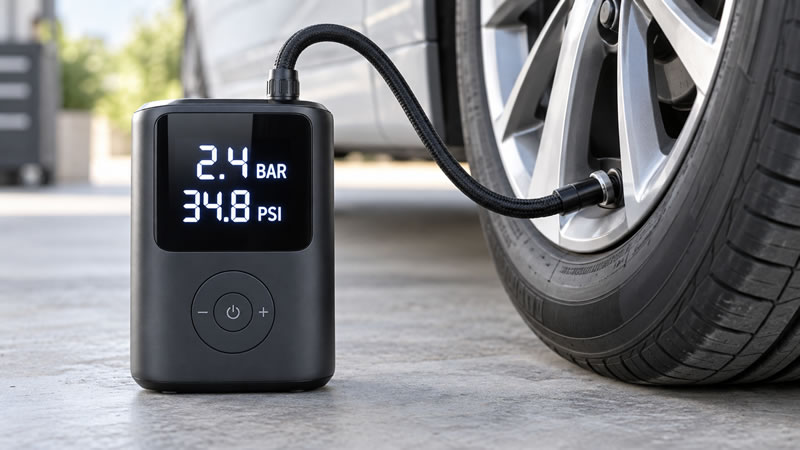
The driver selects bar on the machine and enters the value shown on the rental car’s label. Some modern pumps can switch between bar, psi and kilopascals, but others are configured primarily for the unit familiar in the local market.
PSI means pounds-force per square inch and remains familiar in the United States. Bar and kilopascals are frequently encountered on European vehicles and inflation equipment. This difference is why an otherwise simple task can feel unfamiliar during an international journey.
If the warning light appeared because one tyre had lost substantially more pressure than the others, adding air might not solve the underlying problem. A puncture, damaged valve or wheel problem may require inspection by a tyre professional.
Why a Warm Tyre Can Complicate the Reading
The vehicle has already travelled along the motorway, so its tyres are warm. As a tyre rolls, flexing and road friction generate heat. The warmer air inside produces a higher gauge reading than it would when the tyre was cold.
Vehicle manufacturers normally publish cold inflation pressures. NHTSA describes a cold tyre as one on a vehicle that has not been driven for at least three hours. Some manufacturers also permit only a very short, low-speed journey when determining whether a tyre is cold, so the vehicle handbook should take priority.
The driver should not release air merely because a warm tyre reads above the cold value. Removing air from a correctly inflated warm tyre could leave it underinflated after it cools. When an adjustment must be made during a journey, the manufacturer’s instructions should be followed and the pressure should be checked again when the tyres are cold.
What the Warning Light Does—and Does Not—Tell the Driver
A tyre-pressure monitoring system warns that attention is needed, but it does not replace a manual pressure check. The light may indicate that one or more tyres have fallen below the system’s threshold. It does not prove that every tyre requires the same amount of air.
The driver checks each tyre separately and compares the readings with the values on the vehicle label. If the light remains illuminated after the pressures have been corrected, the vehicle may need to be driven for a short distance so the system can update, or the system may need to be reset according to the manufacturer’s instructions.
A warning that returns soon after inflation should not be ignored. It may indicate continuing air loss or another fault requiring professional attention.
The Useful Lesson from the Journey
The important step was not simply remembering that 35 psi is about 2.41 bar. It was checking the correct pressure for the actual vehicle before performing the conversion.
35 psi ≈ 2.41 bar
By reading the vehicle’s pressure label, recognising that the recommendation applies to cold tyres and converting only when necessary, the traveller can use an unfamiliar European pump without guessing. The unit changes, but the required physical pressure remains the same.