Convert pressure from bar to pounds per square inch. This is useful when a vehicle handbook gives tyre pressure in bar but your gauge or air pump displays psi.
Bar to PSI Conversion Formula
One bar is equal to approximately 14.5038 pounds-force per square inch:
1 bar ≈ 14.503773773 psi
To convert bar to psi, multiply the pressure by 14.503773773:
Pressure in psi = pressure in bar × 14.503773773
Example: Convert 2.5 Bar to PSI
Multiply 2.5 by the conversion factor:
2.5 bar × 14.503773773 = 36.2594 psi
Rounded to two decimal places, 2.5 bar equals 36.26 psi.
Conversion-factor reference
The NIST Guide to the SI conversion factors defines one bar as 100,000 pascals and lists one pound-force per square inch as approximately 6,894.757 pascals. Comparing these two pressure values gives approximately 14.5038 psi per bar.
NIST also discusses the use of pascals, kilopascals and psi in practical pressure measurements in its article “Under Pressure: Blaise Pascal, the Barometer and Bike Tires” .
Understanding Bar and PSI
Bar and psi both measure pressure, but they come from different measurement systems:
- Bar is a metric pressure unit equal to 100,000 pascals.
- PSI means pounds per square inch, or more precisely, pound-force per square inch.
Vehicle information from metric countries often uses bar, while gauges and manuals from the United States commonly use psi. Converting between them does not change the pressure—only the unit used to describe it.
Common Bar to PSI Conversions
| Bar | Pounds per square inch (psi) |
|---|---|
| 1.3 bar | 18.86 psi |
| 1.5 bar | 21.76 psi |
| 1.8 bar | 26.11 psi |
| 2.0 bar | 29.01 psi |
| 2.1 bar | 30.46 psi |
| 2.2 bar | 31.91 psi |
| 2.3 bar | 33.36 psi |
| 2.4 bar | 34.81 psi |
| 2.5 bar | 36.26 psi |
| 2.6 bar | 37.71 psi |
| 2.8 bar | 40.61 psi |
| 3.0 bar | 43.51 psi |
| 3.5 bar | 50.76 psi |
| 4.0 bar | 58.02 psi |
Why Do Tyre Gauges Show Both Bar and PSI?
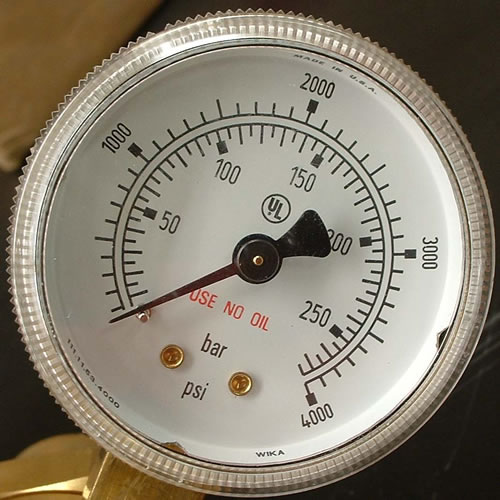
A dual-scale tyre gauge may place two different numbers at the same point on its dial. One scale might show 2.2 bar, while the other shows approximately 32 psi. The numbers differ because bar and psi use different-sized units, but both describe the same pressure inside the tyre.
PSI, normally written as psi, means pounds-force per square inch. It expresses pressure as an amount of force distributed across an area and remains familiar in the United States and in markets influenced by US customary or British Imperial measurements.
The bar is a metric pressure unit defined as exactly 100,000 pascals, or 100 kilopascals. Although bar is not the SI unit of pressure—the pascal is—it is widely used on vehicle displays, compressors and pressure gauges.
The definitions and conversion factors can be checked in the NIST pressure conversion tables .
Why Are Both Units Printed on One Gauge?
Vehicles, tyres and inflation equipment are sold across countries that do not always use the same pressure unit. A car’s handbook might specify bar or kilopascals, while a portable inflator or filling-station pump might be labelled in psi.
Manufacturers can make one gauge useful in several markets by displaying two scales. Mechanical gauges commonly place one scale around the outer part of the dial and another inside it. Digital gauges often let the user switch among bar, psi and kPa.
The presence of two scales does not mean that the gauge is measuring two different properties. It is presenting one pressure in two numerical forms—much like a speedometer that displays both miles per hour and kilometres per hour.
How Bar and PSI Became Common Pressure Units
PSI developed from measurement systems that expressed force in pounds-force and area in square inches. This made the unit convenient in engineering environments where pounds and inches were already used for other measurements.
Bar followed a different route. The unit became associated with meteorology and other pressure measurements during the early twentieth century. Norwegian physicist and meteorologist Vilhelm Bjerknes was an influential early advocate of the bar and related units.
One reason the bar is convenient is its scale. Standard atmospheric pressure is approximately 1.01325 bar, so one bar is close to ordinary atmospheric pressure at sea level. Typical car-tyre pressures can therefore be expressed with manageable values such as 2.2 or 2.5 bar.
As international vehicle manufacturing expanded, neither convention completely displaced the other. PSI remained familiar in some countries, while bar and kilopascals became common elsewhere. Dual-unit gauges developed into a practical way of supporting drivers familiar with either system.
TyreSafe notes that vehicle pressures may be displayed in psi, bar or kPa, depending partly on the market and measurement convention. See TyreSafe’s explanation of tyre-pressure units .
Converting a Tyre Pressure Between Bar and PSI
One bar equals approximately 14.5038 psi. To convert bar to psi, multiply the pressure by 14.5038:
psi = bar × 14.5038
Example: Convert 2.2 Bar to PSI
2.2 × 14.5038 = 31.90836 psi
Rounded to one decimal place, 2.2 bar equals 31.9 psi. A pump that displays whole numbers may show this as approximately 32 psi.
To convert in the opposite direction, multiply psi by approximately 0.0689476:
bar = psi × 0.0689476
Example: Convert 35 PSI to Bar
35 × 0.0689476 = 2.41317 bar
Therefore, 35 psi is approximately 2.41 bar. On a pump that uses one decimal place, this may be entered or displayed as 2.4 bar.
| Bar | Kilopascals | PSI |
|---|---|---|
| 1.8 bar | 180 kPa | 26.1 psi |
| 2.0 bar | 200 kPa | 29.0 psi |
| 2.2 bar | 220 kPa | 31.9 psi |
| 2.3 bar | 230 kPa | 33.4 psi |
| 2.4 bar | 240 kPa | 34.8 psi |
| 2.5 bar | 250 kPa | 36.3 psi |
| 2.8 bar | 280 kPa | 40.6 psi |
| 3.0 bar | 300 kPa | 43.5 psi |
These values are examples for comparing units. They are not recommended pressures for every vehicle.
What Does a Tyre Gauge Actually Measure?
An ordinary tyre gauge normally displays gauge pressure. This is the tyre’s internal pressure above the surrounding atmospheric pressure. A gauge reads approximately zero before it is connected because the same atmospheric pressure is acting inside and outside its measuring mechanism.
Absolute pressure includes the surrounding atmospheric pressure. For example, a tyre reading of 32 psi on an ordinary gauge has an absolute internal pressure of roughly 46.7 psi when atmospheric pressure is about 14.7 psi.
Drivers generally do not need to perform this absolute-pressure calculation. Vehicle manufacturers’ tyre recommendations and ordinary automotive gauges use gauge pressure, so the displayed values can be compared directly.
Why Tyre Pressure Should Be Checked When Cold
Tyres warm as they flex and roll along the road. The air inside also warms, causing the measured pressure to rise. A reading taken immediately after a long journey can therefore be higher than a reading taken before the journey.
Recommended inflation values are normally specified for cold tyres. TyreSafe advises checking pressure before the vehicle has travelled far enough to warm the tyres. The US National Highway Traffic Safety Administration similarly advises checking tyres when cold and consulting the vehicle’s tyre-information label or owner’s manual.
A warm tyre should not automatically be deflated merely because its reading is above the cold recommendation. Releasing air while the tyre is warm could leave it underinflated after it cools. If possible, check it again under the cold conditions specified by the vehicle manufacturer.
Use the Vehicle’s Recommended Pressure
The appropriate pressure should come from the vehicle manufacturer rather than from a general conversion table. It can usually be found in the owner’s manual or on a tyre-information label located inside the driver’s door opening, on a door pillar or near the fuel-filler flap.
The label may specify different pressures for the front and rear tyres. It may also provide separate recommendations for ordinary driving and for carrying additional passengers or luggage.
The pressure moulded into a tyre’s sidewall is generally a maximum value associated with that tyre, not necessarily the recommended operating pressure for a particular vehicle. NHTSA explains this distinction in its guidance on tyre pressure and load limits .
Correct inflation contributes to the handling, braking, durability and energy efficiency intended by the vehicle manufacturer. Underinflation can increase tyre flexing, heat generation, shoulder wear and rolling resistance. Excessive inflation can also alter ride quality, grip and wear.
A dual-scale gauge makes the comparison easier, but it does not determine the correct setting. Its purpose is to express one physical pressure in familiar units. The vehicle label provides the target; the bar-to-psi conversion simply helps the driver enter that target on a differently labelled pump.