Convert yards to metres when comparing US short-course swimming with international long-course competition. See why a 25-yard pool equals 22.86 metres, how it compares with a 50-metre pool and why different turn counts affect race times.
Yard to Metre Conversion Formula
One international yard is exactly 0.9144 metres (meters in US spelling):
1 yd = 0.9144 m
To convert yards to metres, multiply by 0.9144:
m = yd × 0.9144
The yard is defined as exactly 0.9144 m, so the factor is exact. To go the other way, divide the metres by 0.9144, or multiply by about 1.0936.
Yard to Metre Conversion Table
| Yards (yd) | Metres (m) |
|---|---|
| 0.1 yd | 0.09144 m |
| 0.5 yd | 0.4572 m |
| 1 yd | 0.9144 m |
| 2 yd | 1.8288 m |
| 5 yd | 4.572 m |
| 10 yd | 9.144 m |
| 25 yd | 22.86 m |
| 50 yd | 45.72 m |
| 100 yd | 91.44 m |
| 1,000 yd | 914.4 m |
From a 25-Yard US Pool to a 50-Metre International Pool
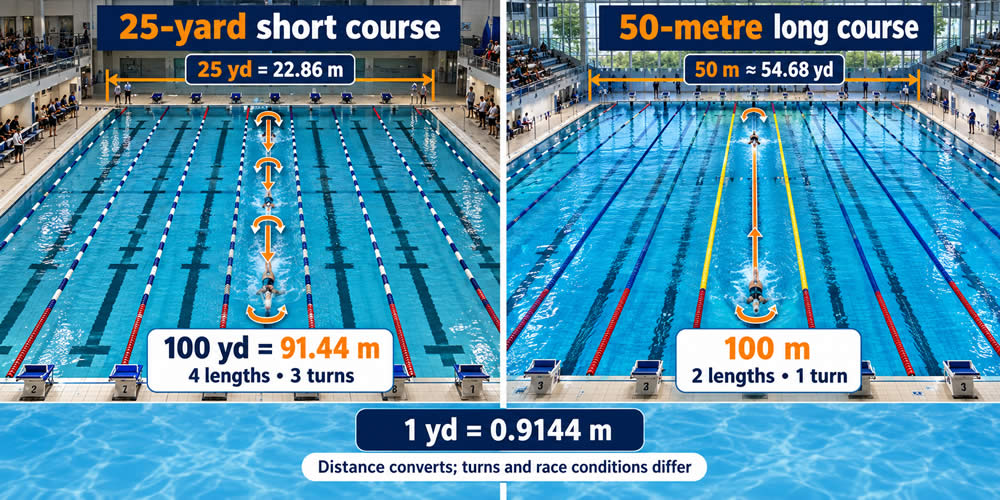
A competitive swimmer in the United States may train and race in a 25-yard pool. When the swimmer attends an international long-course competition, the pool may instead be 50 metres long. Converting yards to metres helps explain how different these two pools are.
USA Swimming facility records distinguish between 25-yard short-course pools and 50-metre long-course pools . World Aquatics also publishes separate documentation for competitions held in 50 m and 25 m pools.
Three Standard Pool Courses
Results are labelled by the course on which they were swum: short course yards (SCY), short course metres (SCM) and long course metres (LCM).
| Course | Abbreviation | Length in metres | Length in yards |
|---|---|---|---|
| Short course yards | SCY | 22.86 m | 25 yd |
| Short course metres | SCM | 25 m | 27.34 yd |
| Long course metres | LCM | 50 m | 54.68 yd |
Converting the 25-Yard Pool
One international yard equals exactly 0.9144 metres. To convert the US pool length, multiply 25 by 0.9144:
25 yd × 0.9144 = 22.86 m
A 25-yard swimming pool is therefore 22.86 metres long. It is 2.14 metres shorter than a 25-metre pool (8.56% shorter) and less than half the length of a 50-metre long-course pool.
How Long Is a 50-Metre Pool in Yards?
To express the international pool in yards, divide 50 metres by 0.9144:
50 m ÷ 0.9144 ≈ 54.68 yd
A 50-metre pool is approximately 54.68 yards long. Compared with a 25-yard pool, one long-course length is slightly more than twice as long:
50 m ÷ 22.86 m ≈ 2.19
A 100-Yard Race Is Not a 100-Metre Race
The names of the events may look similar, but the distances are different. Converting 100 yards gives:
100 yd × 0.9144 = 91.44 m
A 100-yard race is therefore 8.56 metres shorter than a 100-metre race:
100 m − 91.44 m = 8.56 m
In a 25-yard pool, a 100-yard race requires four lengths. In a 50-metre pool, a 100-metre race requires two lengths.
| Yard event | Equivalent in metres | Nearest metre event | Difference |
|---|---|---|---|
| 50 yd | 45.72 m | 50 m | 4.28 m shorter |
| 100 yd | 91.44 m | 100 m | 8.56 m shorter |
| 200 yd | 182.88 m | 200 m | 17.12 m shorter |
| 500 yd | 457.2 m | 400 m | 57.2 m longer |
| 1,000 yd | 914.4 m | 800 m | 114.4 m longer |
| 1,650 yd | 1,508.76 m | 1,500 m | 8.76 m longer |
The longer yard events (500, 1,000 and 1,650 yards) are treated as the counterparts of the 400, 800 and 1,500 metre races, but they are not equal distances.
The Number of Turns Also Changes
Pool length affects more than total distance. Four lengths in a 25-yard pool normally involve three turns, while two lengths in a 50-metre pool involve one turn. Turns provide opportunities to push from the wall and travel underwater, so short-course and long-course performances should not be compared by distance conversion alone.
Research on world championship races has found that the larger number of turns in short-course races results in significantly faster race times. Race times can also be affected by starts, turn technique, underwater phases and the swimmer's ability to maintain speed over a longer uninterrupted length. Official results therefore identify whether a swim took place in short-course yards, short-course metres or long-course metres.
Why Swimmers Use Time Conversion Factors
Because turns matter, converting a time is not the same as converting a distance. 100 metres is 1.0936 times as far as 100 yards, but swimming organisations commonly use a factor of about 1.11 to convert a short course yards time to short course metres. Official course conversion factors are published for college (NCAA) and high school (NFHS) swimming, and they vary by event.
For illustration, a 100-yard time of 50.00 seconds is about 55.5 seconds as a 100-metre time with the 1.11 factor, but only 54.68 seconds if the distance ratio alone were used, a difference of 0.82 seconds. These are estimates, and conversions to long course add further adjustments for the missing turns.
Converting a Training Session
Suppose a US swimmer completes a workout totalling 2,000 yards. Its direct metric equivalent is:
2,000 yd × 0.9144 = 1,828.8 m
This means the workout covers approximately 1.83 kilometres. However, swimming 2,000 yards in a 25-yard pool is not mechanically identical to swimming the converted distance in a longer pool because the number of turns will differ.
Preparing for a Longer Pool
A swimmer moving from a 25-yard pool to a 50-metre pool may notice that each length lasts longer and offers fewer wall push-offs. Training may therefore place more emphasis on pacing, stroke efficiency and maintaining technique between turns.
When you convert yards to metres, multiply the yard value by 0.9144. The conversion accurately compares distance, but pool configuration and the number of turns must also be considered when comparing workouts or race performances.
Yards to Metres Questions and Answers
Standards and Further Reading
For authoritative unit guidance, consult the BIPM SI Brochure and NIST information about SI length.