Convert yards to inches when fabric or strap material is sold by the yard but your pattern and cutting plan use inches. Explore practical examples showing how a three-yard fabric order becomes 108 inches and how five yards of strap material provides 180 inches for individual cuts.
Yard to Inch Conversion Formula
One yard is exactly 36 inches (3 feet × 12 inches):
1 yd = 36 in
To convert yards to inches, multiply by 36:
in = yd × 36
This also follows from the metre definitions used by the converter (spelled "meter" in US English): 1 yd = 0.9144 m and 1 in = 0.0254 m, and 0.9144 ÷ 0.0254 = 36.
Writing Inches as Yards and Inches
To go the other way, divide the inches by 36. The whole number is the yards and the remainder is the inches. For example, 269 in ÷ 36 gives 7 with a remainder of 17, so 269 inches is 7 yd 17 in.
Yard to Inch Conversion Table
| Yards (yd) | Feet (ft) | Inches (in) |
|---|---|---|
| 0.1 yd | 0.3 ft | 3.6 in |
| 0.5 yd | 1.5 ft | 18 in |
| 1 yd | 3 ft | 36 in |
| 2 yd | 6 ft | 72 in |
| 5 yd | 15 ft | 180 in |
| 10 yd | 30 ft | 360 in |
| 25 yd | 75 ft | 900 in |
| 50 yd | 150 ft | 1,800 in |
| 100 yd | 300 ft | 3,600 in |
| 1,000 yd | 3,000 ft | 36,000 in |
| Fraction of a yard | Decimal yards | Inches |
|---|---|---|
| ⅛ yd | 0.125 yd | 4.5 in |
| ¼ yd | 0.25 yd | 9 in |
| ⅓ yd | 0.333 yd | 12 in |
| ⅜ yd | 0.375 yd | 13.5 in |
| ½ yd | 0.5 yd | 18 in |
| ⅝ yd | 0.625 yd | 22.5 in |
| ¾ yd | 0.75 yd | 27 in |
| ⅞ yd | 0.875 yd | 31.5 in |
Fabric Sold by the Yard with Its Width Listed in Inches
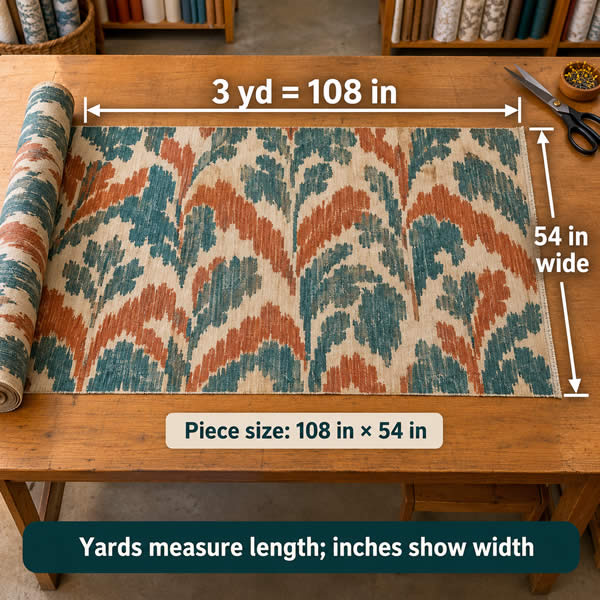
In a US fabric shop, material is commonly sold by the linear yard, while its width is listed in inches. A product might therefore be described as 54-inch-wide fabric sold by the yard. The two measurements describe different directions: yards measure the length taken from the roll, along the edge of the fabric, while inches measure the distance from one edge of the fabric to the other.
A yard is always 36 inches long, but a "yard of fabric" has no single size, because the width varies. Widths of about 44 to 45 inches are common for quilting cotton, and 54 or 60 inches are common for upholstery and home décor fabrics, though other widths exist.
| Fabric width | Width in cm | Size of one yard | Area |
|---|---|---|---|
| 44 in | 111.76 cm | 36 × 44 in | 11.0 ft² |
| 45 in | 114.3 cm | 36 × 45 in | 11.25 ft² |
| 54 in | 137.16 cm | 36 × 54 in | 13.5 ft² |
| 60 in | 152.4 cm | 36 × 60 in | 15.0 ft² |
Imagine a customer ordering 3 yards of 54-inch-wide upholstery fabric. Because one yard contains 36 inches, the purchased length is:
3 yd × 36 = 108 in
The customer receives a piece measuring approximately 108 inches long by 54 inches wide, an area of 5,832 square inches, or 40.5 square feet. Converting the yard measurement to inches makes it easier to compare the material with a cutting pattern in which every panel, seam allowance and hem is already specified in inches.
The conversion does not calculate how much usable fabric the project will produce. Pattern direction, matching, trimming, defects and the slightly narrower usable width inside the edges may require additional material.
Strap Material Purchased by the Yard and Cut in Inches
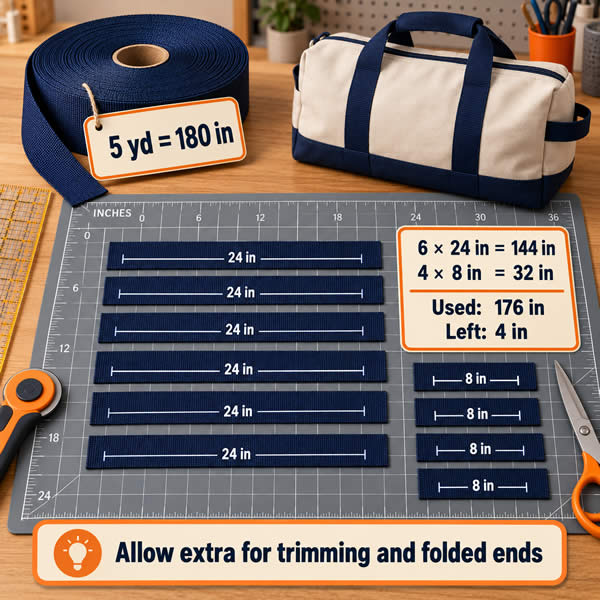
A US supplier may sell nylon or polyester strap material by the linear yard, while the customer's project instructions list each required strap length in inches. Converting the complete order to inches gives the customer one consistent unit for preparing the cutting plan.
Suppose a customer purchases 5 yards of strap material. Since one yard contains exactly 36 inches, the total available length is:
5 yd × 36 = 180 in
The project requires six long straps measuring 24 inches each and four short straps measuring 8 inches each:
| Piece | Quantity | Length each | Total |
|---|---|---|---|
| Long straps | 6 | 24 in | 144 in |
| Short straps | 4 | 8 in | 32 in |
| Complete cutting list | 10 | 176 in |
After the required straps are cut, the theoretical remainder is:
180 in − 176 in = 4 in
Although every planned piece fits within the five-yard order, four spare inches leave little room for trimming, folded ends or cutting errors. The customer may need to order extra material when the straps must be sewn, sealed or passed through buckles and other hardware.
Converting yards to inches helps prepare the cutting plan, but it does not determine whether the strap material is suitable for a particular load. Straps intended for lifting, vehicle restraint, fall protection or other safety-critical uses require appropriately tested materials, hardware and construction.
Yards to Inches Questions and Answers
Standards and Further Reading
For authoritative unit guidance, consult the BIPM SI Brochure and NIST information about SI length.