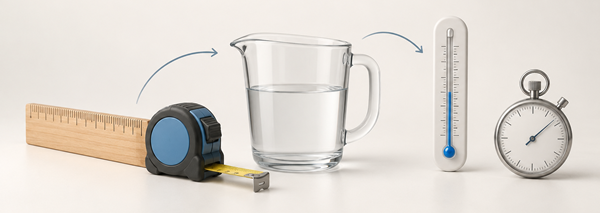
Convert yards to feet when a golf-course distance needs to become a detailed working measurement. See how a 420-yard hole equals 1,260 feet, while shorter drainage routes, planting strips and maintenance areas can be planned more conveniently in feet.
Yard to Foot Conversion Formula
One yard is exactly 3 feet:
1 yd = 3 ft
To convert yards to feet, multiply by 3:
ft = yd × 3
This factor follows from the metre definitions used by the converter (spelled "meter" in US English): 1 yd = 0.9144 m and 1 ft = 0.3048 m, and 0.9144 ÷ 0.3048 = 3. It applies only to lengths. Areas and volumes use the squared and cubed factors, as shown below.
Yard to Foot Conversion Table
| Yards (yd) | Feet (ft) |
|---|---|
| 0.1 yd | 0.3 ft |
| 0.5 yd | 1.5 ft |
| 1 yd | 3 ft |
| 2 yd | 6 ft |
| 5 yd | 15 ft |
| 10 yd | 30 ft |
| 25 yd | 75 ft |
| 50 yd | 150 ft |
| 100 yd | 300 ft |
| 1,000 yd | 3,000 ft |
From a Golf Hole Measured in Yards to Maintenance Plans in Feet
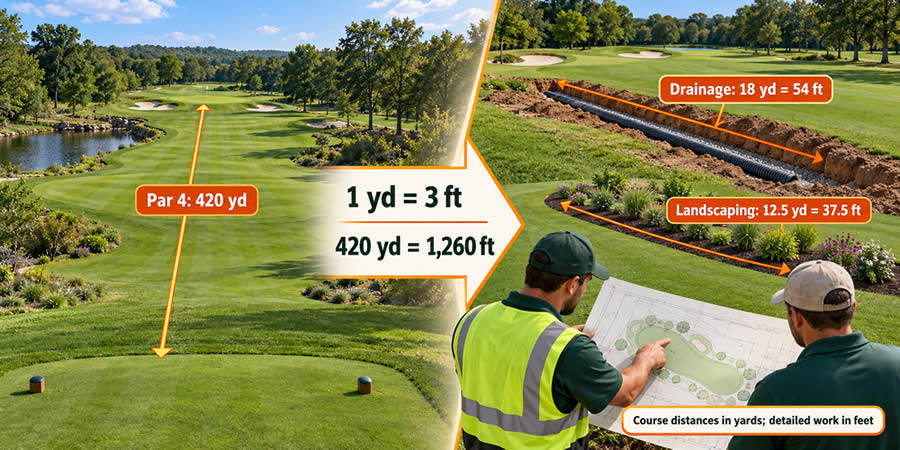
Golf-course distances are commonly presented in yards. A scorecard may describe a par-four hole as 420 yards from a particular tee to the centre of the green. That measurement is useful for players, but the designers and grounds team responsible for the course may need feet when planning smaller areas and individual pieces of infrastructure.
Converting yards to feet connects the playing distance shown on the scorecard with detailed measurements used for drainage, landscaping, irrigation and maintenance work.
The Scorecard Shows the Hole in Yards
Imagine a golf course with a par-four hole measuring 420 yards. Because one yard contains exactly three feet, the complete playing length can also be expressed as:
420 yd × 3 = 1,260 ft
Players would normally continue to describe the hole as 420 yards. Writing 1,260 feet on a scorecard would be less familiar and harder to interpret during a round. For a site plan, however, feet can be useful when the team needs to examine shorter sections of the same course.
How Hole Lengths Are Measured
Under USGA course-rating practice, each hole is measured horizontally (as the crow flies, not along the ground) from the permanent yardage marker to the centre of the green, to the nearest yard. A hole with a dogleg is measured to the bend in the fairway and then to the green. So 420 yards is a rounded, horizontal figure, not a precise surveyed length of the ground. The USGA course-measurement guidance is on its handicap-manual page.
Rounding to the nearest yard means a hole listed at 420 yards could be anywhere from 419.5 to 420.5 yards, or about 1,258.5 to 1,261.5 feet. The 1,260 feet used here is therefore an approximate working figure.
How Yardage Relates to Par
The USGA's guidelines relate a hole's length to its par, but they are based on its "effective playing length", which adjusts the measured yardage for factors such as elevation, wind and altitude. The 420-yard example sits in the men's par-four range but above the women's:
| Par | Men (yards) | Men (feet) | Women (yards) | Women (feet) |
|---|---|---|---|---|
| Par 3 | up to 250 | up to 750 | up to 210 | up to 630 |
| Par 4 | 251–470 | 753–1,410 | 211–400 | 633–1,200 |
| Par 5 | 471–690 | 1,413–2,070 | 401–575 | 1,203–1,725 |
These are guidelines, not strict rules, and courses often depart from them. They show why yards remain the standard for playing distance while feet suit smaller working measurements.
Planning a Drainage Run
After heavy rain, water begins collecting in a low area beside the fairway. The grounds team plans a short drainage run measuring 18 yards on the course survey.
The pipe layout and trench plan use feet, so the team converts the distance:
18 yd × 3 = 54 ft
The planned drainage route is therefore 54 feet long. This result can be compared directly with pipe sections, trench measurements and the distances shown on a feet-based maintenance drawing.
In practice, the team may need more than 54 feet of pipe to allow for connections, bends, changes in elevation or extensions beyond the measured route. For illustration only, a 1% fall along 54 feet is a drop of 0.54 ft, or about 6.5 inches. The required fall depends on the design and local standards.
Breaking a Landscaping Area into Smaller Sections
The same conversion can help when renovating the space around a tee, bunker or pathway. Suppose a strip of planting extends for 12.5 yards:
12.5 yd × 3 = 37.5 ft
Expressing the strip as 37.5 feet may make it easier to position edging, plan plant spacing or calculate the number of shorter landscape components required.
Maintenance Measurements Need More Than Length
A yards to feet converter changes a length from one unit to another, but it does not calculate area, slope or material quantity automatically. A drainage project may also require information about pipe diameter, trench depth and gradient. Landscaping work may depend on width, soil depth and planting spacing.
Area measurements must use square units. For example, a rectangular maintenance zone measuring 10 yards by 4 yards covers 40 square yards. Converting each side first gives 30 feet by 12 feet:
30 ft × 12 ft = 360 ft²
This is why an area conversion uses a squared relationship: 1 yd² = 9 ft², not 3 ft².
Volumes use a cubed relationship, 1 yd³ = 27 ft³. Landscape materials such as topsoil and mulch are commonly sold by the cubic yard. A planting strip 37.5 ft long, 3 ft wide and 6 inches (0.5 ft) deep needs 37.5 × 3 × 0.5 = 56.25 ft³, or 56.25 ÷ 27 ≈ 2.08 cubic yards of material, before allowing for settling or waste.
One Course, Different Measurement Scales
Yards remain convenient for describing tee-to-green distances, while feet can provide a more practical scale for local construction and maintenance tasks. Both units may therefore appear in documents for the same golf course.
When you convert yards to feet, multiply the yard value by three. The conversion lets a broad course measurement become a detailed working dimension without changing the physical distance being measured.
Yards to Feet Questions and Answers
Standards and Further Reading
For authoritative unit guidance, consult the BIPM SI Brochure and NIST information about SI length.