Convert metres to yards when an imported fibre-optic cable must be compared with a US yard-based installation plan. See how a 100-metre cable becomes approximately 109.36 yards and how the remaining length can provide routing and service-loop allowance.
Meter to Yard Conversion Formula
One meter is equal to 1.09361329834 yards:
1 m = 1.09361329834 yd
To convert meters to yards, multiply by 1.09361329834:
yd = m × 1.09361329834
This factor follows from the meter definitions used by the converter: 1 m = 1 m and 1 yd = 0.9144 m.
Meter to Yard Conversion Table
| Meters (m) | Yards (yd) |
|---|---|
| 0.1 m | 0.109361329834 yd |
| 0.5 m | 0.546806649169 yd |
| 1 m | 1.09361329834 yd |
| 2 m | 2.18722659668 yd |
| 5 m | 5.46806649169 yd |
| 10 m | 10.9361329834 yd |
| 25 m | 27.3403324584 yd |
| 50 m | 54.6806649169 yd |
| 100 m | 109.361329834 yd |
| 1,000 m | 1,093.61329834 yd |
From a 100-Metre Fibre Cable to a Yard-Based Project Plan
Telecommunications equipment often crosses international borders before it reaches an installation site. A fibre-optic cable manufactured for a metric market may be labelled in metres, while a US contractor’s stock records or preliminary site measurements use yards.
Converting the imported cable from metres to yards gives the engineering team a common unit for comparing the available cable with the planned route.
The Cable Arrives with a Metric Label
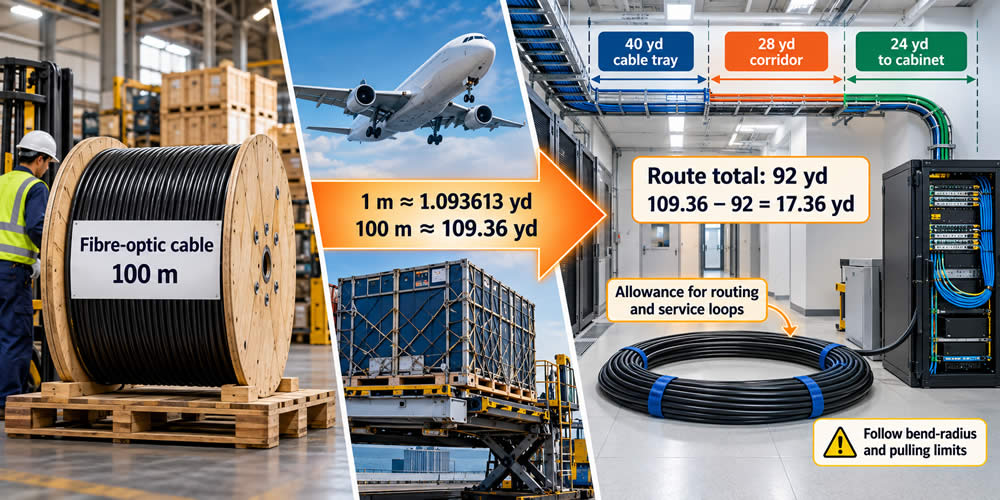
Imagine a US telecommunications company importing a 100-metre fibre-optic cable. The manufacturer’s packaging and test documentation show the length in metres, but the project team wants to record the cable in yards.
One metre equals approximately 1.093613 yards. The conversion is:
100 m × 1.093613 ≈ 109.36 yd
The imported cable is therefore approximately 109.36 yards long. A metres to yards converter can calculate this value for cables of any length.
Comparing the Cable with the Planned Route
Suppose the proposed cable pathway is divided into three sections:
- 40 yd through the main cable tray
- 28 yd above an office corridor
- 24 yd between the final junction and equipment cabinet
The measured route totals:
40 yd + 28 yd + 24 yd = 92 yd
Comparing the route with the converted cable length gives:
109.36 yd − 92 yd = 17.36 yd
On the initial plan, approximately 17.36 yards remain after covering the measured route.
The Remaining Length Is Not Necessarily Waste
A fibre installation normally requires more cable than the simple point-to-point distance. The route may rise or descend between floors, pass around structural features and enter equipment cabinets from a specific direction.
The engineer may also allow service loops near cabinets, splice enclosures or other access points. These loops provide additional cable for maintenance, repositioning or future termination work.
The apparent 17.36-yard surplus should therefore be checked against the complete installation design before any cable is cut.
Protecting the Fibre During Installation
Fibre-optic cable cannot be treated like an ordinary rope or extension lead. Pulling it too tightly, crushing it or bending it around a small radius can damage the fibres and increase signal loss.
Installation teams should follow the manufacturer’s limits for minimum bend radius and pulling tension. Any spare cable should be stored in a suitable loop rather than folded sharply.
Length Does Not Confirm Compatibility
Converting 100 metres to 109.36 yards confirms the approximate cable length, but it does not show whether the product is suitable for the network. The project specification may also need to confirm:
- Single-mode or multimode fibre
- Fibre count and cable construction
- Connector type and polarity
- Indoor, outdoor, riser or plenum rating
- Optical-loss requirements
- Fire, electrical and building-code compliance
A cable can be long enough and still be unsuitable for the intended link.
Nominal and Usable Cable Length
The mathematical conversion is precise, but a product sold as a 100-metre cable may be subject to a manufacturing tolerance. Connector assemblies and the supplier’s measurement method may also affect the usable routed length.
The engineering team should check the product datasheet and verify the received cable before relying on the converted value for a closely measured installation.
Connecting Metric Supply with US Planning
When you convert metres to yards, multiply the metre value by approximately 1.093613. A 100-metre fibre cable becomes approximately 109.36 yards, allowing the imported product to be compared with a yard-based route or inventory record.
The conversion provides a useful starting point, but the final plan must also account for the real cable pathway, service loops, installation limits and the technical requirements of the network.
Meter and Yard Questions and Answers
Meters and yards are close in size, but they are not interchangeable: one meter is slightly longer than one yard. The examples below show how both units appear in fabric sales, gardens, sport, construction and technical measurements. Use 1 m ≈ 1.09361 yd and 1 yd = 0.9144 m.
Standards and Further Reading
For authoritative unit guidance, consult the BIPM SI Brochure and NIST information about SI length.