Use the instant converter above for a single value, or the charts below when you need to read several measurements at once. Every value on this page uses the exact international definition, 1 inch = 0.0254 metres, so the chart results are exact rather than rounded estimates.
The page also explains why that factor is exact, what the inch was before 1959 and why older American records can differ very slightly from modern conversions.
Inch to Metre Conversion Formula
One international inch is exactly 0.0254 metres (meters in US spelling):
m = in × 0.0254
Going the other way, one metre is about 39.3701 inches (1 ÷ 0.0254). Dividing by 39.37 gives a close mental estimate, but multiplying by 0.0254 is the exact method. If your starting value is already metric, use the metres to inches converter.
Because 1 in is exactly 25.4 mm, you can also convert to millimetres first and then divide by 1,000. For example, 7/8 in = 22.225 mm = 0.022225 m.
Fractional Inches to Metres Chart
Tape measures, drill bits and many product drawings use sixteenths of an inch. This chart gives the exact millimetre and metre value for each sixteenth up to one inch.
| Inches | Millimetres | Metres |
|---|---|---|
| 1/16 in | 1.5875 mm | 0.0015875 m |
| 1/8 in | 3.175 mm | 0.003175 m |
| 3/16 in | 4.7625 mm | 0.0047625 m |
| 1/4 in | 6.35 mm | 0.00635 m |
| 5/16 in | 7.9375 mm | 0.0079375 m |
| 3/8 in | 9.525 mm | 0.009525 m |
| 7/16 in | 11.1125 mm | 0.0111125 m |
| 1/2 in | 12.7 mm | 0.0127 m |
| 9/16 in | 14.2875 mm | 0.0142875 m |
| 5/8 in | 15.875 mm | 0.015875 m |
| 11/16 in | 17.4625 mm | 0.0174625 m |
| 3/4 in | 19.05 mm | 0.01905 m |
| 13/16 in | 20.6375 mm | 0.0206375 m |
| 7/8 in | 22.225 mm | 0.022225 m |
| 15/16 in | 23.8125 mm | 0.0238125 m |
| 1 in | 25.4 mm | 0.0254 m |
To convert a mixed measurement such as 2 3/8 in, add the parts: 2 in = 0.0508 m and 3/8 in = 0.009525 m, giving 0.060325 m.
Whole Inches to Metres Chart
| Inches (in) | Metres (m) |
|---|---|
| 1 in | 0.0254 m |
| 2 in | 0.0508 m |
| 3 in | 0.0762 m |
| 4 in | 0.1016 m |
| 5 in | 0.127 m |
| 6 in | 0.1524 m |
| 7 in | 0.1778 m |
| 8 in | 0.2032 m |
| 9 in | 0.2286 m |
| 10 in | 0.254 m |
| 11 in | 0.2794 m |
| 12 in (1 ft) | 0.3048 m |
| 18 in | 0.4572 m |
| 24 in | 0.6096 m |
| 36 in (1 yd) | 0.9144 m |
| 48 in | 1.2192 m |
| 60 in | 1.524 m |
| 72 in | 1.8288 m |
| 100 in | 2.54 m |
| 1,000 in | 25.4 m |
Common Sizes Quoted in Inches
Some products are still sold by inch size even in metric countries. The tables below convert the quoted size only; they do not describe the full product.
Screen Diagonals
A television or monitor size is the diagonal of the visible screen, not its width. A 55-inch screen measures 1.397 m corner to corner, but its width and height depend on the aspect ratio and the frame around it.
| Diagonal | Metres | Centimetres (1 d.p.) |
|---|---|---|
| 24 in | 0.6096 m | 61.0 cm |
| 32 in | 0.8128 m | 81.3 cm |
| 43 in | 1.0922 m | 109.2 cm |
| 55 in | 1.397 m | 139.7 cm |
| 65 in | 1.651 m | 165.1 cm |
| 75 in | 1.905 m | 190.5 cm |
| 85 in | 2.159 m | 215.9 cm |
Wheel Rim Diameters
Car tyre sizes often mix units: width in millimetres, an aspect ratio as a percentage and the rim diameter in inches. The rim figure converts as follows.
| Rim diameter | Metres |
|---|---|
| 15 in | 0.381 m |
| 16 in | 0.4064 m |
| 17 in | 0.4318 m |
| 18 in | 0.4572 m |
| 19 in | 0.4826 m |
| 20 in | 0.508 m |
For a 225/45 R17 tyre, the sidewall is 45% of 225 mm, or 0.10125 m. The overall diameter is 0.4318 m + 2 × 0.10125 m = 0.6343 m, about 24.97 in. A converted size helps comparison but does not confirm that a wheel or tyre fits a particular vehicle.
Worked Example: A 36-Inch Component Prepared for a Metric Market
Consider an illustrative supply-chain example. A US supplier records a rectangular automotive trim component as 36 in long, 4 in wide and 0.25 in thick. An overseas distributor needs metres for its catalogue and warehouse system. The physical part does not change; only the way its dimensions are written changes.
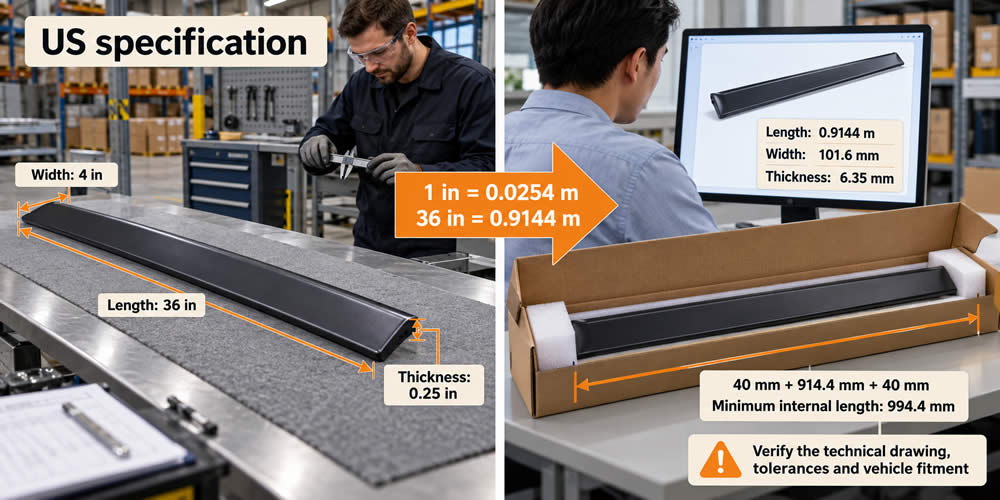
Each dimension is converted separately:
- Length: 36 in × 0.0254 = 0.9144 m
- Width: 4 in × 0.0254 = 0.1016 m
- Thickness: 0.25 in × 0.0254 = 0.00635 m
Why the Number of Decimal Places Matters
Rounding 0.9144 m to 0.91 m makes the value easier to read, but it changes the displayed length by 4.4 mm. That may be acceptable in a general catalogue but not on a fitment drawing. A sensible product record shows both values: Length: 36 in (0.9144 m).
Conversion Does Not Confirm Fitment
Two components can share the same 36-inch length and still be incompatible. Fitment can depend on mounting-hole positions, curvature, material, model year and orientation, and a quoted length may be measured between different reference points. The manufacturer's part number and drawing remain the authority; the converted length only communicates the size.
How the Inch-to-Metre Factor Changed
The factor 0.0254 has been exact only since 1959. Before then, the United States and the United Kingdom each defined the inch slightly differently, and engineers had already started using a rounded "industrial inch" to make precision parts interchangeable.
| Definition | Basis | 1 inch in metres |
|---|---|---|
| US legal inch (1866, metre-based from 1893) | 1 m = 39.37 in | 0.0254000508… m |
| Industrial inch (BSI 1930, ASA 1933) | 1 in = 25.4 mm for industry | 0.0254 m |
| International inch (from 1 July 1959) | 1 yd = 0.9144 m | 0.0254 m exactly |
The American Inch: 39.37 Inches to the Metre
In 1866 the US Congress set the legal foot at 1200/3937 m, which makes one metre exactly 39.37 inches. From 1893 the United States based its customary units on the metre rather than on British standards. Under that definition an inch was 0.0254000508 m, about two parts per million longer than today's inch.
The Industrial Inch
The British and American inches differed by only a few millionths, but that was enough to complicate precision gauges. The British Standards Institution adopted an inch of exactly 25.4 mm for industrial use in 1930, and the American Standards Association followed in 1933. Manufacturers on both sides of the Atlantic could then convert drawings with the same simple factor.
1959: One Inch for Everyone
On 1 July 1959, Australia, Canada, New Zealand, South Africa, the United Kingdom and the United States agreed to define the yard as exactly 0.9144 m. One inch, a thirty-sixth of a yard, therefore became exactly 0.0254 m, matching the industrial inch. The length converter hub summarises the agreement.
Why Old Survey Records Still Differ
The United States kept the older definition, renamed the US survey foot, for geodetic surveying. Over 1,000 inches the two definitions differ by about 0.05 mm, but across state plane coordinates measured in millions of feet the gap becomes several feet. NIST and the National Geodetic Survey retired the survey foot after 31 December 2022. Records made with it should still be read using the unit in which they were created.
Frequently Asked Questions
How many metres are in an inch?
Exactly 0.0254 metres, which is 2.54 centimetres or 25.4 millimetres.
How many inches are in a metre?
About 39.3701 inches. The exact value is 1 ÷ 0.0254 = 39.370078740…
Is 1 inch = 0.0254 m exact or rounded?
It is exact by definition. Any rounding in a result comes from the number of decimal places you choose to display, not from the conversion factor.
What is the quickest way to estimate inches to metres?
Multiply by 2.5 to get centimetres, then divide by 100. For 40 in this gives 1.00 m, against an exact 1.016 m. Use the exact factor whenever the result will be used for ordering, manufacturing or fitting.
How do I convert feet and inches to metres?
Convert the whole measurement to inches first (feet × 12 + inches), then multiply by 0.0254. For example, 5 ft 9 in = 69 in = 1.7526 m. The feet to metres converter handles feet directly.
Sources and Calculation Notes
All chart values are calculated from the exact relationship 1 inch = 0.0254 metres and are shown without rounding unless a column says otherwise. Screen, wheel and component sizes are explanatory examples, not product or fitment recommendations.