Convert feet to yards as a railway track grows from a short construction section into a much longer completed route. Compare milestones from 10 feet to 1,000 feet and see why feet suit detailed work while yards make longer progress easier to describe.
Foot to Yard Conversion Formula
One foot is equal to 0.333333333333 yards:
1 ft = 0.333333333333 yd
To convert feet to yards, multiply by 0.333333333333:
yd = ft × 0.333333333333
This factor follows from the meter definitions used by the converter: 1 ft = 0.3048 m and 1 yd = 0.9144 m.
Foot to Yard Conversion Table
| Feet (ft) | Yards (yd) |
|---|---|
| 0.1 ft | 0.0333333333333 yd |
| 0.5 ft | 0.166666666667 yd |
| 1 ft | 0.333333333333 yd |
| 2 ft | 0.666666666667 yd |
| 5 ft | 1.66666666667 yd |
| 10 ft | 3.33333333333 yd |
| 25 ft | 8.33333333333 yd |
| 50 ft | 16.6666666667 yd |
| 100 ft | 33.3333333333 yd |
| 1,000 ft | 333.333333333 yd |
From a Few Feet of Railway Track to Hundreds of Yards
A railway track is not completed in one movement. Construction advances through surveying, ground preparation, drainage, ballast placement, sleeper installation, rail positioning and inspection. At the beginning of the work, progress may be measured in feet because the completed section is still short.
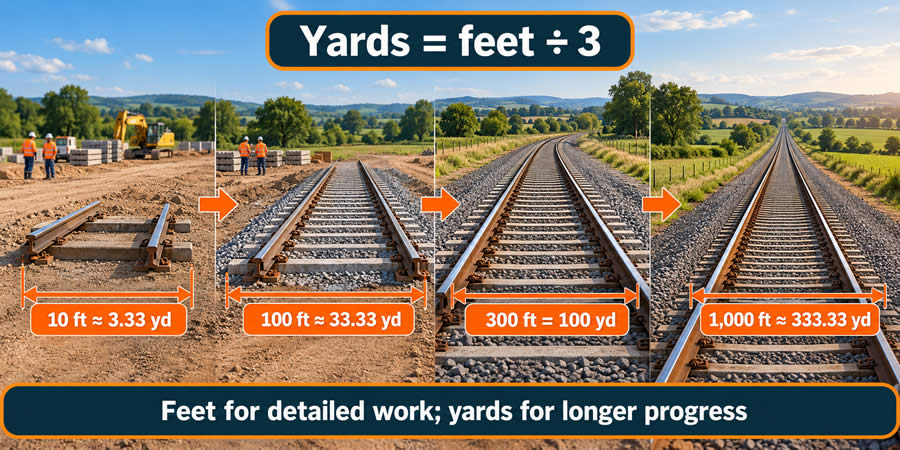
As the rails extend farther along the route, the same distance can reach hundreds or thousands of feet. Converting feet to yards then produces a shorter number that can be easier to discuss in progress reports and general project summaries.
The First 10 Feet
Imagine a construction team beginning a short demonstration or siding project. After the first section is aligned, only 10 feet of track has been positioned.
One yard contains exactly three feet, so the completed distance is:
10 ft ÷ 3 ≈ 3.33 yd
At this stage, feet remain a practical unit because the team may be checking small distances between joints, sleepers, drainage features and nearby structures.
Progress Reaches 100 Feet
As installation continues, the completed track reaches 100 feet. Converting this distance gives:
100 ft ÷ 3 ≈ 33.33 yd
Both units are still easy to interpret. The engineering drawing may retain feet, while a general update might describe the completed section as slightly more than 33 yards.
Three Hundred Feet Becomes One Hundred Yards
At 300 feet, the conversion produces a whole-yard result:
300 ft ÷ 3 = 100 yd
This is a useful milestone because the distance can now be described as exactly 100 yards. A feet to yards converter can make similar project milestones easier to compare without changing the original measurement.
More Than 1,000 Feet of Completed Track
Once the constructed section passes 1,000 feet, the equivalent measurement in yards becomes:
1,000 ft ÷ 3 ≈ 333.33 yd
A progress report might therefore state that approximately 333.33 yards of track have been completed. If construction reaches one statute mile, the conversion is:
5,280 ft ÷ 3 = 1,760 yd
At that scale, yards—or eventually miles or kilometres—can be more convenient for communicating overall progress than a large number of feet.
Different Tasks Still Need Different Units
Converting the total length to yards does not mean every railway measurement should use yards. Detailed construction and inspection work may still use feet, inches or metric units, depending on the country, project specification and engineering standard.
Workers may need smaller units when checking clearances, rail joints, drainage positions or the distance to trackside equipment. Surveyors and engineers may also use formal stationing or chainage references rather than relying only on a single total distance.
One Track, A Growing Measurement
The sequence shows how the most readable unit can change as a railway section grows:
- 10 ft ≈ 3.33 yd
- 100 ft ≈ 33.33 yd
- 300 ft = 100 yd
- 1,000 ft ≈ 333.33 yd
When you convert feet to yards, divide the number of feet by three. Feet remain useful for detailed work, while yards provide a compact way to describe the increasing length of the completed track.
Foot and Yard Questions and Answers
These questions apply the exact relationship 1 yard = 3 feet to carpeting, concrete placement, land surveying, theatre production, golf, irrigation and other practical measurements.
Standards and Further Reading
For authoritative unit guidance, consult the BIPM SI Brochure and NIST information about SI length.