
A major internet backbone link can carry terabytes of data per second — yet your own download, on the very same internet, might crawl along at a few megabytes per second. The gap isn't a mistake; it's the difference between shared infrastructure and one connection's slice of it, covered below. Use the converter above for an instant TB-to-MB result, or the formula below to work it out by hand.
Terabyte to Megabyte Formula
This converter uses decimal data units, where the prefix tera represents 1012 and mega represents 106. Therefore, one terabyte contains one million megabytes.
To convert terabytes to megabytes, multiply the terabyte value by 1,000,000.
Megabytes = Terabytes × 1,000,000
1 TB = 1,000,000 MB
These decimal prefix values follow the NIST definitions of metric prefixes . NIST also explains the difference between decimal units such as MB and TB and binary units such as MiB and TiB in its guide to binary prefixes .
Common Terabyte to Megabyte Values
| Terabytes | Megabytes |
|---|---|
| 0.001 TB | 1,000 MB |
| 0.01 TB | 10,000 MB |
| 0.1 TB | 100,000 MB |
| 0.25 TB | 250,000 MB |
| 0.5 TB | 500,000 MB |
| 0.75 TB | 750,000 MB |
| 1 TB | 1,000,000 MB |
| 1.5 TB | 1,500,000 MB |
| 2 TB | 2,000,000 MB |
| 3 TB | 3,000,000 MB |
| 4 TB | 4,000,000 MB |
| 5 TB | 5,000,000 MB |
| 8 TB | 8,000,000 MB |
| 10 TB | 10,000,000 MB |
From an ISP Backbone to Your Home: TB/s Capacity and MB/s Downloads
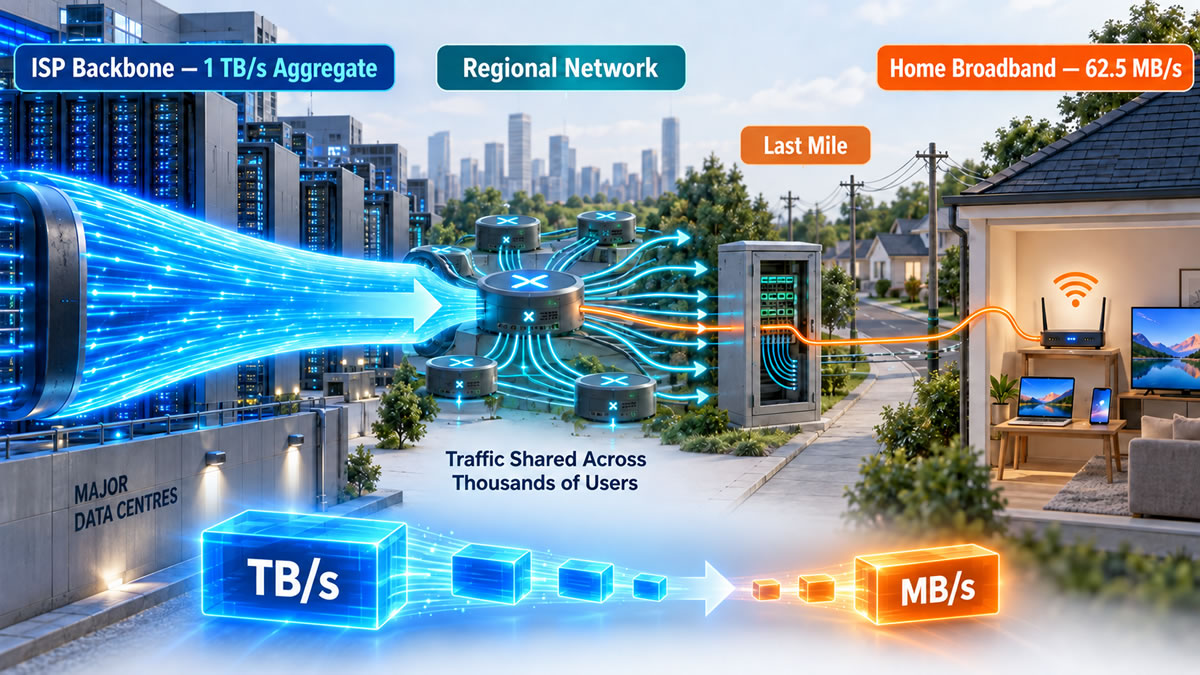
A film download, video call or website request may travel across network links carrying data for thousands of customers before reaching one home. The combined capacity of a large network can be expressed in terabits or terabytes per second, while a download application commonly reports its transfer rate in megabytes per second.
These measurements may look directly comparable, but they usually describe different parts of the system. Backbone capacity is shared across many routes and customers, whereas the MB/s figure on a computer describes the transfer rate experienced by one application.
Converting TB to MB
This example uses decimal data units, in which one terabyte contains one million megabytes:
1 TB = 1,000,000 MB
For example:
2.5 TB × 1,000,000 = 2,500,000 MB
If the same time unit appears on both sides, the relationship can also be applied to a data rate:
1 TB/s = 1,000,000 MB/s
This arithmetic converts the unit only. It does not mean that a household connected to a large network can use all of that network's capacity.
Backbone Capacity Is Shared Infrastructure
A telecommunications backbone connects major routers, data centres, regional facilities, internet exchanges and other networks. Providers use high-capacity fibre connections to transport large volumes of data over long distances.
There is no single worldwide internet backbone. The internet consists of many independently operated networks that exchange traffic. Reaching a website may involve the customer's internet service provider, one or more intermediate networks and infrastructure operated by the content provider.
Network capacity is normally advertised in bits per second. A hypothetical group of links with an aggregate capacity of 8 terabits per second would have the following equivalent byte rate:
8 Tbps ÷ 8 = 1 TB/s
The division by eight is used because a byte contains eight bits, as described in the NIST definition of a byte . The result represents aggregate capacity in this simplified example, not a promised rate for an individual subscriber.
How Shared Traffic Reaches One Household
Internet data is divided into packets. A packet contains part of the transmitted information together with control details that help networks deliver it toward the intended destination.
Traffic for many customers may share the same high-capacity link. The link could simultaneously carry streaming video, business backups, mobile traffic, video calls and requests for websites. Routers forward the packets along suitable paths, and only the traffic intended for a particular connection is directed toward that household.
Internet protocols define how packets are addressed and handled. For example, the IETF IPv6 specification describes the structure of IPv6 packets and their headers.
The Access Network Provides the Local Connection
The connection between a provider's local infrastructure and a customer is commonly called the access network. Depending on the service, it may use fibre, coaxial cable, copper wiring, fixed wireless or a mobile network.
This section of the route can limit household speed, but it is not always the only bottleneck. A distant server, congested route, busy Wi-Fi channel, older router or slow storage device may reduce the transfer rate before the broadband connection reaches its advertised maximum.
Converting a 500 Mbps Plan to MB/s
Broadband plans are normally advertised in megabits per second (Mbps). Browsers, game launchers and download tools may instead report megabytes per second (MB/s).
Because eight bits make one byte, the theoretical conversion for a 500 Mbps connection is:
500 Mbps ÷ 8 = 62.5 MB/s
Capitalisation matters. A lowercase b represents bits, while an uppercase B represents bytes. Therefore, 500 Mbps is not the same as 500 MB/s; a rate of 500 MB/s corresponds to 4,000 Mbps before accounting for protocol overhead.
| Advertised connection speed | Theoretical byte rate |
|---|---|
| 50 Mbps | 6.25 MB/s |
| 100 Mbps | 12.5 MB/s |
| 500 Mbps | 62.5 MB/s |
| 1 Gbps | 125 MB/s |
| 2 Gbps | 250 MB/s |
These figures are mathematical upper rates, not guaranteed download results. Network traffic includes headers and control information, so not every transmitted bit belongs to the file being downloaded.
Why Real Download Speeds Are Usually Lower
A download passes through several devices, networks and software layers. Its real speed is generally limited by the slowest or busiest relevant part of that path.
- The source server may limit the rate provided to each user.
- Several devices may share the household broadband connection.
- Wi-Fi interference or weak reception may reduce local performance.
- Regional or inter-provider links may be busy.
- A router, cable or network adapter may support a lower speed.
- A storage device may be unable to write the download quickly enough.
- Protocol headers and encryption consume some transmitted capacity.
- Lost or delayed packets may need recovery or retransmission.
Reliable transport protocols can detect missing data and arrange for it to be sent again. The IETF Transmission Control Protocol specification describes the mechanisms used by TCP to provide reliable delivery.
Capacity Is Different from Current Usage
A network described as having 8 Tbps of aggregate capacity is not necessarily moving 8 Tbps continuously. Capacity describes how much the relevant infrastructure is designed to carry under specified conditions. Current traffic describes how much data is actually moving at a particular moment.
The same distinction applies at home. A 500 Mbps broadband plan describes a service rate, not a constant flow of 500 megabits every second. When no applications are downloading, streaming or communicating, actual traffic may be much lower.
From TB/s Infrastructure to MB/s on One Device
In decimal units, a hypothetical aggregate rate of one terabyte per second equals:
1 TB/s = 1,000,000 MB/s
That capacity could be distributed across many routes, services and customers. One household might have a 500 Mbps access service, theoretically equal to 62.5 MB/s, while an individual download may use only part of that rate. Backbone capacity, household access speed and application throughput describe different scopes within the same journey.