One petabyte holds a million gigabytes — enough to store roughly 250,000 HD movies, or, as the section below covers, years of satellite imagery of the entire planet. Use the converter above for an instant result, or the formula and table below to work it out by hand.
Gigabyte to Petabyte Conversion Formula
This converter uses decimal data units, where giga represents 109 and peta represents 1015. Therefore, one gigabyte is one-millionth of a petabyte.
The conversion formula is:
1 GB = 0.000001 PB
Or simply:
PB = GB × 0.000001
You can also divide the gigabyte value by one million:
PB = GB ÷ 1,000,000
This conversion uses decimal byte-based factors: 1 GB = 1,000,000,000 B and 1 PB = 1,000,000,000,000,000 B.
The decimal meanings of the prefixes giga and peta follow the NIST definitions of metric prefixes . NIST also explains the difference between decimal units such as GB and PB and binary units such as GiB and PiB in its guide to binary prefixes .
Gigabytes to Petabytes Conversion Table
This table uses decimal data units, where 1 petabyte equals 1,000,000 gigabytes.
| Gigabytes (GB) | Petabytes (PB) |
|---|---|
| 1 GB | 0.000001 PB |
| 10 GB | 0.00001 PB |
| 100 GB | 0.0001 PB |
| 500 GB | 0.0005 PB |
| 1,000 GB | 0.001 PB |
| 1,024 GB | 0.001024 PB |
| 5,000 GB | 0.005 PB |
| 10,000 GB | 0.01 PB |
| 25,000 GB | 0.025 PB |
| 50,000 GB | 0.05 PB |
| 100,000 GB | 0.1 PB |
| 250,000 GB | 0.25 PB |
| 500,000 GB | 0.5 PB |
| 750,000 GB | 0.75 PB |
| 1,000,000 GB | 1 PB |
| 2,000,000 GB | 2 PB |
| 5,000,000 GB | 5 PB |
| 10,000,000 GB | 10 PB |
How GB Satellite Observations Grow into PB Earth Archives
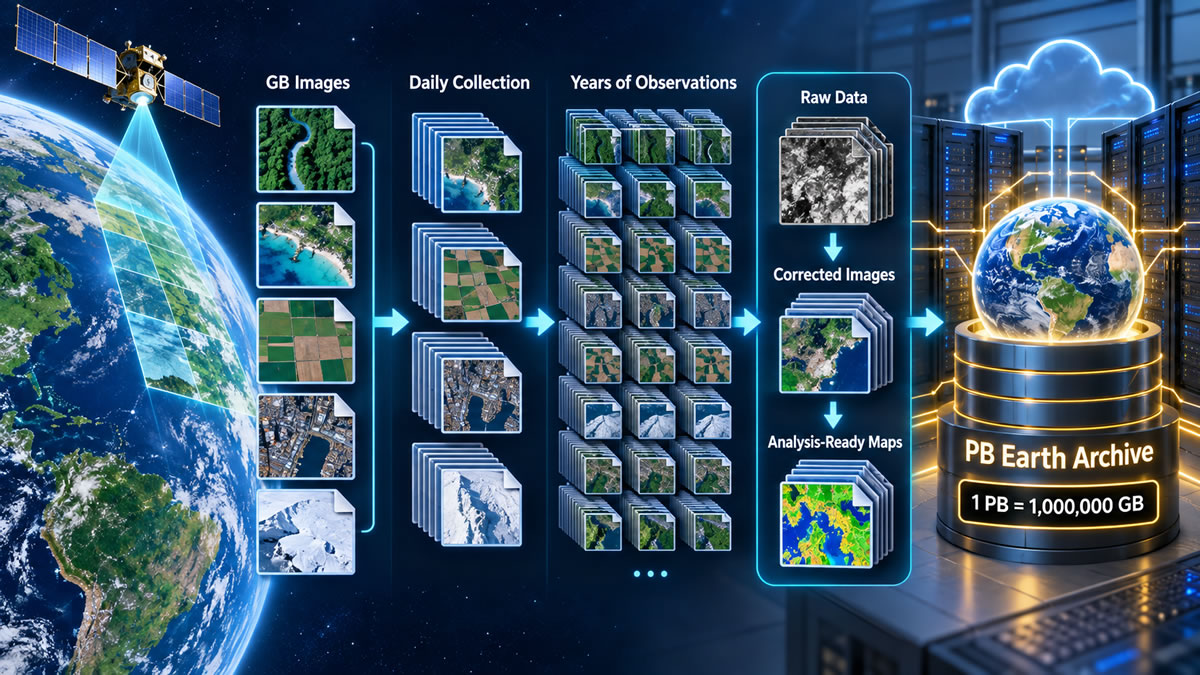
A single Earth-observation product may occupy several megabytes or gigabytes. A satellite programme, however, does not collect only one image. Its instruments repeatedly observe the planet, revisit the same regions and generate scientific products from the original measurements. Over months, years and decades, files measured individually in GB can accumulate into an archive measured in petabytes.
A GB to PB Converter helps express that growth in a consistent unit. It does not predict how much data a particular mission will collect, but it can convert a known archive size from gigabytes to petabytes.
Converting Gigabytes to Petabytes
Using decimal data units, one petabyte contains one million gigabytes:
1 PB = 1,000,000 GB
To Convert GB to PB, divide the number of gigabytes by 1,000,000:
Petabytes = gigabytes ÷ 1,000,000
For example, an archive containing 2,500,000 GB represents:
2,500,000 GB ÷ 1,000,000 = 2.5 PB
This conversion changes only the unit used to describe the data. It does not compress the files, create additional observations or alter the physical storage required.
A Satellite Product Contains More Than a Visible Picture
An ordinary digital photograph normally records visible light through red, green and blue channels. Earth-observation instruments may measure a broader range of wavelengths. Depending on the sensor, separate bands can record visible light, infrared energy, thermal radiation or other physical signals.
Researchers can use these measurements to investigate vegetation, surface temperature, water, snow, burned land and changes in land use. One observation may therefore contain several spectral bands rather than a single ready-to-view colour image.
A delivered product can also include quality masks, viewing angles, calibration information, geographic coordinates, acquisition details, metadata and preview images. The USGS guide to Landsat Collection 2 Level-1 data explains that Landsat products contain calibrated multispectral data and are processed according to their geometric and radiometric quality.
Product size varies with the area covered, spatial resolution, number of bands, bit depth, file format and compression method. There is no universal file size for every satellite observation.
Repeated Observations Build a Timeline
Earth-observation satellites regularly return to the same parts of the planet. One acquisition records conditions at a particular moment. A sequence of acquisitions allows researchers to compare seasons, years and longer periods — logging, wildfire damage and regrowth in a forest, or expanding cities, changing coastlines, flood extent and glacier retreat elsewhere.
Consider a simplified example in which a programme adds 2,000 GB of observations to its archive each day. After 500 days, it would contain:
2,000 GB × 500 = 1,000,000 GB
Using the GB-to-PB conversion:
1,000,000 GB ÷ 1,000,000 = 1 PB
This is an illustrative calculation rather than a measurement of a particular satellite programme. Actual data volumes depend on the instruments, observation schedule, processing methods and number of spacecraft involved.
One Acquisition Can Produce Several Products
Data transmitted by a spacecraft may require processing before it is suitable for mapping or scientific analysis. Ground systems can validate the files, apply calibration information, correct geometric effects and associate measurements with positions on Earth. Further processing may create surface-reflectance data, surface-temperature products, quality masks or specialised environmental datasets — each stored as its own product alongside the original.
The USGS overview of Landsat processing, archiving and distribution describes how mission data move through processing systems before being archived and made available to users. An archive may retain the original data, standard processed products and selected derived datasets — though storage policies vary, and not every programme permanently stores every possible version.
Finding One Observation Among Millions of Files
Once an archive contains millions of files, a folder structure alone is not enough. Each product needs searchable metadata identifying where and when it was collected, which instrument produced it, how it was processed and whether clouds or other quality conditions may affect its use.
Spatial catalogues let users search by location and time without opening every image. The USGS Landsat SpatioTemporal Asset Catalog provides structured information for discovering cloud-hosted Landsat assets.
Petabyte Archives Require Distributed Storage
A petabyte-scale collection cannot be managed like files on a personal computer. The data may be distributed across many drives, servers or cloud-storage systems, with storage software keeping track of each object so authorised applications can retrieve it when needed. Frequently requested files can remain on faster storage, while older material may move to a lower-cost archival tier.
Additional copies must not be confused with conversion. Expressing 1,000,000 GB as 1 PB describes the same amount of data. Creating a second copy genuinely increases the physical storage requirement.
Why Preserve Decades of Observations?
The scientific value of an observation can increase when it is compared with measurements collected years later. A single scene captures one moment; a sustained archive can reveal the direction and pace of change. Historical imagery also provides a reference after floods, wildfires, volcanic eruptions and severe storms, letting analysts compare conditions before and after an event.
The movement from GB to PB is therefore more than an increase in the displayed number. Individual observations become part of an organised, searchable scientific record.