Convert kilocalories to small calories. A kilocalorie contains 1,000 small calories, so the numerical value increases by a factor of 1,000.
1 kcal = 1,000 cal
How to Convert Kilocalories to Small Calories
To convert kilocalories to small calories, multiply the kilocalorie value by 1,000:
Small calories = kilocalories × 1,000
Example: Convert 250 Kilocalories to Small Calories
250 kcal × 1,000 = 250,000 cal
Therefore, 250 kilocalories equals 250,000 small calories.
This relationship assumes that the kilocalorie and calorie use the same underlying calorie definition. For example, one thermochemical kilocalorie contains exactly 1,000 thermochemical calories.
Is a Kilocalorie the Same as a Big Calorie?
Yes. In nutrition, one kilocalorie is commonly called one big Calorie or food Calorie. A capital C is sometimes used to distinguish the big Calorie from the much smaller lowercase calorie.
1 kcal = 1 Cal = 1,000 cal
- kcal means kilocalorie.
- Cal means big Calorie or food Calorie.
- cal means the small scientific calorie.
For example, a food label showing 250 Calories normally means 250 kcal. When expressed using small calories, the same energy equals 250,000 cal.
| Unit | Meaning | Equivalent Value |
|---|---|---|
| 1 kcal | One kilocalorie | 1,000 cal |
| 1 Cal | One big or food Calorie | 1 kcal or 1,000 cal |
| 1 cal | One small calorie | 0.001 kcal |
Capitalization is important because Cal and cal can represent units that differ by a factor of 1,000. However, everyday writing and food labels do not always follow this capitalization consistently. The abbreviation kcal is usually the clearest way to identify food energy.
Kilocalorie to Small Calorie Conversion Table
| Kilocalories (kcal) | Small Calories (cal) |
|---|---|
| 1 kcal | 1,000 cal |
| 5 kcal | 5,000 cal |
| 10 kcal | 10,000 cal |
| 50 kcal | 50,000 cal |
| 100 kcal | 100,000 cal |
| 250 kcal | 250,000 cal |
| 500 kcal | 500,000 cal |
| 1,000 kcal | 1,000,000 cal |
The Language Difference Between the Kitchen and the Laboratory
Imagine a meal whose nutrition label reports 500 kcal. Moving that meal from a kitchen counter to a laboratory does not alter its energy, but the quantity can be written in several equivalent ways:
- 500 kcal
- 500,000 cal
- 2,092 kJ
- 2,092,000 J
The numbers differ because each unit represents a different-sized portion of energy. This is similar to describing the same distance as one kilometre or 1,000 metres: the physical quantity remains unchanged while the numerical value changes with the unit.
The calorie relationship is:
1 kcal = 1,000 cal
When the thermochemical definition is used, one small calorie equals exactly 4.184 joules. Therefore:
1 kcal = 1,000 cal = 4,184 J = 4.184 kJ
What "Calorie" Usually Means Around Food
Nutrition uses the kilocalorie because the small calorie is inconveniently tiny for meals and packaged foods. A snack containing 150 kcal would require the much larger-looking value 150,000 cal if it were reported in small calories.
In everyday food language, the word calorie normally means a kilocalorie. A menu describing a meal as having 500 Calories is therefore communicating approximately the same energy as 500 kcal.
A capital C is sometimes used to distinguish the food Calorie from the small calorie:
1 Cal = 1 kcal = 1,000 cal
Capitalization is not completely consistent across packaging, publications and applications, however. The symbol kcal is clearer because it explicitly identifies the kilocalorie.
The UK Food Standards Agency explains that food labels commonly present energy in kilojoules and kilocalories and that the kcal figure is the value usually described as calories.
What the Units Mean in Scientific Work
A scientific calculation should never rely on the unqualified word "calorie." The symbol must indicate whether the value means cal or kcal, because the difference is a factor of 1,000.
For example:
- 500 cal = 0.5 kcal = 2,092 J
- 500 kcal = 500,000 cal = 2,092,000 J
Modern laboratory and engineering work generally favours the SI unit of energy, the joule, rather than the calorie. Calories and kilocalories may still appear in chemistry, nutrition, physiology and older reference material, making the complete unit symbol essential.
The NIST Guide to SI conversion factors lists calorie and kilocalorie relationships with the joule.
| Nutrition value | Small calories | Kilojoules |
|---|---|---|
| 50 kcal | 50,000 cal | 209.2 kJ |
| 100 kcal | 100,000 cal | 418.4 kJ |
| 150 kcal | 150,000 cal | 627.6 kJ |
| 500 kcal | 500,000 cal | 2,092 kJ |
| 1,000 kcal | 1,000,000 cal | 4,184 kJ |
A Calorimeter Measures Heat Released by a Sample
A bomb calorimeter can be used to study the energy released when a prepared sample burns. The sample is placed in a strong sealed vessel containing oxygen. That vessel is surrounded by a measured environment, and the resulting temperature change is used to calculate the heat released.
This measurement represents the sample's gross combustion energy. The human body does not necessarily obtain all of that energy because food is digested and metabolized rather than completely burned inside the body.
Food-label values are therefore not produced simply by placing every finished product into a bomb calorimeter. Manufacturers may determine energy using the measured or calculated amounts of protein, carbohydrate, fat, alcohol and other relevant components, applying accepted energy factors.
OpenStax's explanation of calorimetry distinguishes bomb-calorimeter measurement from the component-based methods used for modern food labels.
One Serving Is Not Necessarily the Whole Package
The number printed on a nutrition panel normally applies to the stated serving. If a package contains two servings and each serving provides 250 Calories, eating the entire package represents:
2 × 250 kcal = 500 kcal
Converted to small calories:
500 kcal × 1,000 = 500,000 cal
The unit conversion is exact, but the amount consumed depends on the serving quantity. The US Food and Drug Administration advises consumers to consider both the calorie value and the number of servings in the container.
The Nutrition Convention Also Appears in Fitness Technology
Treadmills, smartwatches and health applications generally use "Calories" in the nutritional sense. If a watch says that an activity used 400 Calories, it normally means an estimated 400 kcal:
400 kcal = 400,000 cal = 1,673.6 kJ
The conversion between units is fixed, but the fitness value itself is an estimate. Devices infer energy expenditure from information such as movement, exercise duration, body mass and heart rate, so different products may report different results.
The Same Energy Written in Different Languages
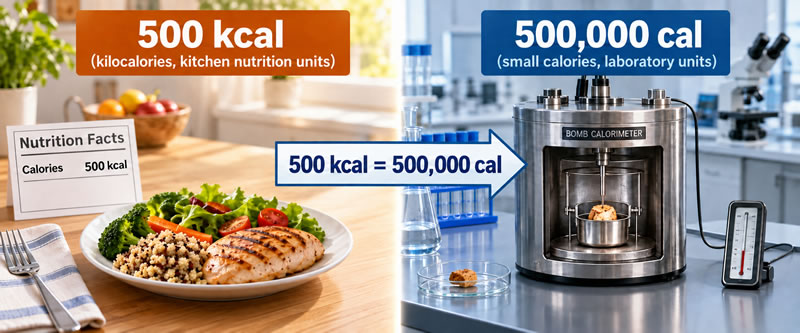
The kitchen and laboratory do not follow two incompatible energy systems. They simply favour different terminology and unit scales. Nutrition commonly uses kilocalories, while scientific work generally uses joules and may sometimes use small calories.
Reading the symbol prevents confusion:
- cal identifies a small calorie.
- kcal identifies 1,000 small calories.
- Calorie in food and exercise contexts normally means one kilocalorie.
- J or kJ identifies energy in SI-derived units.
Remembering that 1 kcal = 1,000 cal prevents the thousandfold error that can occur when a unit prefix or capital letter is overlooked.