Convert small calories (cal) to kilocalories (kcal). One small calorie is one-thousandth of a kilocalorie.
1 cal = 0.001 kcal
How to Convert Small Calories to Kilocalories
One kilocalorie contains 1,000 small calories. To convert small calories to kilocalories, divide the small-calorie value by 1,000:
Kilocalories = small calories ÷ 1,000
kcal = cal ÷ 1,000
You can also multiply the small-calorie value by 0.001:
kcal = cal × 0.001
Example: Convert 500 Small Calories to Kilocalories
500 cal ÷ 1,000 = 0.5 kcal
Therefore, 500 small calories equals 0.5 kilocalories.
Small Calorie to Kilocalorie Conversion Table
| Small Calories (cal) | Kilocalories (kcal) |
|---|---|
| 1 cal | 0.001 kcal |
| 2 cal | 0.002 kcal |
| 5 cal | 0.005 kcal |
| 10 cal | 0.01 kcal |
| 20 cal | 0.02 kcal |
| 50 cal | 0.05 kcal |
| 100 cal | 0.1 kcal |
| 200 cal | 0.2 kcal |
| 500 cal | 0.5 kcal |
| 1,000 cal | 1 kcal |
| 2,500 cal | 2.5 kcal |
| 5,000 cal | 5 kcal |
What Is a Small Calorie?
A small calorie is a unit of energy represented by the lowercase symbol cal. The thermochemical calorie is defined as exactly 4.184 joules.
Small calories are used mainly in scientific contexts such as chemistry, physics and calorimetry. Because the unit is small, scientific energy values may contain hundreds or thousands of calories.
What Is a Kilocalorie?
A kilocalorie is an energy unit equal to 1,000 small calories. Its symbol is kcal.
1 kcal = 1,000 cal
Kilocalories are commonly used to describe food energy and the energy used by the human body. On food labels, one kilocalorie is often called one uppercase Calorie (Cal).
Small Calories, Kilocalories and Food Calories
The word "calorie" can describe two differently sized units, so the symbol and capitalization are important:
- cal means one small calorie.
- kcal means one kilocalorie.
- Cal means one big or food Calorie.
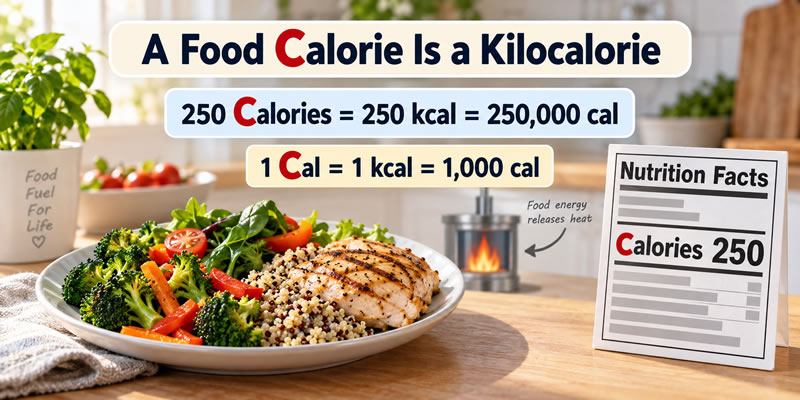
- 1 Cal = 1 kcal = 1,000 cal.
For example, 500 small calories equals 0.5 kcal. However, a food label showing 500 Calories normally means 500 kcal, which equals 500,000 small calories.
Why Is a Food Calorie Actually a Kilocalorie?
The calorie number on a food package is much larger than the scientific unit suggested by the everyday word. In nutrition, one Calorie normally represents one kilocalorie, not one small calorie.
This produces a thousand-to-one relationship:
1 food Calorie = 1 kcal = 1,000 cal
Using the thermochemical calorie, the same quantities can be expressed in joules:
- 1 cal = exactly 4.184 J
- 1 kcal = exactly 4,184 J
- 1 kcal = exactly 4.184 kJ
NIST identifies the calorie used in nutrition with the thermochemical kilocalorie in its federal unit-conversion guidance .
A Capital Letter Can Signal a Thousandfold Difference
Scientific and nutritional writing sometimes distinguishes the units by capitalization:
- calorie (cal) — the smaller unit of energy
- Calorie (Cal) — the food or large calorie, equivalent to one kilocalorie
- kilocalorie (kcal) — 1,000 small calories
Under this convention, changing cal to Cal changes the represented amount by a factor of 1,000. Capitalization is not applied consistently in ordinary conversation, websites or fitness applications, however. People commonly say "calories" when they mean kilocalories.
The symbol kcal is therefore the least ambiguous choice when the distinction matters. It states directly that the quantity is measured in kilocalories rather than relying on a capital letter.
Why Food Energy Uses the Larger Unit
A small calorie is inconvenient for describing an ordinary meal. A snack containing 200 kcal would have to be labelled as 200,000 small calories:
200 kcal × 1,000 = 200,000 cal
The larger unit keeps food-energy values compact enough to read and compare. A breakfast might contain 400 kcal and a meal 700 kcal instead of 400,000 cal and 700,000 cal.
The same 200 kcal snack can also be expressed as kilojoules:
200 kcal × 4.184 = 836.8 kJ
Changing the unit does not change the energy represented. It changes only the numerical scale used to report it.
Why Labels May Show Both kJ and kcal
The joule is the SI-derived unit of energy, so many countries require or prefer food energy to be declared in kilojoules. Kilocalories remain familiar to consumers and are therefore often displayed alongside kilojoules.
UK nutrition declarations for prepacked foods normally state energy in both kilojoules (kJ) and kilocalories (kcal). The UK government's nutrition legislation information explains the required presentation of energy and other nutrients.
In the United States, the Nutrition Facts panel uses the heading Calories. In that context, the value represents kilocalories even though the abbreviation "kcal" may not be printed beside the number.
What Does "200 Calories per Serving" Mean?
A label value must be read together with its serving size. Suppose a package contains two servings and lists 200 Calories for each serving:
2 servings × 200 kcal = 400 kcal
Eating the entire package would therefore represent 400 kcal, not 200 kcal. It would also equal:
400 kcal = 400,000 cal = 1,673.6 kJ
The US Food and Drug Administration's calorie-label guidance advises readers to compare the listed calories with the stated number of servings.
Food Energy Is Not Usually Measured by Burning Every Product
A bomb calorimeter can measure the heat released when a food sample is burned completely. That gross heat value is useful scientifically, but it is not automatically identical to the amount of energy the human body can obtain from the food.
Nutrition values are often calculated from the amounts of protein, carbohydrate, fat, alcohol and other relevant components using accepted energy factors. Digestion, absorption and metabolism affect how food energy is interpreted, so the label is not simply a report of one item being burned in a laboratory.
Label values can also be rounded under applicable regulations. Converting a printed value from kcal to kJ can be mathematically exact while the original label value remains rounded.
What Does a Fitness Watch Mean by Calories?
When a smartwatch or exercise machine reports that a workout used 300 Calories, it normally means approximately 300 kcal. It does not mean 300 small calories, which would equal only 0.3 kcal.
The displayed result is generally an estimate derived from information such as exercise type, movement, duration, body mass, age and heart rate. Different devices and algorithms can produce different results for the same activity.
A fitness estimate should therefore not be treated as an exact calorimeter measurement. The unit conversion may be exact, but the underlying estimate has uncertainty.
How to Read the Units Correctly
| Displayed quantity | Equivalent energy | Typical context |
|---|---|---|
| 1 cal | 4.184 J | Small thermochemical calorie |
| 1 kcal | 1,000 cal or 4.184 kJ | Nutrition and food energy |
| 1 Cal | 1 kcal | Capital-C food Calorie convention |
| 100 Calories | 100 kcal or 418.4 kJ | Food label or fitness application |
| 250 Calories | 250 kcal or 1,046 kJ | Meal, snack or drink |
Context is the safest guide. In chemistry or thermodynamics, cal may mean the small calorie. In food, diet and exercise discussions, the everyday word "calorie" normally means kcal. Confusing those meanings introduces a thousandfold error.