Convert electric current from amperes to milliamperes. Milliamperes provide a convenient way to express the smaller currents used by electronic components, sensors, portable devices, and test equipment.
Ampere to Milliampere Conversion Formula
One ampere contains exactly 1,000 milliamperes:
1 A = 1,000 mA
To convert amperes to milliamperes, multiply by 1,000:
mA = A × 1,000
For example:
0.25 A × 1,000 = 250 mA
The conversion factor is exact because the metric prefix milli- means one-thousandth.
Why Amperes Are Multiplied by 1,000
A milliampere is a smaller unit than an ampere. It takes 1,000 milliamperes to make one ampere, so the numerical value becomes larger when a current is changed from amperes to milliamperes.
0.001 A = 1 mA
0.01 A = 10 mA
0.1 A = 100 mA
The physical current does not change during conversion; only the unit and numerical representation change.
Ampere to Milliampere Conversion Table
| Amperes (A) | Milliamperes (mA) |
|---|---|
| 0.001 A | 1 mA |
| 0.002 A | 2 mA |
| 0.005 A | 5 mA |
| 0.01 A | 10 mA |
| 0.02 A | 20 mA |
| 0.05 A | 50 mA |
| 0.1 A | 100 mA |
| 0.25 A | 250 mA |
| 0.5 A | 500 mA |
| 0.75 A | 750 mA |
| 1 A | 1,000 mA |
| 1.5 A | 1,500 mA |
| 2 A | 2,000 mA |
| 2.4 A | 2,400 mA |
| 5 A | 5,000 mA |
| 10 A | 10,000 mA |
Why Charger Labels Use Amps While Small Circuits Use Milliamperes
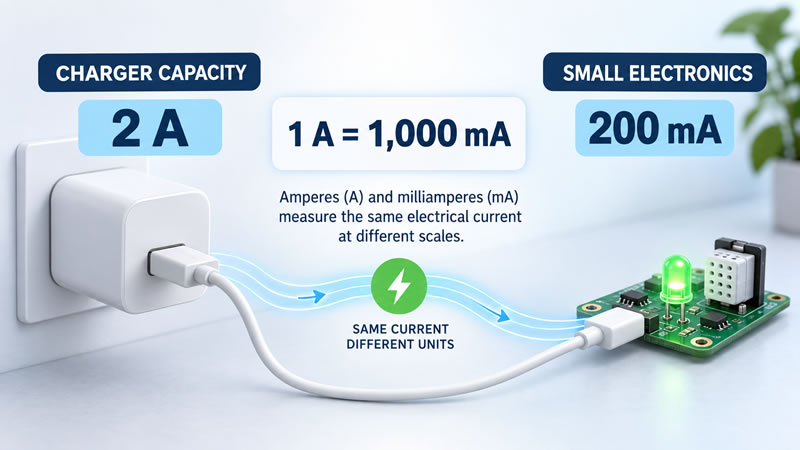
A phone charger and a sensor circuit can both be described by their electric current. The difference between amperes and milliamperes is not the kind of electricity being measured; it is simply the size of the unit selected to display the value conveniently.
The ampere, with the symbol A, is the SI base unit of electric current. The prefix milli represents one-thousandth, giving the exact relationship:
1 A = 1,000 mA
The relationship also works in reverse:
1 mA = 0.001 A
These prefix values follow the NIST definitions of SI prefixes . NIST also identifies the ampere as the SI base unit of electric current .
The Unit Is Chosen to Keep the Number Readable
Phone charging can involve currents of one or more amperes, so amperes normally produce the shorter label. A current of 2 A could also be written as 2,000 mA, but the ampere value is easier to scan on a compact power-adapter label.
Small circuits often operate at a lower scale. An indicator LED might use 10 or 20 mA, while a sensor or low-power microcontroller could use only a few milliamperes. Writing 20 mA is clearer than writing 0.020 A.
| Example | Amperes | Milliamperes |
|---|---|---|
| Low-current indicator LED | 0.01 A | 10 mA |
| Small electronic circuit | 0.2 A | 200 mA |
| USB-powered accessory | 0.5 A | 500 mA |
| Example phone-charger output | 2 A | 2,000 mA |
| Higher-current charging profile | 3 A | 3,000 mA |
What Does a 2 A Charger Rating Actually Mean?
A label such as 5 V ⎓ 2 A describes an output condition the adapter is designed to support. Under that profile, the adapter can supply up to 2 A while maintaining the stated output voltage within its specification.
The 2 A value does not mean that every connected product continuously receives 2 A. The connected load and its charging electronics determine the current that flows, subject to the limits communicated or permitted by the power source, cable and charging standard.
For example, an accessory drawing 200 mA from a compatible 5 V, 2 A supply is using:
200 mA = 0.2 A
The unused current capability is simply available headroom. It is not automatically pushed through the accessory.
Fast Charging May Change the Voltage as Well as the Current
Modern USB charging cannot always be explained by one current value. A charger may advertise several combinations of voltage and current, such as 5 V at 3 A or 9 V at 2 A. Each combination represents a different power profile.
Electrical power is calculated as:
Power = voltage × current
For example:
- 5 V × 2 A = 10 W
- 9 V × 2 A = 18 W
Although both examples use 2 A, the second profile transfers more electrical power because its voltage is higher.
With USB Power Delivery, the source announces supported capabilities and the receiving device requests a suitable operating profile. The official USB Implementers Forum explanation of USB Power Delivery describes flexible power delivery and devices obtaining only the power required for a particular application.
The Cable Is Part of the Charging System
A charger and phone may both support a higher charging rate, yet an unsuitable or damaged cable can restrict the available power. Cable resistance causes voltage loss and heating, while USB-C systems may use electronically marked cables when particular current or power levels are required.
The output actually available can therefore depend on all of the following:
- The voltage and current profiles supported by the charger
- The profiles accepted by the connected device
- The cable's current and power rating
- The charging protocol shared by both products
- Battery temperature, charge level and device activity
- Power sharing when one adapter supplies several ports
Charger Current Is Not the Same as Battery Capacity
The symbol mA describes current at a particular moment. A battery capacity written in mAh describes electric charge accumulated over time. The two quantities are related, but they are not interchangeable.
For example, a battery marked 5,000 mAh is not continuously supplying 5,000 mA. Its actual current changes with the workload, charging state, power-management system and operating conditions.
Why Both Units Remain Useful
Using amperes for chargers and milliamperes for small circuits is similar to using kilometres for a journey and millimetres for a small component. The underlying quantity remains the same, but an appropriately sized unit avoids unnecessary zeros and decimal places.
Amperes usually make charger and power-supply ratings easier to read, while milliamperes make lower electronic currents easier to compare. Converting between them changes only the numerical representation:
2 A and 2,000 mA describe the same current.
Ampere and Milliampere Questions and Answers
These practical questions show how ampere-to-milliampere conversions are used in electronics, power supplies, measurements, and circuit calculations.